What should you look for when choosing?
Start with your main priority: do you want to serve traditional aniseed sprinkles in a smaller portion, or does the topping itself need to contain demonstrably less sugar?
Traditional sprinkles, in a smaller portion
A good fit if: the aniseed flavour and familiar appearance matter, and you want to measure the amount used on each rusk.
The trade-off: you use fewer sprinkles, but you’re not buying a product with less sugar. A thinner layer will also change how it looks.
A different topping
A good fit if: a verifiable product with less sugar matters more than using traditional aniseed sprinkles.
The trade-off: lower-sugar chocolate vermicelli, such as the option shown by Albert Heijn, isn’t sugared aniseed and won’t have the same flavour or texture.
| What to consider |
What to check when buying |
Who is this important to? |
| Sugar per rusk |
Compare the sugar per 100 g and measure how much you use on each rusk. |
I want to keep the tradition, but serve less sugar from the sprinkles on each rusk. Around 39% of consumers put portion control first. |
| Aniseed flavour and appearance |
Check that the topping is actually aniseed sprinkles; sweets with the same name aren’t necessarily a topping for rusks. |
I want to keep the aniseed flavour and familiar layer of sprinkles for visitors celebrating a new arrival. For around 23% of consumers, tradition is the main consideration. |
| Suitable for guests |
Read the ingredients and allergen information on the chosen packaging. If you’re catering for a group, ask about dietary requirements and check school rules if necessary. |
If I’m handing out rusks, I want to know in advance what my guests can eat. Around 23% of consumers give suitability the highest priority. |
| The right product category |
If you’re choosing an alternative, check both the nutritional information and whether it’s intended to be used on rusks. |
I’ll only switch if the alternative suits my sugar requirements and works as a topping. This is the first thing around 15% of consumers look for. |
Aniseed sprinkles for the traditional portion approach
These sprinkles are suitable if you want to keep the traditional topping and measure out a smaller amount for each rusk. They aren’t a choice for a product with demonstrably less sugar.
 No image available
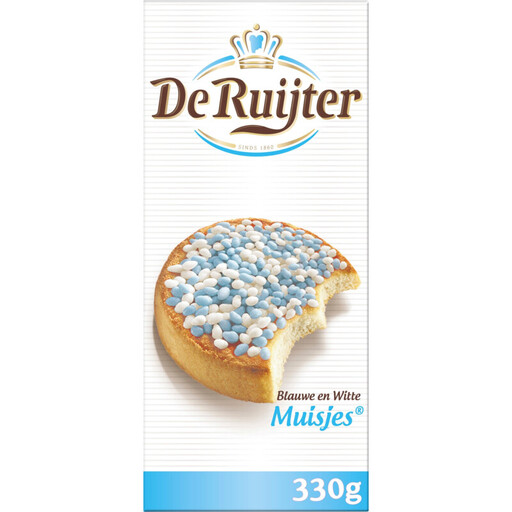
De Ruijter blue and white aniseed sprinkles, 330 g
For rusks with traditional aniseed sprinkles, with the amount measured to suit you.
PLUS lists 79 g of sugars per 100 g for this blue and white variety. The variety reviewed contains wheat and gluten. Check the packaging label if you’re serving guests.
View at Joybuy
Frequently asked questions
Do regular aniseed sprinkles contain less sugar if I use fewer of them?
No. Using fewer sprinkles only changes how many go on the rusk. Albert Heijn lists 79 g of sugars per 100 g for De Ruijter pink and white sprinkles. For another product, check its own packaging.
How can I cut down on sugar from aniseed sprinkles without giving up the tradition?
Measure out a smaller portion rather than sprinkling freely. The Netherlands Nutrition Centre gives an average of 11.9 g of sugar per 15 g of sprinkles. At the same average nutritional value, 7.5 g works out mathematically at around 5.95 g of sugar. The value may differ for the variety you choose.
What should I consider when handing out rusks with aniseed sprinkles to a group?
Check the allergens on the exact packaging and ask about dietary requirements in advance. The De Ruijter sprinkles reviewed contain wheat and gluten. If you’re taking them to a school or after-school club, the local policy on treats is also relevant.
Can lower-sugar chocolate vermicelli replace aniseed sprinkles?
Yes, if you’re happy to use a different topping on your rusks, but chocolate vermicelli isn’t aniseed sprinkles. Albert Heijn lists lower-sugar chocolate vermicelli in its range of sugar-conscious toppings. Check the packaging for the variety you choose, and don’t expect the traditional aniseed flavour and texture of the sprinkles.


