
Brunch host comparing sugar content
You choose based on the listed sugars per 100 g. With biscuits containing sweeteners, you also check the ingredients, polyols and serving size.


For your Easter brunch, first decide whether you want the lowest possible listed sugar content per 100 g or would rather choose a familiar biscuit with a relative reduction in sugar. Then compare similar biscuits by their nutritional values and check the ingredients, sweeteners and allergens. A ‘less sugar’ claim alone doesn’t tell you how much sugar the biscuit contains.
You choose based on the listed sugars per 100 g. With biscuits containing sweeteners, you also check the ingredients, polyols and serving size.
You want a biscuit to share and are happy with a relative reduction in sugar. In that case, the actual sugar content and other nutritional values per 100 g matter just as much as the claim on the front of the pack.
If guests need to avoid certain ingredients, check the current packaging for allergens and sweeteners before serving the biscuits.
Decide which criterion matters most for your brunch. Then compare similar biscuits per 100 g, as recommended by the Netherlands Nutrition Centre, and read the ingredients list too.
| What to look for | What to check when buying | Who is this important to? |
|---|---|---|
| Listed sugars | For similar biscuits, compare the ‘of which sugars’ line per 100 g; don’t confuse total sugars with added sugars. | If I mainly want a low listed sugar content, I look beyond the product name. For around 33% of consumers, this is the main priority. |
| Relative reduction in sugar | Check what the biscuit is being compared with, and also look at the sugars and energy per 100 g. | For a celebratory treat, I value a familiar biscuit more than the lowest possible sugar figure. Around 27% of consumers prioritise this trade-off. |
| Allergens and ingredients | Check the current packaging for ingredients, allergens and any ‘may contain’ statement. | If guests need to avoid certain ingredients, I want to know what I’m serving them. This is the main concern for around 20% of consumers. |
| Sweeteners and polyols | Check which sweeteners have been used, and look out for the warning on the label if the product contains polyols. | If a guest would rather avoid polyols, I don’t choose based on the sugar figure alone. This matters most to around 20% of consumers. |
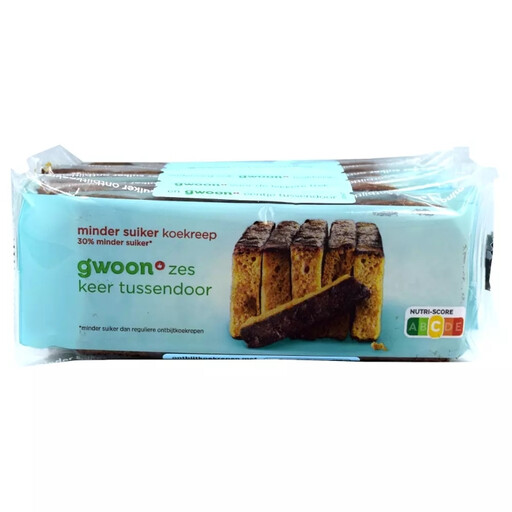
A relative reduction tells you something different from the amount of sugar in the biscuit. Albert Heijn states that AH Roomboter minder suiker stroopwafels contain 32% less sugar than its regular butter stroopwafels, but also lists 23 g of sugars per 100 g.
Read what the claim is based on, then check the ‘of which sugars’ figure per 100 g.
A low listed sugar content doesn’t automatically mean low energy or fat. Albert Heijn lists 0.3 g of sugars, 465 kcal and 20 g of fat per 100 g for AH Digestive 0% suiker.
For similar biscuits, compare energy, saturated fat, fibre and salt too.
Some biscuits containing sweeteners also contain polyols. Product pages for AH Digestive 0% suiker and Céréal Speculoos, among others, include a warning about a possible laxative effect if consumed in excess.
Read the ingredients and warning on the packaging, and consider guests who want to avoid polyols.
Ingredients vary from one biscuit to another. The product information for Céréal Speculoos met amandel and Verkade San Francisco zero lists different allergens, including ingredients from cereals, milk and soya.
Check the current packaging for each product and keep it available for guests when serving.
Within the AH range, Digestive 0% suiker and Roomboter minder suiker stroopwafels offer two different options: a low listed sugar content or a relative reduction in sugar in a stroopwafel.
Céréal offers biscuits in a range of flavours with low listed sugar values, including speculoos with almond pieces and Choco Delight Puur.
San Francisco zero is a biscuit option for anyone looking for something to enjoy with a coffee or tea and wanting to compare its nutritional information with other biscuits.
These two products are biscuits and biscuit bars to consider for an Easter brunch. Compare their listed sugars per 100 g, and don’t assess claims on the packaging separately from the nutritional information.
 No image available
A biscuit for anyone who wants to take the listed sugars and sweetener into account when planning their brunch.
The product information lists 11.7 g of sugars and 470 kcal per 100 g, despite ‘Sugar-Free’ in the original product name. It lists maltitol and the ingredients wheat, soya, oats and egg. Check the current packaging before serving the biscuit to guests.
 No image available
Biscuit bars for anyone looking for individually portioned treats and wanting to compare the nutritional values before buying.
The product information lists 22.8 g of sugars and 9 g of fibre per 100 g. If the packaging says ‘Less Sugar’, check what the product is being compared with; the claim alone doesn’t tell you how much sugar the biscuit bars contain. The allergen information notes that the product may contain wheat, barley, oats, milk, almonds and hazelnuts.
No. The claim describes a comparison; on its own, it doesn’t tell you how much sugar the product contains. Albert Heijn states that its Roomboter minder suiker stroopwafels contain 32% less sugar than the regular AH variant, while also listing 23 g of sugars per 100 g.
Compare similar biscuits per 100 g and check sugars, energy, saturated fat, fibre and salt. The Netherlands Nutrition Centre recommends comparing products per 100 g; also check the ingredients and allergens if they matter to your guests.
Not necessarily: the sugar figure doesn’t tell you how much energy or fat a biscuit contains. For AH Digestive 0% suiker, Albert Heijn lists 0.3 g of sugars, 465 kcal and 20 g of fat per 100 g.
Polyols can have a laxative effect if consumed in excess. This warning appears in the product information for AH Digestive 0% suiker and Céréal Speculoos, among others. So check the ingredients and current packaging before serving the biscuits.
For each biscuit, check the ingredients, highlighted allergens and any ‘may contain’ statement on the current packaging. Don’t rely on a sugar claim alone: it says nothing about whether the product is suitable for a guest with an allergy.