If you want paprika crisps with less fat, start by comparing the nutritional information per 100 g for products in the same category. Albert Heijn lists 13 g of fat per 100 g for Lay's Oven Baked Roasted Paprika and 29 g for regular Lay's Paprika. The oven-baked version also contains milk and, according to its product page, 0.82 g of salt per 100 g. So check the salt, energy, portion size and ingredients as well as the fat.
Who is this comparison for?
If you’re looking for paprika crisps with less fat
You want to keep eating paprika crisps, so you’re comparing their fat content per 100 g with that of regular potato crisps. The nutrition table gives you a clearer picture than a claim on the front of the pack.
If you want to assess your whole snack portion
As well as fat, you check how much you eat, the energy, salt and ingredients. This helps you assess a product on more than just one nutritional value.
If you need to check ingredients or allergens
You check the exact product before buying. The products discussed differ in whether they list milk, soya and the possible presence of gluten.
What should you look for when choosing?
If your aim is to eat less fat, start by comparing the fat per 100 g. Then consider the portion you plan to eat and check the salt and ingredients on the pack of the product you want to buy.
| What to check | What to look for when buying | Who it matters to |
|---|
| Fat content |
Compare the fat per 100 g of products in the same category and check what a ‘less fat’ claim is based on. |
If you want to keep eating paprika crisps but are mainly looking for less fat, make fat content your priority; this is the main purchasing concern for around 36% of consumers. |
| Portion size and energy |
Check the energy per 100 g and the portion size, then decide how much you want to eat. |
I want to know how much energy is in the portion I plan to eat, even if a product has less fat. Around 29% of consumers give this question top priority. |
| Salt |
Compare the salt per 100 g and consider how much you plan to eat. |
If I’m watching my salt intake as well as fat, I want to assess both values separately. For around 21% of consumers, salt is the main consideration when making this choice. |
| Ingredients and allergens |
Read the ingredients list and allergen information on the pack of the exact product. |
If you need to avoid certain ingredients, a lower fat value is no use if the ingredients don’t suit you; this is the most important factor for around 14% of consumers. |
Common mistakes
-
Focusing only on ‘less fat’
A lower fat content doesn’t tell you how much salt a product contains. For example, Jumbo lists 7.2 g of fat and 2.5 g of salt per 100 g for We Care Paprika Flavour Chips.
Compare the fat, salt and energy in the nutrition table, then think about the portion you plan to eat.
-
Assuming oven-baked means you can snack without limits
Albert Heijn lists 427 kcal per 100 g for Lay's Oven Baked Roasted Paprika. Less fat doesn’t change how much you end up eating.
Decide on your portion in advance and check the nutritional information for that amount.
-
Skipping the allergen information on a familiar product
The Lay's Oven Baked Roasted Paprika discussed here contains milk; Jumbo lists soya and the possible presence of gluten for We Care Paprika Flavour Chips. You can’t tell this just from the flavour name.
When buying, check the ingredients and allergen information on the current pack of the exact product.
Relevant brands and retailers
Lay's
Regular Paprika and oven-baked Roasted Paprika offer a direct comparison between paprika-flavoured potato crisps.
- Albert Heijn lists 29 g and 13 g of fat per 100 g respectively. According to Lay's, the oven-baked version has 50% less fat than regular potato crisps.
- Albert Heijn’s product information also lists milk and 0.82 g of salt per 100 g for Oven Baked Roasted Paprika.
We Care
A paprika-flavoured snack to assess separately from classic paprika-flavoured potato crisps.
- Jumbo lists 7.2 g of fat per 100 g for We Care Paprika Flavour Chips.
- The same product information lists 2.5 g of salt per 100 g, soya and the possible presence of gluten. Jumbo also said the product was no longer in its online range, so check current availability.
Albert Heijn
The own-brand AH Ribbelchips Paprika is an example of regular ridged paprika crisps, not a reduced-fat option.
- The product information gives you a specific value to compare: 30 g of fat per 100 g.
- Don’t compare these regular ridged crisps with a product claiming to have less fat based on the own-brand name alone; check the nutrition tables.
Jumbo
Jumbo’s reduced-fat crisps category includes Lay's Oven Baked Paprika and Chio Oven Chips Paprika Flavour.
- The category lets you browse several paprika varieties.
- To compare fat, salt and allergens, check the information for each product and the current packaging.
Paprika crisps at Joybuy
This Joybuy selection features an oven-baked paprika variety. Check the nutritional information on the pack before comparing it with regular paprika crisps.
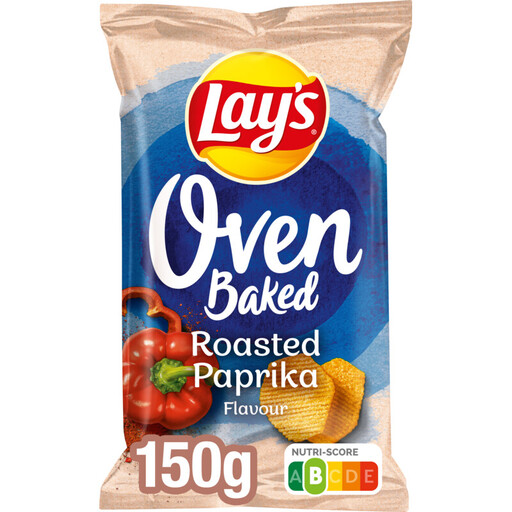 Image unavailable
Lay's Oven Baked Paprika 150 g
For anyone looking to compare an oven-baked paprika variety with regular crisps. The bag contains 150 g; check the current pack for fat, salt, energy and allergens.
View at Joybuy
Frequently asked questions
Are oven-baked paprika crisps automatically a good choice if I want to eat less fat?
No. ‘Oven-baked’ alone doesn’t tell you how much fat the exact product contains. Compare the fat per 100 g: Albert Heijn lists 13 g of fat per 100 g for Lay's Oven Baked Roasted Paprika, as well as 0.82 g of salt per 100 g and milk.
Should I compare fat per portion or per 100 g?
Use the per 100 g value to compare products, then consider how much you want to eat. The stated portion size may not match your own.
Does a paprika snack with less fat also contain less salt?
Not necessarily. Jumbo lists 7.2 g of fat and 2.5 g of salt per 100 g for We Care Paprika Flavour Chips, so compare the salt value separately from the fat content.
Where can I check allergens in paprika crisps?
Read the allergen information and ingredients on the current pack of the exact product. According to the Netherlands Food and Consumer Product Safety Authority, allergens must be listed on the label of prepacked foods. The products discussed differ in their ingredients and allergen information.


