First, check that the lens mount and sensor format are compatible with your camera; the Consumers’ Association stresses that the mount must match. A fast prime is a good fit for a predictable shooting position and low light, while a zoom gives you more freedom to change your framing from one spot. For sharp shots of dancers in motion, shutter speed and autofocus matter too: lens stabilisation alone won’t freeze a dancer.
Who is this relevant to?
Photographers working in low stage light
Want to capture dancers in motion sharply and are weighing up a fast lens against the freedom to frame your shots with a zoom. Canon Europe highlights the importance of a fast shutter speed for action photography.
Photographers with a fixed shooting position
Can’t move around much during the performance and want to switch between a portrait and a full-body dance shot. A zoom lets you adjust the framing from the same spot.
Students with limited space to shoot
Want to fit a dancer fully into the frame and bear in mind that a long portrait focal length may be too tight in a small space.
What should you consider when choosing?
For dance photos taken as part of a school project, the light, your distance from the dancer and the space available are the main factors to consider.
Prime lens
Choose this when: you’re shooting from a predictable position and mostly using one framing, for example in low light.
Bear in mind: you can’t zoom in or out if the dancer or your preferred framing changes.
Zoom lens
Choose this when: you want to switch between a portrait, a pair of dancers and a wider shot from the same spot.
Bear in mind: at the same settings, a zoom with a maximum aperture of f/2.8 lets in less light than an f/1.8 prime.
| What to consider |
What to look for |
Who is it most relevant to? |
| Movement in low light |
Check the maximum aperture and autofocus capabilities of the camera and lens combination. Also consider whether the available light allows for a shutter speed that’s fast enough. |
When I photograph dancers in low light, I want enough light and a shutter speed that can freeze movement. Around 42% of consumers put sharpness in low light first. |
| Changing your framing |
Compare the zoom range and maximum aperture with the distance you’re allowed to shoot from. |
From a fixed position, I want to switch between a portrait and a full-body shot. Around 33% of consumers prioritise this freedom to frame their shots. |
| Limited space |
Work out your shooting distance and preferred framing, and take your camera’s sensor format into account. |
If I can’t move further back, I still want to fit the dancer fully into the frame. Around 25% of consumers put this space limitation first. |
Common mistakes when choosing
-
Focusing only on the brand name or focal length
Lenses in the same product family may be available with different mounts, and a lens also needs to be compatible with your camera’s sensor format.
Make a note of your exact camera model and check the full lens specification before ordering.
-
Choosing an 85mm portrait lens without checking your shooting distance
A portrait may fit the frame nicely, but from the same position you might not have enough room to fit a full-body dancer into the shot.
Check your intended shooting position and framing in advance. A wider angle of view may be more suitable when space is limited.
-
Confusing stabilisation with freezing movement
Stabilisation helps reduce camera shake, but it won’t automatically prevent motion blur when photographing someone dancing.
As well as any lens stabilisation, consider shutter speed, light and the autofocus capabilities of your camera and lens.
Lens brands to consider
Canon
For compatible EOS R cameras, options for different shooting distances include a 50mm prime and an 85mm lens.
- Canon specifies an aperture of f/1.8 and a weight of 160 g for the RF 50mm F1.8 STM.
- The fixed focal length limits your ability to change the framing. Canon says the RF 85mm F2 MACRO IS STM has image stabilisation, but this doesn’t replace a shutter speed fast enough to freeze movement.
Sigma
The 56mm F1.4 DC DN Contemporary is designed for APS-C mirrorless cameras and is available with different mounts.
- Sigma specifies a maximum aperture of f/1.4.
- Choose the version with the right mount. Its fixed focal length makes it less flexible for unexpected group shots.
Sony
The FE 85mm F1.8 is an E-mount portrait lens for anyone with enough distance from the dancer.
- Sony lists it as compatible with full-frame and APS-C cameras.
- In a small space, its angle of view may be too narrow to capture a full-body dance movement.
Nikon
The NIKKOR Z 85mm f/1.8 S is a portrait lens for compatible Nikon Z cameras.
- Nikon specifies a full-frame 85 mm lens with an aperture of f/1.8.
- Its fixed, longer focal length requires enough distance to fit a full-body dance movement into the frame.
Tamron
The 28-75mm F/2.8 Di III VXD G2 and 70-180mm F/2.8 Di III VC VXD G2 offer different zoom ranges for different shooting distances.
- Tamron specifies an f/2.8 aperture throughout the zoom range for both models, and lists versions with Sony E and Nikon Z mounts.
- The 70-180mm may not be wide enough at its shortest focal length for close-up shots. Check the mount of the version you choose for each model.
Joybuy lens
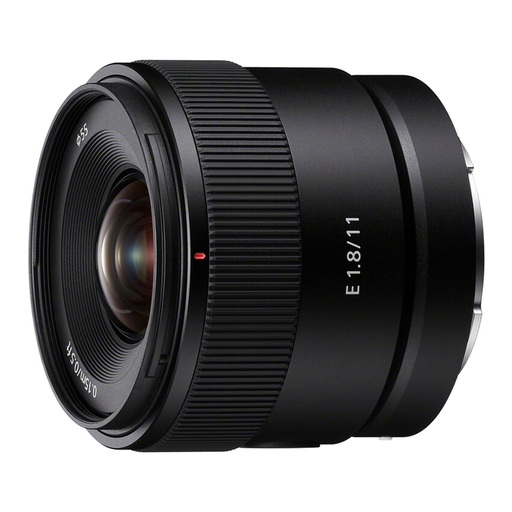
The Joybuy lens below is a fixed ultra-wide-angle lens for anyone who deliberately wants to include a lot of the surroundings. It isn’t a straightforward choice for conventional portrait framing.
 No image available
Sony E 11mm F1.8 APS-C ultra-wide-angle lens SEL11F18
This lens is worth considering if you deliberately want to capture a large part of the scene. For portraits or close-up shots of a dancer, a fixed ultra-wide-angle lens isn’t an obvious choice.
11 mm, f/1.8, APS-C and a fixed focal length.
Joybuy
Frequently asked questions
Is image stabilisation enough to take sharp photos of a dancer in motion?
No. Image stabilisation helps reduce camera shake, but you also need a suitable shutter speed to freeze movement and must be able to focus on the dancer with autofocus. The right settings depend on the movement and the light.
How can I avoid ordering a lens with the wrong mount?
Check your exact camera model, the mount and the sensor coverage of the specific lens version. The same lens family may be sold with different mounts; the fact that the brand name matches doesn’t prove compatibility.
What should I check when my order arrives, and what are my rights when buying online?
Check that the model and mount match your order and make sure all the listed items have been delivered. According to the Dutch Government, online purchases from a business usually come with a 14-day cooling-off period; buying from a private seller is different. If a product is faulty, contact the seller about your statutory warranty.
Can the school publish recognisable photos of pupils?
According to the Dutch Data Protection Authority, pupils aged 16 and over must give their own consent to publication by the school; for younger pupils, parental consent is required. The school must also keep the images secure. This guidance concerns publication by the school and doesn’t automatically determine every instance of private use by a pupil.


