
Vandaag of morgen in huis

Kwaliteit gegarandeerd

Welkomstaanbiedingen ontgrendelen: GRATIS bezorging | Tot 80% korting | Gratis 30 dagen JoyPlus-proefperiode
Download de app
An LED sensor light switches on automatically as soon as movement is detected. That is useful in a dark hallway, inside a kitchen cupboard, on a balcony or beside your front door. However, not every light is suitable for every situation. A small night light is no substitute for a powerful outdoor light, and a solar outdoor light with a motion sensor is less predictable in a shady location.
As a Joybuy Product Recommendation Officer, I filter product information according to practical, verifiable criteria. This helps you avoid paying mainly for marketing claims and choose a light that suits the space, installation location and desired brightness.
The lumen count indicates how much light a lamp produces according to its product specification. For a sensor night light, 30 to 40 lumens may be enough. For a driveway or façade, you may need several hundred or even several thousand lumens.
Also consider the light colour. Warm white around 2700–3200K is usually suitable for a bedroom, entrance or patio. Cool white around 5000–7000K is more focused on visibility in cupboards, work areas and outdoor lighting.
A wireless sensor light usually runs on batteries, solar power or a built-in rechargeable battery. With a rechargeable LED light, you therefore need to consider charging time and battery life. A product with a small battery may be practical for short periods, but less suitable if the light is activated frequently every day.
For solar outdoor lighting, positioning is more important than many adverts suggest. The solar panel needs enough direct daylight. In winter, or on a north-facing, shaded façade, the operating time may be reduced.
An IP44 water-resistant light is protected against splashing water and solid objects of a certain size. This does not mean that the light can be exposed to a powerful jet of water or submerged. IP44 may be suitable for a covered balcony or sheltered entrance. For an exposed façade, a higher level of protection, such as IP65, is worth considering.
Also check whether the light needs to be mounted on a fixed wall or whether it can be positioned using a magnet, tape or a freestanding base.
An LED light with a motion sensor usually uses a PIR sensor, which detects changes in infrared radiation. Look at:
A range of 3–5 metres is often practical for a hallway or bedroom. A longer range may be more useful for a driveway or garden. The stated distance depends on the mounting height, direction of movement and any obstacles.
Compare lumens rather than simply looking at the number of LEDs. Cupboard lighting with a motion sensor does not need to produce as much light as an outdoor wall light with a sensor.
A light with multiple colour temperatures offers extra flexibility. Warm light creates a calmer atmosphere in a bedroom, while neutral or cool light may be more convenient when searching in a cupboard. Some models also allow you to adjust the brightness. This is useful for a sensor night light, so that it is not unnecessarily bright.
A USB-rechargeable light can be charged using a suitable 5V USB adapter, laptop or power bank. Always check the specified charging voltage and use a compatible charger. For a built-in lithium battery, pay attention to the capacity in mAh, but compare this with the operating mode: sensor mode, continuous lighting and brightness level all affect battery life.
Magnetic fittings or removable tape are appealing in rented homes because drilling is not always desirable. Do check the surface and the weight, though. A magnetic light must be securely attached to prevent it from falling.

Why it suits this profile: This compact wireless sensor light is designed for bedrooms, nurseries, hallways and bedside tables. The built-in battery can be charged via USB, and the set contains two lights.
The specifications state 30 lumens, a detection range of 3–5 metres and up to 10 hours of use in sensor mode. This makes it clear that the model is intended mainly for accent and orientation lighting, not for illuminating a large driveway.
Three colour temperatures, five brightness levels, USB charging and a standard mode for continuous light.

Why it suits this profile: This solar outdoor light with a motion sensor is suitable for a façade, entrance, patio or garden where no power cable is available and where the solar panel can receive direct daylight.
The IP44 rating is not presented as waterproof: the light is designed for splashing water and must not be submerged. Positioning in direct sunlight remains essential.
According to the product specification: 1000 lumens, warm white light at 3000K, two lighting modes and an integrated motion sensor.
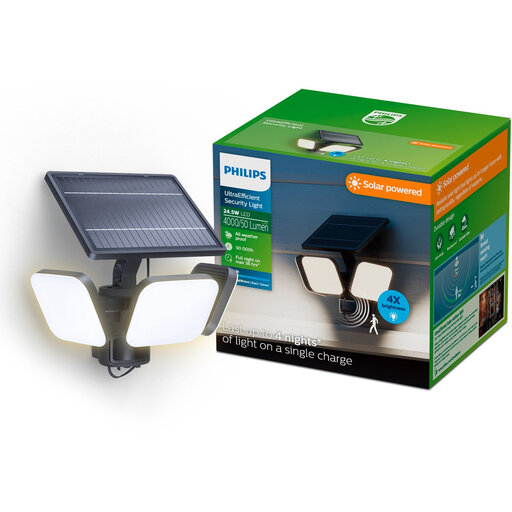
Why it suits this profile: This solar wall light is designed for larger outdoor areas, such as a driveway, garden or side façade. The adjustable lamp head helps direct the light where you need it.
The stated IP65 rating provides a higher level of protection against dust and water than IP44. The specified detection range is also clearly defined: up to 8 metres directly in front of the sensor and up to 16 metres from the side.
According to the product specification: 4000 lumens, 5000K light, two lighting modes and up to four nights of illumination on a fully charged battery.
We have compiled a complete, up-to-date list of products that fully meet these strict selection criteria and the applicable European safety regulations.
Position the light so that the sensor can clearly detect the route people take and is not blocked by a cupboard door, curtain or large planter. With a solar light, the panel must receive direct light during the day. After installation, test whether the light only switches on when it is dark enough and whether the range suits the intended direction of movement.
Operating time depends on battery capacity, brightness, colour setting and the number of activations. A product may, for example, state up to 10 hours in sensor mode, but this is not a universal operating time for every situation. Therefore, check the product specifications and recharge the light before the battery is completely empty.
A sensor light only uses electricity while the LED is on. With a USB-rechargeable light, you pay indirectly for charging the battery; with a solar outdoor light with a motion sensor, the energy comes from the solar panel. Actual consumption depends on the wattage, operating time and how often the sensor is activated.
