
Embroiderers filming their stitches
You film close up as your hands move over your work. You want to adjust the light without having to reposition your camera setup each time.


Choose a panel that can sit securely at an angle above or beside your embroidery, then make a test recording while your hands are moving. A compact, passively cooled model may suit a small space or a quiet room better; if you want more control over the light or how it operates, weigh these benefits against the size and cooling method. Only compare lux figures taken at the same distance, and check exactly what’s included in the kit.
You film close up as your hands move over your work. You want to adjust the light without having to reposition your camera setup each time.
You want different thread colours to look consistent in successive recordings. Compare adjustable white light using test footage and a fixed white balance.
You need to fit the light, mount and cables into a small workspace. If you’re recording with ambient sound, you’ll also want to consider the cooling method.
Start by considering where to position the light and how it will fall across your embroidery hoop. Then check colour rendering, cooling and exactly what’s included with the light.
| What to consider | What should you check? | Who should consider this most? |
|---|---|---|
| Visible stitches without hand shadows | Check that the panel, diffuser and mount will fit at an angle beside or above your embroidery hoop. Film while moving your hands, too. | If you film close-ups while stitching, you’ll want to make sure your hands don’t obscure your work; around 28% of consumers give avoiding hand shadows top priority. |
| Thread colours that look true to life | Compare the adjustment range of the exact model and film your own threads with a fixed camera white balance. | If you want to compare colours between recordings, you’ll want to see how your threads look under your chosen light; around 22% of consumers prioritise true-to-life thread colours. |
| Space and noise | Measure the available space, including the mount and cables. Check the cooling method and listen to the complete setup during a test recording. | If your workspace is also a shared bedroom, you’ll want to be able to set up and put away the light without cluttering the room; around 22% of consumers prioritise space-saving design and quiet operation. |
| Footage without visible bands | Test the light with the camera, frame rate, shutter speed, room lighting and dimming level you actually plan to use. | If you’re filming and want to avoid distracting bands in your footage, try out the light with your camera settings; around 17% of consumers say banding in footage is their main concern. |
| A complete, usable setup | Check whether a mount or stand, diffuser, mains adapter and any battery are included with the specific version. | If you want to know in advance which parts you’ll need, compare the full kit contents with your setup; around 11% of consumers prioritise a complete kit. |
Lux figures measured at different distances aren’t directly comparable, and don’t necessarily tell you how well the light will illuminate your embroidery at your working distance.
Compare the measurement distance and light setting, then assess the light on your work with a test recording from your filming position.
The NEEWER NL660 is available with or without a stand, and the manufacturer says NP-F batteries aren’t included. For the SmallRig P200, the manufacturer lists a USB-C cable but no stand or mains adapter.
Before buying, make a list of the parts your setup needs and check the contents of the version you’ve chosen.
These models have separate specifications. The Godox LEDP260C manual gives a different colour temperature range from the P260C Pro product details.
Check the full model name before comparing features, power options or accessories.
The P200 is a compact panel worth comparing if workspace is limited and you need to put it away after use.
The NL660 is a larger bi-colour panel. The manufacturer offers versions with and without a stand.
The P60x is a panel to compare if lighting control and operation matter to you and you have room for the setup.
Compare the P260C Pro and LEDP260C as separate bi-colour panel models; their specifications aren’t interchangeable.
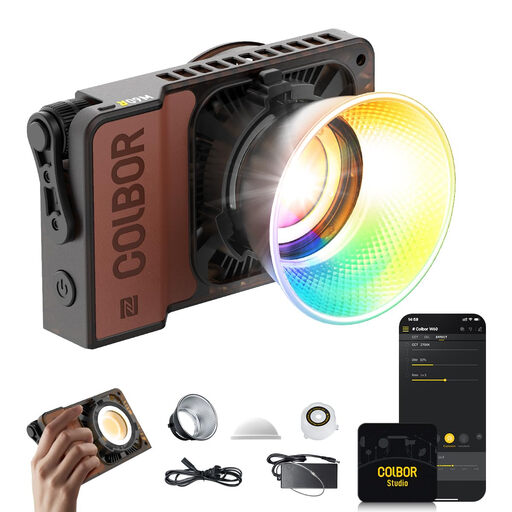
This Joybuy selection includes a portable RGB video light to consider for its colour control, size and suitability for your embroidery setup.
 No image available
If you want to film different thread colours, you can compare this portable RGB video light with the lighting setup you have in mind.
The product name lists 60 W and 345 g. The product description mentions RGB, adjustable colour temperature and CRI 97+.
The product description also mentions app control and a stated noise level of ≤28 dB at 1 m. These are product claims, not independent measurements. Make a test recording in your own workspace and check the applicable conformity information and power version for the exact product before buying.
Position the panel securely at an angle above or beside your embroidery, then make a test recording while you’re actually stitching. Check that the bracket or mount can point the light in the direction you need. Some models may offer extra ways to control the light using an included diffuser or barn doors.
Only if the measurement conditions are comparable. SmallRig quotes 2000 lux at 0.3 m for the P200; Aputure gives 5070 lux at 1 m and 5600 K for the P60x. This isn’t a direct performance test between the two models.
Test the light, dimming level and camera settings you’ll actually use together. Nikon explains that, for the Z 30, flicker can be related to the combination of shutter speed, frame rate and light source. The camera settings available vary by model.
Check whether the exact kit includes a stand or mount, diffuser, mains adapter and battery. The NEEWER NL660 comes with a stand only in certain versions, while SmallRig lists a USB-C cable in the P200 box. For consumer purchases in the Netherlands, if a product doesn’t perform as you could reasonably expect under normal use, the seller must put this right free of charge under ACM ConsuWijzer guidance—for example, through repair, replacement or a refund.
For a product covered by the relevant EU rules, check that the required conformity assessment and CE marking apply to the exact version. The European Union explains that the manufacturer uses the CE marking to declare that the product meets the applicable requirements; a CE logo isn’t a general independent quality assessment. Also check which power version comes with the product.