
Bookbinder dealing with shadows
If you film from above, you want the paper and binding work to stay clearly visible while your hands move. Godox and Neewer include diffusion in their panel solutions.


Start by working out where you can mount the panel out of shot. Then test whether diffused light reaches the whole book and your moving hands. A larger adjustable panel gives you more options as a key light, but needs space; a mini panel is easier to position, but you should test it before using it as the only light source for the whole work surface.
If you film from above, you want the paper and binding work to stay clearly visible while your hands move. Godox and Neewer include diffusion in their panel solutions.
When filming in a small workspace, you need to position your light and camera without blocking your workspace or movements. Ulanzi describes mounting options for the VL49 RGB.
If you film paper, cover materials and thread, look for adjustable colour temperature and stated colour rendering. Godox, Neewer and amaran publish specifications for their models, but these alone cannot tell you how the footage will look with your camera.
First, work out where you can position the light without getting in the way of your work surface. Then compare the diffuser, mounting options, power supply and settings that suit your filming.
| What to consider | What to look for when buying | Who is this important for? |
|---|---|---|
| A clear view of your work | Check whether a diffuser or softbox is included, and test the light while moving your hands across the whole book. | If I film from above, I want to see the paper and my binding work without my hands obscuring it. Around 31% of consumers say being able to see their work is their main concern. |
| Positioning on a small desk | Measure the available space and check which stand or mount comes with the version you have chosen. | When my camera and light have to share a small space, I want to be able to move my hands freely without blocking the setup. Around 25% of consumers give top priority to fitting their lighting into a small workspace. |
| Colour of materials | Compare the stated colour temperature and colour rendering of the exact model, then record a test shot with your materials. | If I film paper, covers and thread together, I want to judge how these materials look in my footage. Around 19% of consumers prioritise how materials and colours are rendered. |
| Flicker in your footage | Test your preferred brightness with your camera settings and frame rate. | If visible bands appear in my footage, I want to know whether the chosen light setting and camera settings work well together. Around 13% of consumers name flicker as their main concern. |
| Power during filming | Check whether the version you choose requires mains power, a battery or both, and which accessories are included. | For a long binding task, I want to keep working without a battery running out or a cable crossing my workspace. Around 12% of consumers put power supply at the top of their list when filming. |
A stated light or colour rating alone cannot tell you whether your moving hands will remain visible or the whole book will be well lit.
Consider positioning and any diffusion alongside the specifications, and record a test shot while carrying out the actual binding work.
What’s included varies by version: Neewer offers the NL660 with or without a stand and states that the NP-F battery is not included. amaran lists a light stand separately for the P60x.
Before buying, check the contents of the exact version you choose and what mounting equipment or power supply you still need.
A small panel can be easy to mount, but that doesn’t prove it will light the whole work surface as you want.
Test the paper, book edges and moving hands in a single shot. If the panel doesn’t light the whole book, use it as a local fill light instead.
The LP400Bi is an adjustable bi-colour panel for anyone looking into a portable key light with built-in diffusion.
The NL660 is a larger bi-colour panel. The version and what comes in the kit matter when planning your setup.
The P60x is a panel you can position separately, for comparing options that include a softbox and grid.
The VL49 RGB is a small, mountable panel for local fill light when space is limited.
This selection is for anyone looking for compact, portable camera lighting for a small workspace.
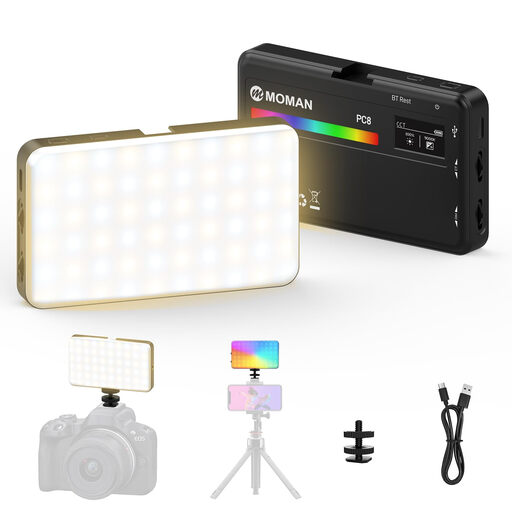 No image available
The portable design suits a workspace with limited room; test whether the light reaches the whole book and your hands in your setup.
The stated battery life is up to 80 minutes at full power.
Position the light out of shot and record a test while carrying out the binding tasks you want to film. A diffuser or softbox can help soften shadows; the result depends on how you position the light in your setup.
First, test the light setting and camera settings you’ll actually use. Sony recommends adjusting the shutter speed to address flicker under certain light sources; the features available vary by camera.
It depends on the version you choose. Neewer offers the NL660 with or without a stand and states that an NP-F battery is not included. For the amaran P60x, the manufacturer lists a softbox and mains power supply, but a light stand is sold separately.
The Netherlands Enterprise Agency classifies lighting as electrical and electronic equipment covered by the relevant EU product rules. A CE marking is the manufacturer’s declaration of conformity, not an independent safety certification. Check the marking and product information for the exact version.
According to ACM ConsuWijzer, online consumer purchases generally come with a statutory cooling-off period of up to 14 days after delivery, subject to exceptions. You’re also entitled to a legal guarantee if a product doesn’t perform as you could reasonably expect under normal use; a manufacturer’s guarantee does not replace this right.