
Vandaag of morgen in huis

Kwaliteit gegarandeerd

Welkomstaanbiedingen ontgrendelen: GRATIS bezorging | Tot 80% korting | Gratis 30 dagen JoyPlus-proefperiode
Download de app
A light that switches on automatically sounds simple. Yet many people buy LED sensor lights without first checking what the sensor responds to, how the light is charged or whether the housing is suitable for outdoor use. As a result, a light may be too bright in the bedroom, provide insufficient light on the driveway or work less effectively after several dark days.
With these buying tips, you can compare a sensor light for indoors, LED outdoor lighting with a motion sensor or a wireless solution for cupboards, hallways and bedrooms.
A light sensor switches a light on when the surrounding area becomes dark. A motion sensor responds to movement within a specific range. For a night light in the hallway, a light sensor may be sufficient. For a driveway, front door or stairs, motion detection is often more practical.
Also look out for combination sensors. A solar security light with both a daylight and motion sensor will usually remain off during the day and only switch on when it is dark and movement is detected.
A light with a high output is not always comfortable in a bedroom or nursery. Around 20 to 40 lumens may be enough for soft orientation lighting, while a driveway or larger patio may need more light.
As well as lumens, consider the colour temperature:
Always check the IP rating. An IP44 outdoor light is protected against solid objects from 1 millimetre and against splashing water. This does not mean that the light is waterproof or suitable for a location where it is constantly exposed to direct rain or jets of water.
IP44 may be suitable for a sheltered wall, balcony or entrance. For an exposed location, a higher protection rating, such as IP65, may be a better choice. Also check whether the mounting method and cables are suitable for the location in question.
The range is important with a PIR sensor. A sensor that only responds at three metres may not be suitable for a long driveway. Also check whether the sensor only detects movement or works together with a dusk sensor. Do not place the light behind glass unless the product information confirms that it is suitable for this; doing so may affect detection.
A plug-in sensor light is convenient for a fixed indoor location. A rechargeable sensor light offers greater flexibility, but needs to be charged via USB from time to time. With a solar wall light with motion sensor, positioning is crucial: the panel needs sufficient direct daylight. Shade from a roof edge or tree can limit charging performance, particularly during darker periods.
Look out for:
A dimmable LED sensor light is useful when you want to switch between orientation lighting and task lighting. Some models offer several brightness levels or colour temperatures. Check whether these settings are selected manually or work automatically. A simple light with one fixed setting may actually be more convenient for a child’s bedroom or hallway.
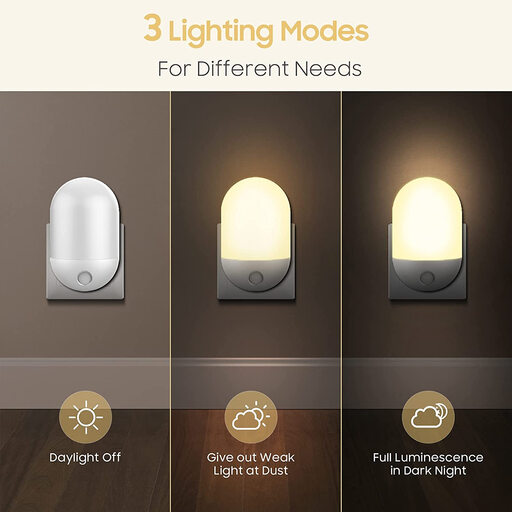
Why it suits this profile: This compact light is designed for a bedroom, nursery or hallway and operates via a light sensor. With 20 lumens and warm light at 2800–3200 K, it provides soft illumination without a rechargeable battery or disposable batteries.
The product specification states both the light colour and the light output. So do not expect powerful main lighting; use it as an orientation light indoors.
0.5 W, warm white light and a 110–220 V connection. Suitable for permanent indoor installation.

Why it suits this profile: For an entrance, garden path or driveway without a power cable, this solar wall light combines a daylight sensor and motion sensor with 1000 lumens and warm white light at 3000 K.
The IP44 rating clearly defines its outdoor use: splash-resistant, but not designed for immersion or direct water jets. Position the panel in a sunny location.
Solar power, two lighting modes, 1000 lumens and a stated IP44 rating.

Why it suits this profile: This LED cupboard light with motion sensor is suitable for kitchen cupboards, wardrobes and shelves. The set contains two lights with PIR detection, three colour temperatures and a built-in 1100 mAh battery.
The 40 cm length and PIR range of 3–5 metres are clearly stated. Check beforehand that the cupboard width and adhesive mounting are suitable for your surface.
61 LEDs, three colour temperatures, two lights per set and USB charging without drilling.

Why it suits this profile: This wireless LED wall light runs on a rechargeable battery and can be used flexibly on a balcony, patio, in the hallway or temporarily in another room, thanks to its magnetic mounting.
The light is IP44-rated and therefore suitable for splashing water, but not for immersion. Also check that the magnetic mounting plate is secure enough for the surface.
300 lumens, 3000 K, motion sensor, USB-C charging and a magnetic system without permanent wiring.
We have put together a complete, up-to-date list of products that fully meet these strict selection criteria and the applicable European safety regulations.
According to the product description, a Philips Diara solar wall light with motion sensor provides warm white light at 2700 K, 400 lumens and IP44 protection. The claim that the housing can withstand certain weather conditions is a product claim made by Philips; therefore, always check the official specifications and installation instructions for your situation.
For a night light or hallway, 20 to 100 lumens is often sufficient for orientation lighting. More light may be useful for a cupboard or kitchen worktop. An outdoor light for a driveway or large patio will generally require a higher light output. Also consider the beam angle, as lumens alone do not indicate how widely the light is distributed.
This depends on the amount of direct sunlight, positioning, battery capacity and how often the sensor is activated. In winter, the days are shorter and the sun is lower in the sky. Position the panel as openly as possible and keep it clean. Manufacturers may state operating times or charging performance, but these depend on the conditions at the installation site.
Service life varies depending on the light source, battery and frequency of use. An integrated LED is generally not designed to be replaced by the user. With rechargeable models, the battery is usually the main consideration. Check whether a model has a replaceable battery, how it is charged and which warranty or statutory consumer rights apply.
