
Vandaag of morgen in huis

Kwaliteit gegarandeerd

Welkomstaanbiedingen ontgrendelen: GRATIS bezorging | Tot 80% korting | Gratis 30 dagen JoyPlus-proefperiode
Download de app
Automatic lighting is useful in a dark hallway, inside a cupboard, on the driveway or beside the back door. However, not every LED sensor light is suitable for every situation. A lamp that works perfectly well as a night light may not provide enough light for a garden path, for example. And an outdoor light with a motion sensor may disappoint sooner if the solar panel receives little direct daylight.
The main pitfalls usually have less to do with appearance and more with the combination of sensor, power supply, brightness and protection against moisture. Use the checks below to choose lighting that suits your home and how you use it.
Lumens indicate how much light a lamp emits according to its product specifications. However, the positioning, beam angle and colour temperature determine how that light is experienced. An LED sensor night light producing, for example, 20 or 40 lumens may be suitable for a bedroom or hallway, but not for a driveway.
Also consider the colour temperature:
A motion sensor light switches on when movement is detected. A light sensor responds to the amount of ambient light and can activate a lamp at dusk. Some models combine both functions, while others do not.
So check whether the product description refers to:
For example, the Aigostar PIR-360 specifies adjustable light sensitivity from 10 to 2000 lux and a delay of 10 seconds to 7 minutes. This makes the sensor suitable when you want to fine-tune your automatic lighting more precisely.
The IP classification is important for outdoor use. In practice, IP44 means protection against splashing water and solid objects measuring 1 millimetre or more. This is not the same as protection against powerful water jets or immersion. IP65 offers greater protection against dust and water jets, but even then the lamp must be installed according to the mounting instructions.
A solar-powered wall light with IP44, for example, is suitable for a sheltered entrance or patio. For a more exposed location, such as a garden wall or driveway, a model with IP65 may be more practical.
Choose the brightness based on the space:
The UME outdoor light specifies 3000 lumens, a detection distance of 60 feet and a detection angle of 180 degrees. These values come from the product information and indicate the potential range; actual performance also depends on mounting height, obstacles and temperature.
An energy-efficient LED lamp generally uses little electricity, but the type of power supply determines how convenient it is to use every day.
Position a solar lamp so that the panel receives enough direct light during the day. Clean the panel and sensor window regularly with a soft, slightly damp cloth.
Pay attention to the fixings supplied and the mounting surface. Self-adhesive strips are handy for lightweight motion sensor cupboard lighting, but are less suitable for a heavy lamp or an outdoor wall with a rough texture. Magnetic mounting is flexible, but check that the mounting plate is securely attached and can support the weight.
Mains-powered electrical sensors must be installed according to the instructions and relevant electrical safety regulations. If in doubt, consult a qualified installer.
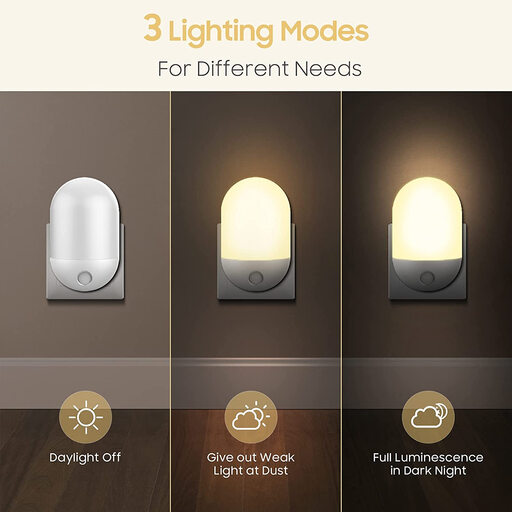
Why it suits this profile: The lamp has a plug connection, 0.5 W power rating and a stated light output of 20 lumens. This makes it a straightforward choice for a bedroom, nursery or hallway where gentle orientation lighting is all that is needed.
The specifications make it clear that this is a compact indoor lamp, not a powerful outdoor light. This helps you avoid using a small night light to illuminate a large space.
Warm white 2800-3200 K, 20 lumens and direct connection to 110-220 V according to the product information.
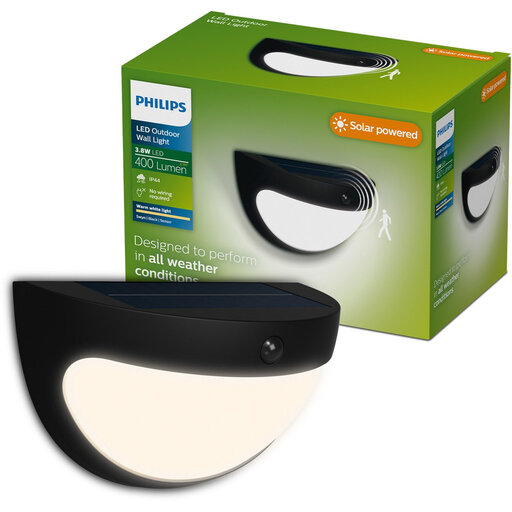
Why it suits this profile: For a fixed entrance, balcony or patio, this solar lamp is an appealing choice when you do not want to run a cable and are looking for a recognised brand with clear product information.
The product information specifies IP44 and warns that the lamp must not be immersed. This prevents you from interpreting its water resistance too broadly.
Two lighting modes, motion sensor, daylight sensor, 2700 K warm white light and integrated battery according to the product specifications.

Why it suits this profile: This solar outdoor light with motion sensor is designed for larger areas such as a garage, garden, driveway or patio where broad light coverage is needed.
The IP65 classification, stated range of 60 feet and 180-degree angle can all be checked specifically. Positioning the lamp where it receives enough sunlight remains essential.
302 LEDs, stated output of 3000 lumens, three lighting modes and three adjustable lamp heads according to the product description.

Why it suits this profile: This slimline wireless LED lighting is designed for kitchen cupboards, wardrobes, shelves and other narrow spaces where wiring is difficult.
The sensor distance of 3-5 metres, USB charging function and dimensions of 400 x 38 x 10 mm are clearly specified in advance. This allows you to assess whether it will fit and how convenient it will be to charge.
61 LEDs, three colour temperatures, a built-in 1100 mAh battery and two lamps per set according to the product details.
We have compiled a complete, up-to-date list of products that fully meet these strict selection criteria and the applicable European safety regulations.
An LED lamp generally uses little power, but consumption depends on wattage, lighting duration and the number of times it is activated. A 0.5 or 1 W lamp in a hallway uses considerably less energy than a powerful outdoor lamp of several watts that stays on for a long time. With a solar lamp, the energy comes from the integrated battery, which is charged by the panel during the day.
The operating time per charge depends on battery capacity, brightness, detection frequency and lighting duration. A model with 1100 mAh may operate for longer with occasional use than with frequent movement throughout the evening. Also check whether the battery is replaceable. With some lamps, the LED light source or battery is integrated and not designed to be replaced by the user.
First check the IP classification, power supply and installation location. IP44 is designed for splashing water and is mainly suitable for sheltered locations. According to the classification, IP65 offers greater protection against dust and water jets. An outdoor light with a motion sensor must also be attached to a sturdy surface and, with a solar model, receive enough direct sunlight.
