
Vandaag of morgen in huis

Kwaliteit gegarandeerd

Welkomstaanbiedingen ontgrendelen: GRATIS bezorging | Tot 80% korting | Gratis 30 dagen JoyPlus-proefperiode
Download de app
An LED sensor light can automatically illuminate a dark cupboard, hallway or driveway without you having to search for a switch. However, not every light is suitable for every location. A motion-sensor light for a kitchen cupboard has different requirements from a solar wall light for the garden.
The most common unsuitable purchases result from three misunderstandings:
A motion-sensor light using PIR technology detects changes in infrared radiation caused by movement. The range varies from product to product. For example, the ultra-thin cupboard lights in this selection have a PIR range of approximately 3 to 5 metres.
For a cupboard, wardrobe or kitchen cupboard, a short range is usually sufficient. For a hallway or external door, a longer range may be more practical. A sensor night light that responds only to ambient light switches on automatically when it gets dark, but does not necessarily detect movement.
Also check whether the light:
A rechargeable cupboard light is useful if you do not want to drill holes or conceal cables. Pay attention to the battery capacity, charging port and charger supplied. For example, a USB-rechargeable light can be charged via a laptop, power bank or suitable USB adapter.
A plug-in light, such as the Aigostar LED Sensor Night Light, does not require a rechargeable battery or battery replacement. However, you will need a spare socket. For a balcony, shed or garden, a solar wall light may be the more logical choice. However, this type of light needs to be installed where the solar panel receives enough direct daylight.
Colour temperature is expressed in kelvins:
For under-cabinet kitchen lighting, the dimensions are important. A 30 or 40 cm light needs enough space and must not come into contact with cupboard doors or handles. A 20 cm Yeelight Closet Sensor Light A20 is more compact. Before purchasing, also check the installation method: magnet, adhesive strip, screws or plug.
A light with IP44 is protected against splashing water from various directions. This makes a product suitable for sheltered outdoor locations such as a balcony, covered patio or terrace, depending on the installation instructions. IP44 does not mean that the light is waterproof. Do not install this type of model where it will be exposed to heavy rain, direct jets of water or immersion for prolonged periods.
For outdoor lighting, also check:
According to the product information, the Philips Swyn has a light output of 400 lumens per light point and IP44 protection. The Philips Diara also lists 400 lumens, 2700 K and IP44. These details come from the product descriptions; the actual experience depends, among other things, on installation height, weather conditions and the selected lighting mode.
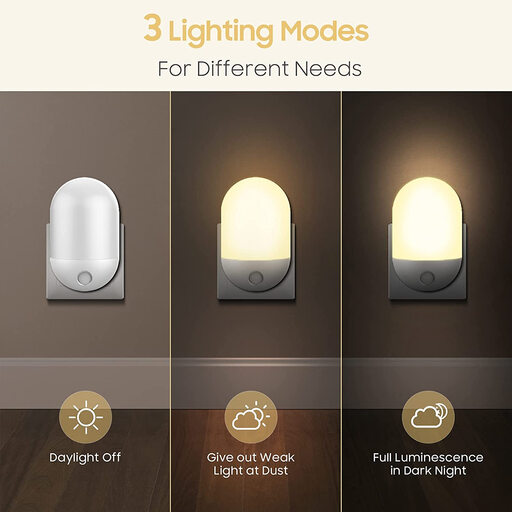
Why it suits this profile: According to the product information, this compact light operates at 110–220 V and produces 20 lm of warm white light at 2800–3200 K. This makes it suitable for a hallway, bedroom or baby’s room where soft lighting is preferred.
The light output is clearly stated, so you will not mistake 20 lm for powerful main lighting. It is a light-sensor lamp, not a fully fledged motion-sensor light.
Plug-in design, 20 lm and warm white colour temperature according to the product specifications.
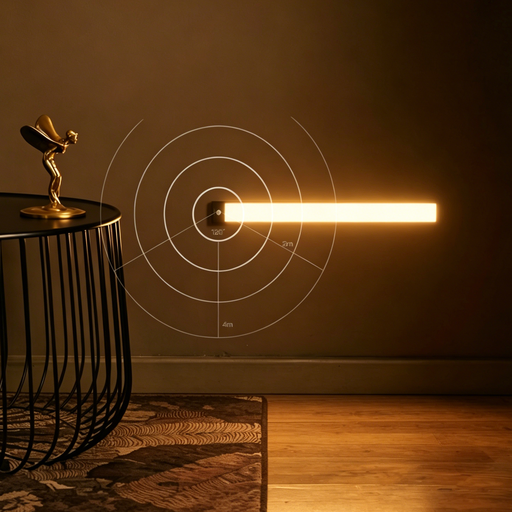
Why it suits this profile: The 20 cm length is suitable for compact cupboards, shelves and small work surfaces. This version is designed as targeted LED cupboard lighting without fixed wiring.
The compact size helps prevent you from buying a light that is too long. However, check the product page to see which sensor and charging functions apply to the version selected.
20 cm length and wireless installation according to the product listing.

Why it suits this profile: This set contains two 40 cm lights with 61 LEDs per light, PIR detection at 3–5 metres and a built-in 1100 mAh battery. This is practical for several kitchen cupboards or a cloakroom.
The specifications state both the sensor range and the battery capacity. This allows you to plan for charging and the required installation space in advance.
2-pack, three colour temperatures, USB charging and slim dimensions of 400 × 38 × 10 mm.

Why it suits this profile: According to the listed specifications, this light has an integrated motion sensor, magnetic mounting, USB-C charging and 300 lm at 3000 K. IP44 makes it suitable for installation on a sheltered balcony, terrace or near an entrance.
The IP44 rating makes the limit clear: splash-resistant, but not suitable for immersion or powerful water jets. Also check that the mounting plate is securely fastened.
300 lm, 3000 K, magnetic mounting, USB-C and IP44 according to the product information.
We have put together a complete, up-to-date list of products that fully meet these strict selection criteria and the applicable European safety regulations.
For rented homes, magnetic mounting and adhesive strips are often more appealing than drilling. First remove dust and grease from the surface and check that the adhesive strip is suitable for the material. With heavier lights, such as some battery-powered wall lights, screw mounting is generally safer.
Do not install a sensor light behind a door, curtain or large cupboard if the sensor needs an unobstructed view. Test the light after installation from the direction in which you normally walk past. With a solar wall light, the panel should receive as much direct light as possible during the day.
This depends on the wattage, how long it remains lit and the power method. A 1 W light that operates for only a few hours a day uses relatively little energy. A rechargeable-battery or solar light does not use mains electricity while lit, but it does need to be charged or receive enough sunlight. For a fair comparison, look at wattage and operating time, not just the term energy-efficient.
The lifespan varies by model and usage conditions. Some product descriptions, for example, state 25,000 hours for the integrated light source. This is a quoted product specification, not a guarantee that every component will last equally long. With rechargeable models, the battery is also an important wear component.
No. Check the IP rating and the manufacturer’s instructions. IP44 is suitable for splashing water and certain sheltered applications, but not for immersion or direct water jets. An indoor light designed for a cupboard or bedroom should not be installed outdoors, even if it is wireless.
