
Vandaag of morgen in huis

Kwaliteit gegarandeerd

Welkomstaanbiedingen ontgrendelen: GRATIS bezorging | Tot 80% korting | Gratis 30 dagen JoyPlus-proefperiode
Download de app
An LED sensor light can automatically illuminate a dark hallway, cupboard, bedroom, driveway or entrance as soon as it detects movement or a change in ambient light. However, not every sensor light is suitable for every location. A light for a wardrobe has different requirements from a solar outdoor light with a motion sensor.
Most disappointing purchases are down to three common mistakes:
Looking only at the lumen count
A high light output isn’t automatically useful. For a bedroom night light, 20 to 40 lumens may be enough, while a driveway needs more light and wider coverage.
Misinterpreting the IP rating
IP44 means protection against splashing water, not powerful water jets or immersion. An IP44 outdoor light may be suitable for a sheltered entrance. For a more exposed location, an IP65 waterproof outdoor light is a more sensible starting point, provided the installation and product information support this.
Not checking the sensor, battery and installation method
A battery-powered motion sensor light is easy to install, but needs occasional maintenance. A rechargeable cupboard light avoids disposable batteries, while a solar-powered light depends on receiving enough daylight. Also check whether the light is fitted with adhesive strips, screws, a magnet or a fixed electrical connection.
An LED motion sensor light switches on when a PIR sensor detects heat differences and movement. The range varies by model. For example, the 30 and 40 cm cupboard lights in this selection have a stated detection range of 3 to 5 metres. That’s practical for a kitchen cupboard, wardrobe or short hallway, but they aren’t designed to monitor an entire garden.
A light sensor works differently. It responds to the difference between day and night. A sensor night light with a day-night sensor can therefore switch on automatically when a room gets dark, without anyone needing to walk past it.
Lumens indicate how much visible light a lamp produces, according to its product specifications. Also consider the colour temperature:
A light with several colour temperatures and dimming settings offers greater flexibility. However, check that these features are actually listed in the product description, rather than only in general advertising copy.
A wireless LED light with a USB-rechargeable battery is useful when there isn’t a socket nearby. Check the battery capacity, charging method and whether the light can be removed. For solar outdoor lighting, positioning is important: the panel needs enough direct sunlight during the day.
For permanent outdoor installation, consider the IP rating, the materials and the installation instructions. An IP44 light is splashproof according to its stated rating, but must not be immersed. The UME outdoor light in this selection is listed as IP65 in the product information and is intended for a more exposed outdoor setting. Always follow the installation instructions for electric wall lights; some models must be connected by a qualified installer.
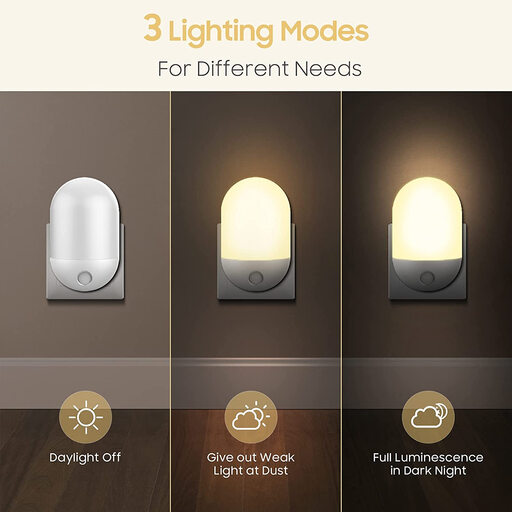
Why it suits this type of user: This compact sensor light is designed for a bedroom, nursery or hallway where you want gentle lighting without a complicated installation.
The stated light output is 20 lumens, with a colour temperature of around 2800–3200 K. This makes it clear what the light is designed for: helping you find your way, rather than lighting a large workspace.
Warm white light, a light sensor and a power rating of 0.5 W according to the product information.

Why it suits this type of user: A good choice if you’re looking for a well-finished wall light for an entrance, patio or exterior wall without having to install an electrical cable.
The product information specifies two lighting modes, a motion sensor, a dusk sensor, 1000 lumens and IP44. Check that your chosen installation spot is sheltered enough.
Solar-powered, with two modes and a stated light colour of 3000 K.

Why it suits this type of user: Designed for larger outdoor areas such as a driveway, garage, garden or patio, where wide coverage and a strong light output are important.
The listed specifications include a 180° detection angle, a range of 60 feet, three adjustable light heads and IP65. Make sure the solar panel is positioned somewhere with enough direct sunlight.
302 LEDs, a stated output of 3000 lumens and three lighting modes, according to the product page.

Why it suits this type of user: A practical choice for a kitchen, wardrobe, shelf or bedroom, with no need for drilled holes or fixed wiring.
The light uses a PIR sensor, has a stated range of 3–5 metres and comes as a 2-pack. Its USB-rechargeable battery means you won’t need to replace disposable batteries.
40 cm long, with 61 LEDs, three colour temperatures and a built-in 1100 mAh battery, according to the product information.
We’ve put together a complete, up-to-date list of products that meet these strict selection criteria and the applicable European safety requirements.
It depends on the model. A cupboard light can be attached with adhesive strips or a magnet. A solar wall light is usually fitted with screws and doesn’t need to be connected to the mains. A fixed 230 V wall light must be connected in accordance with the product instructions, preferably by a qualified installer.
Battery life depends on its capacity, how often the light switches on, how long it stays on each time and its brightness. For a rechargeable cupboard light, 1100 mAh is a verifiable product specification, but it doesn’t automatically tell you how long the battery will last. Also check the charging time and whether you can use the light while it’s charging.
LED lights generally use little power, but consumption varies by model. A 0.5 or 1 W light that switches on only briefly uses less energy than an outdoor light that stays on at high brightness for a long time. A solar-powered light doesn’t use mains electricity, but its performance depends on sunlight, battery charge and positioning.
