
Vandaag of morgen in huis

Kwaliteit gegarandeerd

Welkomstaanbiedingen ontgrendelen: GRATIS bezorging | Tot 80% korting | Gratis 30 dagen JoyPlus-proefperiode
Download de app
An LED sensor light can automatically illuminate a dark hallway, cupboard, kitchen or entrance as soon as movement is detected. However, not every light is suitable for every location. A model for a wardrobe, for example, does not need to withstand rain, whereas an outdoor light needs sufficient protection against moisture.
The biggest buying mistakes usually come down to three points:
Pay attention to the detection range, detection angle and the way the light responds to ambient light. Some models only switch on when it is dark enough. This prevents automatic lighting from coming on unnecessarily during the day.
A cupboard light with a sensor generally does not need a long range. For a hallway or staircase, it is more important that the sensor detects movement from the direction people approach from. Also check whether the light has a constant-light setting in addition to an automatic mode. This is useful when you need the light to stay on for longer.
With a separate motion sensor, such as the Aigostar PIR-360, the product information states that sensitivity and activation-time settings are available. The specified detection range is up to 6 metres in diameter, with adjustable light sensitivity from 10 to 2000 lux and a delay of between 10 seconds and 7 minutes. Always check that the installation and connection are suitable for your existing light.
Lumens (lm) indicate how much light a lamp emits according to its specification. An LED night light with 20 or 40 lm is intended for orientation, not for fully lighting a room. A higher light output may be preferable for a worktop or entrance.
Colour temperature is expressed in kelvins (K):
A model with several colour temperatures and dimming settings offers greater flexibility. Do check whether the brightness is stated in lumens and whether dimming is continuous or available in fixed levels.
Three power options are common for a wireless sensor light:
For outdoor lighting with a motion sensor, check the IP rating. IP44 means protection against splashing water, but not against immersion or powerful water jets. According to the classification, IP65 offers greater protection against dust and water jets. Positioning remains important: a light under a canopy faces different conditions from one fully exposed to rain.
Also check the mounting method. Magnets and adhesive strips are convenient for lightweight indoor lights, but an outdoor light must be securely fixed in place. A 230V wall light must be installed by a qualified installer.
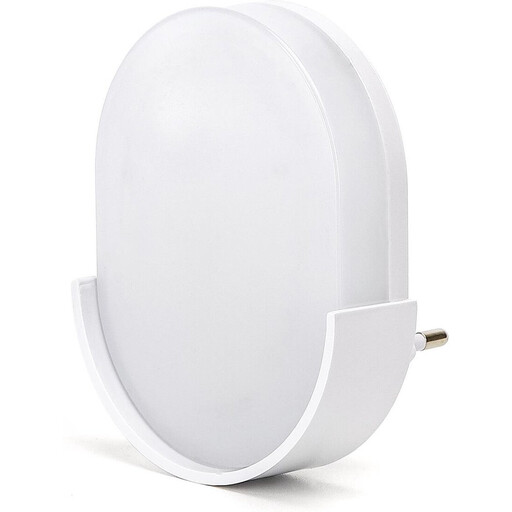
Why it suits this profile: This plug-in night light is suitable for a hallway, nursery or bedroom where you do not want to replace batteries or recharge a lamp.
The specified light sensor automatically switches between day and night. The light operates via a plug, so loose batteries and charging cables are not needed.
According to the product specification: 40 lm, 1 W, a 120° beam angle and stated indoor use.

Why it suits this profile: A rechargeable LED light with magnetic mounting is ideal for anyone looking for flexible lighting for a balcony, patio, entrance or hallway.
The specification states IP44 and a motion sensor. This makes it clear that the light offers splash protection, rather than being fully waterproof.
The stated specifications are 300 lm, 3000 K, USB charging, magnetic mounting and an integrated sensor.

Why it suits this profile: This solar outdoor light with a motion sensor is designed for larger outdoor spaces such as gardens, driveways, garages or patios.
The stated IP65 rating and solar design are better suited to outdoor use. For reliable operation, the panel must receive direct daylight.
According to the product description: 302 LEDs, 3000 lm, three lighting modes, a 180° detection angle and three adjustable light heads.
For cupboard and kitchen lighting, the ultra-slim 30 or 40 cm models are practical options to compare. According to the product specification, the 40 cm version has 61 LEDs, a PIR sensor with a range of 3 to 5 metres, three colour temperatures and a built-in 1100mAh battery. The light is charged via USB and can be mounted without drilling using an adhesive strip.
According to the product information, the 30 cm version uses 41 LEDs and has the same stated battery capacity, colour options and sensor range. Choose the length based on the shelf or cupboard door. Before mounting, check that the surface is clean, flat and suitable for the adhesive strip. In a kitchen, the light should also not be exposed to steam, splashes or excessive humidity.
Consumption depends on the wattage, operating time and number of activations. A 1 W light that is on for 1 hour a day theoretically uses around 0.365 kWh per year. With a sensor light, actual consumption is often lower because the light only comes on briefly, but this varies according to how it is used.
With battery and USB models, charging frequency and battery capacity are more important than wattage alone. With solar lighting, the amount of sunlight, temperature and selected lighting mode affect operating time. So do not just look at the stated lumen value; also consider the power method and installation location.
We have put together a complete, up-to-date list of products that fully meet these strict selection criteria and the applicable European safety regulations.
Mount the light so that the sensor has a clear view of the route people use. Do not place it directly behind a cupboard shelf or decoration. After mounting, test the distance and check whether the light only comes on when it is dark enough. With adhesive mounting, a clean, dry surface is important.
Lifespan varies depending on the LED module, rechargeable battery, battery type and frequency of use. An integrated LED cannot always be replaced. Therefore, check whether the manufacturer states a lifespan and whether the rechargeable battery can be replaced. With a battery-powered model, standard batteries are easier to replace than a built-in rechargeable battery.
A sensor light can reduce the number of hours the light is on because it only switches on when movement is detected. The result depends on the wattage, the set operating time and how often the sensor is activated. A short switch-off delay and a well-positioned light sensor help prevent unnecessary operation.
