
Vandaag of morgen in huis

Kwaliteit gegarandeerd

Welkomstaanbiedingen ontgrendelen: GRATIS bezorging | Tot 80% korting | Gratis 30 dagen JoyPlus-proefperiode
Download de app
An LED sensor light can automatically illuminate a dark wardrobe, hallway or staircase. However, not every light is suitable for every location. A motion sensor works differently from a light sensor, a USB rechargeable light requires maintenance, and an outdoor light needs the right IP rating.
So don't just focus on the number of LEDs or a low price. The key differences often lie in the sensor, power supply, brightness, colour temperature and installation method.
A motion sensor light switches on when movement is detected. This is practical in a wardrobe, hallway or on a staircase. A light sensor, on the other hand, responds to the level of ambient light. An LED night light with a light sensor, for example, turns on when it gets dark and switches off during the day.
So check which type of sensor you need:
A light sensor is not automatically suitable if you only need brief light when you walk past.
More lumens means more light, but not always better illumination for the space. A 20-lumen light can be pleasant as a warm white night light beside a bed. For a deep wardrobe or garage, a higher light output is more practical.
Alongside lumens, also consider:
A long LED cupboard light generally distributes light more evenly across a shelf than a small, spot-like light.
A wireless LED light often runs on batteries or a built-in rechargeable battery. This avoids cables, but you will need to recharge the light or replace the batteries. Check whether a USB cable is included, what charging type is used, and whether the light can function while charging.
When mounting with adhesive tape, the surface is also important. Dust, grease or a rough wall can reduce adhesion. For a heavy light with a magnetic mount, the surface needs to be flat and sufficiently sturdy.
A PIR sensor with a range of 3 to 5 metres is useful in a cupboard, bedroom or short hallway. For a driveway or garden, you may need a longer range and a wider detection angle. Also pay attention to the shut-off delay. A light that turns off too quickly can be inconvenient on a staircase or in a garage.
Colour temperature is expressed in kelvin:
A dimmable LED night light offers more control when different family members use the same space. Some models have several fixed settings; others advertise a stepless dimming function, for example from 10% to 100%.
A USB rechargeable light with a built-in battery is handy where no plug socket is available. A plug-in model with, for example, 0.3 W consumes very little power according to the product specification, but it still depends on a socket.
For outdoor use, you need to check the IP rating. IP44 means protection against splashing water, but not against immersion or strong water jets. IP65 is described in the product information as protection against dust and water jets. Always install a light according to the instructions and take into account rain, snow and direct exposure.

Why this fits the profile: The set includes two compact lights for, say, a kitchen cupboard and a wardrobe. The adhesive tape mounting is designed for use without drilling.
The product specification states a PIR range of 3-5 metres, three colour temperatures and a built-in battery. This means you don't have to combine separate batteries or a separate sensor yourself.
41 LEDs, USB charging, 1100mAh battery and a length of 300 mm. The pack contains two lights.
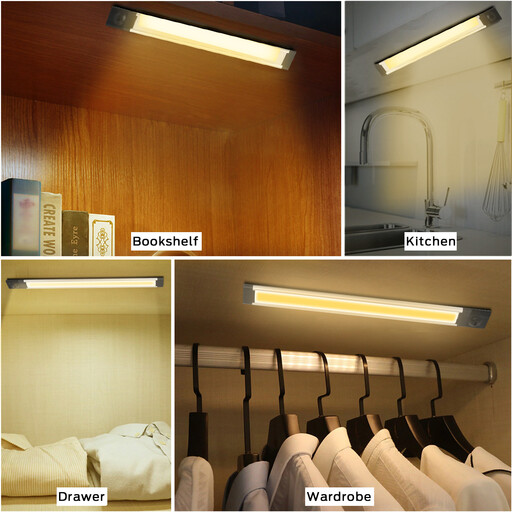
Why this fits the profile: This light is aimed at users who value brightness and flexible placement in a bedroom, cupboard, garage or stairwell.
The stated light output is 400 lumens and the colour temperature ranges from 2800K to 6500K. This gives you more information than simply saying "bright light".
36 SMD LEDs, gesture control with dimming function and magnetic mounting or hooks. Dimensions: 26 x 4 x 1 cm.

Why this fits the profile: For the garden, driveway, garage or patio, a solar sensor light is interesting when you don't want to run a power cable.
The product specification states IP65, three light modes and a detection angle of 180 degrees. Do check that the solar panel receives enough direct daylight.
302 LEDs, stated light output of 3000 lumens, three adjustable light heads and an integrated 1800mAh battery.
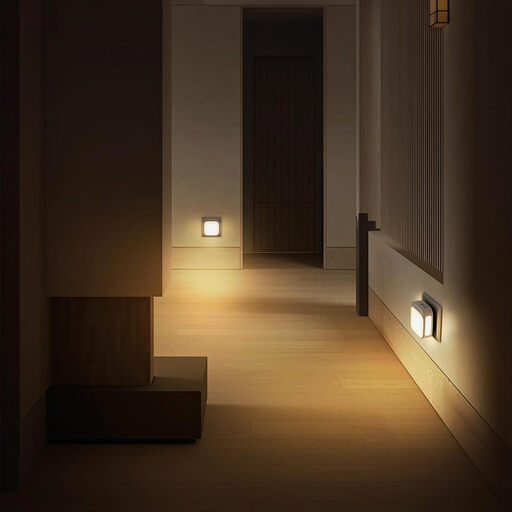
Why this fits the profile: This plug-in model suits a hallway, nursery or toilet where you don't want to recharge a battery and need soft light.
The light uses a light sensor and, according to the product information, switches on at a maximum of 20 lux. This makes it clear that it is not a PIR light that responds to movement.
0.3 W power consumption, warm white light at 2800-3000 K and stepless dimming from 10% to 100%. The set contains two lights.
We've put together a full, up-to-date list of products that fully meet these strict selection criteria and comply with current European safety regulations.
First, clean the surface and let it dry completely. Then attach the adhesive strip, mounting plate or magnet according to the product instructions. Use adhesive mounting mainly on smooth, grease-free surfaces. For a heavy wall light, screw mounting is often more suitable than just a magnet or adhesive strip.
The usage time depends on the battery, brightness, switch-on duration and the number of movements. A light that only turns on briefly in a cupboard uses less power than one that stays on continuously at maximum brightness. So check the battery capacity, charging type and available dimming settings. The stated 1100mAh on some models indicates the battery capacity, not automatically the usage time.
With a battery or USB model, you mainly pay for recharging or replacing batteries. A plug-in light usually states its wattage, for example 0.3 W. The consumption is then determined by the number of hours it is on. Outdoors, a solar sensor light can avoid using mains power, but performance depends on placement, daylight and the weather.
