
Vandaag of morgen in huis

Kwaliteit gegarandeerd

Welkomstaanbiedingen ontgrendelen: GRATIS bezorging | Tot 80% korting | Gratis 30 dagen JoyPlus-proefperiode
Download de app
An LED sensor light can make a dark hallway, wardrobe or bedroom far more practical, without you having to fumble for a switch every time. However, not every light with a motion sensor is suitable for every spot. A sensor might react too slowly, a battery could drain quickly, or the colour temperature might be inconvenient.
With this buying guide, you can compare the key features of a night light with a motion sensor, cupboard lighting with a sensor, and other wireless LED lights. The selection below is based on verifiable product specifications, such as light output, sensor range, power supply, dimensions and control options.
A motion sensor reacts to movement within a certain range. A light sensor, on the other hand, switches on when the surroundings are dark enough. Some models combine both functions, but this is not always the case.
For a hallway or bedroom, an automatic night light with motion detection is handy. For a plug socket next to a bed, a model with only a day/night sensor may be sufficient. So check whether the product description mentions PIR, motion detection, a light sensor, or a combination of these.
A light with a high lumen count can be suitable as kitchen lighting with a motion sensor, but it may be too bright as an LED night light in a bedroom. For orientation at night, a lower light output is often enough. For a wardrobe or worktop, you'll need more light.
Also pay attention to the colour temperature:
A rechargeable sensor light is flexible, but you'll need to charge it periodically via USB. A light running on 230 V doesn't need a battery, but it does require a plug socket. A wireless LED light with a magnetic mount is easy to move around, whereas an adhesive strip may come loose on a dusty or rough surface.
So check beforehand:
For the rechargeable models mentioned, the PIR range is around 3 to 5 metres according to the product information. That range matters in a hallway or wardrobe, but actual detection also depends on placement and the direction of movement. A light that only switches on in low ambient light also prevents it from turning on unnecessarily during the day.
A model with a fixed light sensor, such as some plug-in night lights, is suitable when you don't need motion detection. In that case, look at the stated threshold, for example ≤20 lux, if available.
Lumens indicate how much light a lamp emits according to the product specification. The models in this selection range from approximately 20 to 400 lm. A dimmable night light with multiple modes is more practical when the same light is used in both a nursery and a hallway.
An adjustable colour temperature offers extra choice:
An RGB LED strip is mainly intended for ambience and decoration. For functional lighting in a cupboard or on a staircase, a white LED sensor light is generally clearer.
For a rechargeable sensor light, the battery capacity and stated usage time are more important than just the word "wireless". A model with a built-in 500 mAh battery might claim up to 10 hours of use in sensor mode. Another model uses a 1,100 mAh battery. The actual usage time depends on brightness, number of activations and charge status.
For plug-in models, pay attention to the wattage. A light of 0.3 W or 0.5 W can be suitable for long-term use as orientation lighting. The stated lifespan of the LEDs, such as 25,000 hours for a specific Aigostar model, is a manufacturer's product specification and not a guarantee for every usage scenario.
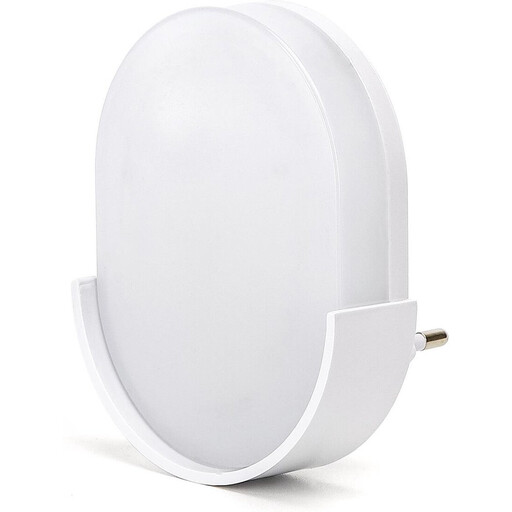
Why this fits the profile: The plug-in design works without separate batteries or a USB charger, making it easy to place in a hallway, bedroom or nursery.
The power supply is clear: plug-and-play on 230 V. The light uses a day/night sensor instead of a motion sensor, which prevents unrealistic expectations about motion detection.
40 lm, 1 W, 120° beam angle and a stated lifespan of 25,000 hours according to the product information.

Why this fits the profile: This smart LED lighting suits anyone who wants to combine ambient light behind a television, under a shelf or in the living room with app and voice control.
The product page mentions dimmability, Matter support and compatibility with multiple smart home platforms. Do check beforehand which features require a Hue Bridge.
5 metres in length, millions of colour settings according to the product description, dimming function and control via app or voice.
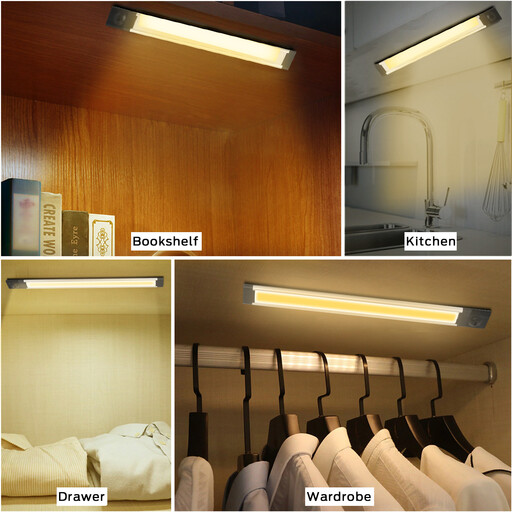
Why this fits the profile: The higher stated light output is aimed at areas where more visibility is needed, such as a wardrobe, garage, staircase or storage space.
The specifications list both the sensor range and the control method. This allows you to assess in advance whether the light is suitable for a functional application.
400 lm, 36 SMD LEDs, colour temperature from 2,800 to 6,500 K and mounting with magnets or hanging hooks.

Why this fits the profile: The 40 cm length covers a larger area of a kitchen cupboard, wardrobe or shelf without taking up much space.
The stated dimensions of 400 × 38 × 10 mm make it easy to check the available space beforehand. Mounting is drill-free using the included tape.
61 LEDs, PIR detection at 3–5 metres, three colour temperatures and a built-in 1,100 mAh battery according to the product description.
We've put together a full, up-to-date list of products that fully meet these strict selection criteria and comply with current European safety regulations.
Place the light in a position where the sensor can detect the walking route, for example next to a door or on the inside of a cupboard. Check that furniture, shelves or doors do not block the detection area. For adhesive mounting, the surface must be flat, clean and dry. Use a magnetic mount if you want to remove the light regularly for charging.
That depends on the battery capacity, brightness setting and number of activations. Product information might, for example, state a usage time of up to 10 hours in sensor mode for a 500 mAh battery. Treat this as a stated guideline. For daily use, it's wise to choose a light that can be easily charged via USB.
A battery-powered light uses relatively little electricity while charging, but it does need to be plugged in regularly. A plug-in model with a low wattage, such as 0.3 W or 0.5 W, is designed for long-term orientation lighting. Calculate the consumption using the formula: wattage in watts × hours of use ÷ 1,000. Also check whether the light only switches on in the dark or only when it detects movement.
