
Vandaag of morgen in huis

Kwaliteit gegarandeerd

Welkomstaanbiedingen ontgrendelen: GRATIS bezorging | Tot 80% korting | Gratis 30 dagen JoyPlus-proefperiode
Download de app
An LED sensor light can be a real help in a dark hallway, wardrobe, bedroom or by the front door. The light comes on when you need it and stops you from having to fumble for a switch every time. That said, models vary widely in how they work, their brightness, installation method and power supply.
If you only look at the number of LEDs or a low price, you can easily fall into some common traps. Below, you'll find out what to look for and which models suit different situations.
A motion sensor reacts to movement, usually within a certain range. A light sensor, on the other hand, measures the ambient light level. So a night light with a motion sensor can switch on when someone walks past, while a lamp with a light sensor automatically tells the difference between day and night.
Check whether you need automatic lighting for:
A light that only reacts to movement can switch on unnecessarily during the day if it doesn't have a light sensor.
A rechargeable LED light doesn't need hardwiring, but the battery does need to be charged regularly. With a battery-powered model, you'll need to factor in replacements. A plug-in model works from the mains and has no battery, but it's less flexible to position.
When looking at a battery or rechargeable light, pay attention to:
A light with 400 lumens can be suitable for a cupboard, stairs or workspace, but it can feel too bright as an LED night light in a nursery or bedroom. For soft orientation lighting, 20 to 40 lumens is often more sensible than a more powerful light.
So look at lumens, not just wattage. Wattage mainly tells you about energy consumption; lumens describe how much light the lamp produces according to the product specification.
With a PIR sensor, also known as an infrared motion sensor, a range is usually stated. The ultra-thin cupboard lights of 30 and 40 cm, for example, state a detection range of 3 to 5 metres. That's practical for a hallway or wardrobe, but the actual performance also depends on placement, direction of movement and obstacles.
Also check whether the light:
Colour temperature is expressed in kelvin:
A dimmable night light gives you extra control when you want to light different rooms with one product. Some models also offer three colour temperatures and multiple dimming levels.
For indoor use, a magnetic fixing, adhesive strip or hook can be enough. Check that the surface is clean, flat and suitable for the fixing material. With a heavier light, the mounting needs to be sturdy enough to prevent it coming loose or falling.
For an outdoor LED wall light, the IP rating is important. According to the product information, IP44 means protection against splashing water, but not against immersion or powerful water jets. So don't place an IP44 light where it will be directly exposed to heavy rain or a garden hose. A fixed 230V light must, according to the product information, be connected by a qualified installer.
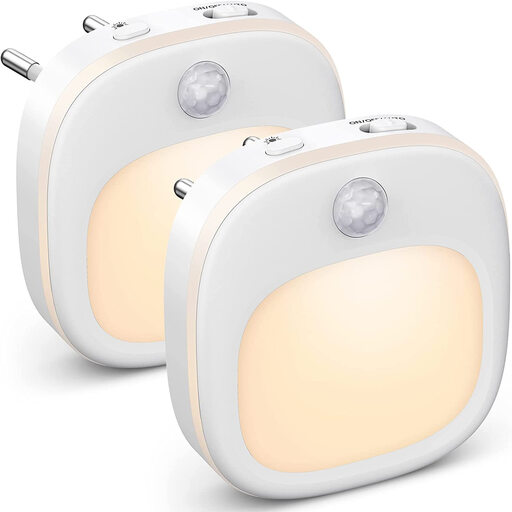
Why this fits the profile: A set of two lights offers a simple way to equip, for example, a bedroom and hallway with automatic lighting at the same time. The three colour temperatures and five dimming levels make the product flexible.
The product information states both a motion sensor and a low power consumption of 1 W. The dimming levels help prevent a fixed brightness from being too strong for night-time use.
2 units, 3 colour temperatures, 5 dimming levels and a stated voltage range of 100–240 V.
Why this fits the profile: This model is aimed at users who want more light and flexible control for a hallway, stairs, wardrobe or storeroom.
The stated light output of 400 lumens makes it clear that this is not a subtle sensor night light. So you can use it more purposefully in places where functional light is needed.
36 SMD LEDs, a colour temperature range of 2,800–6,500 K, dimmable hand-gesture control and magnetic mounting with hooks.

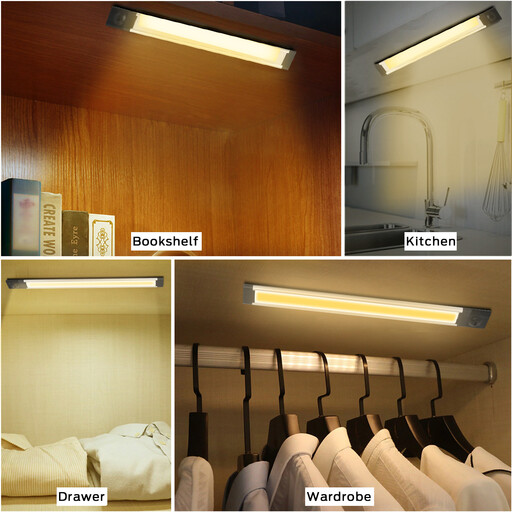
Why this fits the profile: The 40 cm length and slim design suit kitchen cupboards, wardrobes, shelves and other narrow surfaces.
The specifications state a PIR range of 3–5 metres, three colour temperatures and a built-in battery of 1100 mAh. So you can see in advance how the light works and how to charge it.
61 LEDs, USB charging via 5 V, three colour temperatures and drill-free fixing with the included adhesive strip.

Why this fits the profile: This wireless light is designed for use on balconies, patios, in the garden and by entrances. The magnetic mounting allows you to move it without any hardwiring.
The product information states IP44 and a rechargeable battery. This makes it clear that the light is splash-proof, but not suitable for immersion or direct water jets.
300 lumens, 3,000 K, motion sensor, USB-C charging, magnetic mounting and IP44 splash-water protection.
We've put together a full, up-to-date list of products that fully meet these strict selection criteria and comply with current European safety regulations.
Position the light where the sensor has a clear view of the walking route. Avoid curtains, tall cupboards or other obstacles. Also check that the light doesn't shine directly into your eyes. For a narrow hallway, a low-output model with warm white light can be sufficient.
The usage time per charge depends on the battery capacity, light brightness, sensor settings and the number of activations. A light with multiple dimming levels can be used more economically than a model that always runs at full power. Look at the stated battery capacity and charging method, but don't take a general claim about "long battery life" as a fixed usage time.
That depends on the wattage and how often the light is on. A 1 W light uses roughly 1 kWh over 1,000 hours of operation, excluding any power supply losses. A sensor light that only switches on briefly typically uses less energy than a light that stays on continuously. So check both the power in watts and the set burn time.
