
Vandaag of morgen in huis

Kwaliteit gegarandeerd

Welkomstaanbiedingen ontgrendelen: GRATIS bezorging | Tot 80% korting | Gratis 30 dagen JoyPlus-proefperiode
Download de app
An LED sensor light can illuminate a hallway, bedroom, cupboard or entrance without you having to fumble for a switch. However, not every light is suitable for every location. A light for a nursery has different requirements to a solar outdoor light with motion sensor by the driveway.
Pay particular attention to three common pitfalls:
A light sensor measures the ambient light. For example, one model switches on when it gets dark and off in daylight. This suits a fixed orientation light in a hallway or bedroom.
A motion sensor light with PIR technology detects body heat and movement within a certain range. With the ultra-slim cupboard lights in this selection, the product information states a range of 3 to 5 metres. Check whether that range suits the space. In a narrow cupboard, a large range isn't necessary; by an entrance, it can be very practical.
Also pay attention to the switch-on duration. If it isn't adjustable, the light may turn off too quickly when you're walking slowly through a hallway.
Brightness is expressed in lumens. A compact LED night light of 20 lumens is intended for soft orientation lighting. For a worktop or dark entrance, more light is needed. The Brilliant Iseo portable wall light has 300 lumens according to the product data.
Colour temperature is given in kelvin:
A dimmable sensor light is handy when the same light is used at different times. The 2-pack with automatic light sensor has a stated dimming range of 10% to 100%, a power consumption of 0.3 W and a colour temperature of 2800–3000 K.
A plug-in light is easy to install, but takes up a socket. A rechargeable model is more flexible, but the battery capacity and charging method determine ease of use. Check whether a USB cable is included and whether the light can be used while charging.
For cupboard lighting with sensor, a slim shape and secure fixing are important. The 40 cm cupboard lights are 10 mm thick according to the product description, have a built-in battery of 1100 mAh and can be attached with tape.
For outdoor use, look at the IP rating:
An IP rating doesn't automatically make a light suitable for every outdoor location. For example, don't place a splash-proof light where rainwater can fall directly onto the USB port.
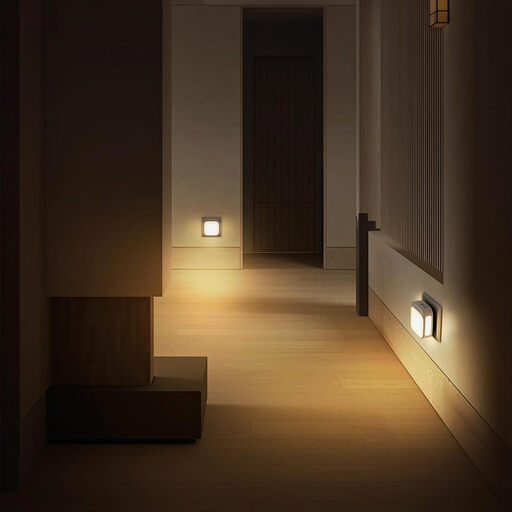
Why this fits the profile: These plug-in lights are suitable for a hallway, bedroom or nursery where soft automatic lighting is needed without recharging.
The product data states an automatic light sensor, so you won't accidentally expect a motion sensor. The stated power consumption is 0.3 W per light.
2 lights, stepless dimming from 10% to 100%, 20 lumens and warm white lighting at 2800–3000 K.

Why this fits the profile: A flexible wireless wall light for a balcony, patio, veranda or hallway where you want more light and easy installation.
The product information states both a motion sensor and IP44 splash-water protection. This makes it clear that the light should not be used as fully waterproof.
300 lumens, 3000 K, rechargeable 18650 batteries, USB connection and magnetic mounting.

Why this fits the profile: For kitchen cupboards, wardrobes and dark shelves where automatic lighting over a longer length is needed.
The specifications mention a PIR sensor with a range of 3–5 metres, three colour temperatures and a rechargeable battery. You can therefore tailor the light to the cupboard or work area.
2 lights of 40 cm, 61 LEDs per light, 1100mAh battery, USB charging and choice of 2800–3200 K, 4500–5000 K and 6500–7000 K.
We've put together a full, up-to-date list of products that fully meet these strict selection criteria and comply with current European safety regulations.
That varies by model. A light sensor reacts to ambient light, while a PIR motion sensor detects movement. Read the product specifications before you order. For a fixed night light, a light sensor is often sufficient; for a cupboard or entrance, a motion sensor can be more practical.
The power consumption depends on the wattage and the duration of use. A light of 0.3 W uses significantly less energy than a 4 W model when both are on for the same length of time. With a sensor light, the actual consumption can be lower because the light isn't on continuously. A rechargeable model also uses electricity while charging, but doesn't need a fixed connection.
The lifespan varies depending on the LED module, battery and usage conditions. Some product information states an estimated lifespan, but this isn't a guarantee for every situation. With rechargeable models, the battery is also an important component. Install the light according to the instructions, keep sensors and solar panels clean, and avoid moisture beyond the stated IP protection.
