
Vandaag of morgen in huis

Kwaliteit gegarandeerd

Welkomstaanbiedingen ontgrendelen: GRATIS bezorging | Tot 80% korting | Gratis 30 dagen JoyPlus-proefperiode
Download de app
An LED sensor light can be useful in a dark hallway, bedroom, wardrobe, garden or by the front door. The light switches on automatically when it gets dark or when movement is detected. However, not every sensor light is suitable for every location. A light that is too dim is of little use on a driveway, while a bright light can be unsettling in a baby’s room.
Joybuy Product Recommendation Officer filters the most important product specifications and common purchasing pitfalls, helping you compare products more effectively.
A light sensor responds to the difference between day and night. For example, a sensor night light switches on automatically when the surroundings become dark. A motion sensor, often a PIR sensor, switches on as soon as movement caused by a person’s body heat is detected.
So, first consider what you need the light for:
A product title containing “sensor” does not automatically tell you which type of sensor is included.
An IP44 outdoor light is protected against splashing water from different directions, but not against immersion or powerful water jets. Therefore, do not install this type of light where rainwater runs directly over the housing.
IP44 can be suitable for a sheltered entrance or balcony. For an exposed garden, an uncovered façade or a location subject to heavy rain and dirt, a higher IP rating, such as IP65, may be more practical. Also check the mounting method and the quality of the wall fixing.
The number of lumens indicates the light output. A 20-lumen light is suitable as soft orientation lighting, but not for brightly illuminating a driveway. A 1000- or 3000-lumen light may be too bright for a bedroom or baby’s room.
Also consider the colour temperature:
The range is important for a PIR sensor. According to the product description, the 30 cm and 40 cm cabinet lights in this selection have a detection range of 3 to 5 metres. This can be practical for a wardrobe or kitchen, but the exact performance depends on the mounting height, direction of view and any obstacles.
Also check whether the light:
A plug-in light does not need recharging, but you will need a power socket. According to the product information, the Aigostar LED Sensor Night Light operates at 230 V, has a light output of 40 lumens and uses a day/night sensor.
A rechargeable LED light offers greater flexibility. Check the battery capacity, charging voltage and charging cable. The ultra-thin cabinet lights in this selection have a built-in 1100mAh lithium battery and charge via DC 5V, 0.5A. Use a suitable USB charger and do not place the light in a damp location if the product information advises against it.
A solar-powered outdoor light does not require mains electricity or a fixed cable. However, its performance depends on direct sunlight. In winter or on a shaded wall, the operating time may be shorter. Keep the solar panel clean and check that the light is securely mounted.
Measure the available space before ordering. A 40 cm sensor cabinet light will not fit on every narrow shelf. The 30 cm version measures 300 × 38 × 10 mm; the 40 cm version measures 400 × 38 × 10 mm. According to the product description, both versions are supplied as 2-packs and can be attached with tape.
For magnetic mounting, the surface must be flat, clean and suitable for supporting the weight. A fixed 230V wall light, such as the Brilliant Todd, must be installed by a qualified electrician.
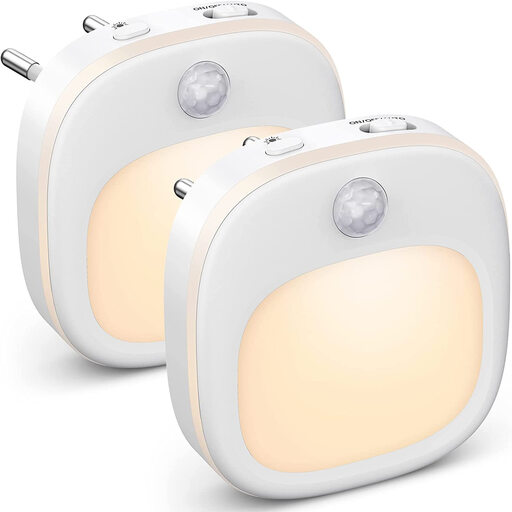
Why it suits this profile: A set of two lights is practical for areas such as the hallway and bedroom. The three colour temperatures and five dimming levels offer more adjustment options than a basic plug-in light.
The product title explicitly mentions motion detection. This makes it clearer that it is not a light with only a day/night sensor.
2-pack; three colour temperatures; five dimming levels; SMD LED; suitable for bedrooms, baby’s rooms and hallways according to the product description.

Why it suits this profile: This solar outdoor light is designed for anyone looking for a permanent outdoor light without a mains connection for an entrance, garden or driveway.
The IP44 rating makes it clear that the light is splashproof, but not designed for immersion. Installation where it is exposed to direct water is still not recommended.
1000 lumens; 3000 K warm white light; motion sensor; dusk sensor; two light settings; solar-powered operation according to the product information.

Why it suits this profile: The 40 cm length and 61 LEDs are designed for wider cupboards, shelves and work areas in the kitchen or bedroom.
The product specifications list the sensor range, battery capacity and dimensions separately. This allows you to check whether the light is suitable for your space.
61 LEDs; PIR detection from 3–5 metres; three colour temperatures; USB rechargeable; 1100mAh battery; 2-pack.
We have put together a complete, up-to-date list of products that fully meet these strict selection criteria and the applicable European safety regulations.
That depends on the type of sensor. A light sensor detects when it gets dark. A PIR motion sensor responds to movement within the specified range. Some models combine both functions, so the light switches on only when movement is detected and it is dark.
The lifespan varies by product and frequency of use. According to the product information, the integrated LED in some models may be rated to last up to 25,000 hours, for example. With rechargeable models, the battery capacity is also important. A battery loses charging capacity over time. Therefore, check whether the battery is replaceable; with several compact models, the light source or battery is not designed to be opened or replaced by the user.
A sensor light generally uses energy only when it is switched on, but total consumption depends on its power rating, how long it remains on and how often it is activated. A 0.5- or 1-watt light used for short periods consumes a different amount of energy from an outdoor light rated at several watts. With a solar outdoor light, the energy comes from sunlight, but operation still depends on sufficient charging and a well-maintained solar panel.
Ultimately, choose based on the space, desired brightness, type of sensor, power supply and IP rating. This will help you avoid buying a light that works technically but does not suit your everyday needs.
