
Vandaag of morgen in huis

Kwaliteit gegarandeerd

Welkomstaanbiedingen ontgrendelen: GRATIS bezorging | Tot 80% korting | Gratis 30 dagen JoyPlus-proefperiode
Download de app
An LED sensor light can automatically illuminate a dark wardrobe, hallway or kitchen corner as soon as you move. Yet not every light is suitable for every spot. A plug-in model works differently from a wireless cupboard light, and a motion sensor responds differently to one that only detects day and night.
Pay particular attention to these common pitfalls:
An LED light with a PIR sensor responds to movement within a certain range. With different models in this range, that range is around 3 to 5 metres. Also check whether the sensor only works in the dark. Some lights specify a threshold of up to 20 lux: the light then only switches on when the room is dark enough.
For a wardrobe, a short range is usually sufficient. In a hallway or near stairs, you need to consider placement so the sensor picks up movement in good time. A sensor light for a bedroom or nursery should ideally not switch on unnecessarily brightly with every small movement.
Brightness is expressed in lumens (lm). As a practical guide:
Colour temperature is given in kelvin (K). Warm white at around 2800–3200K suits a night light for a nursery or bedroom. Neutral white around 4000–5000K is practical in a hallway or kitchen. Cool white at around 6500–7000K provides a clearer, more functional light for cupboards or task lighting.
A dimming function is useful when one light is used for multiple situations. Check whether the product offers stepless dimming or just a few fixed settings.
A USB-rechargeable light is flexible to place, but the run time depends on the battery capacity and the chosen light setting. A built-in 500 mAh battery is compact; 1100 mAh offers more capacity according to the product specification, but the actual run time varies by setting.
Also consider the mounting method:
For a sensor light in the kitchen, bathroom or outdoor area, the IP rating is important. IP44 means protection against splashing water, not against immersion or powerful water jets. Therefore, only use a light outdoors when the product description states this, and place it in a sheltered position.
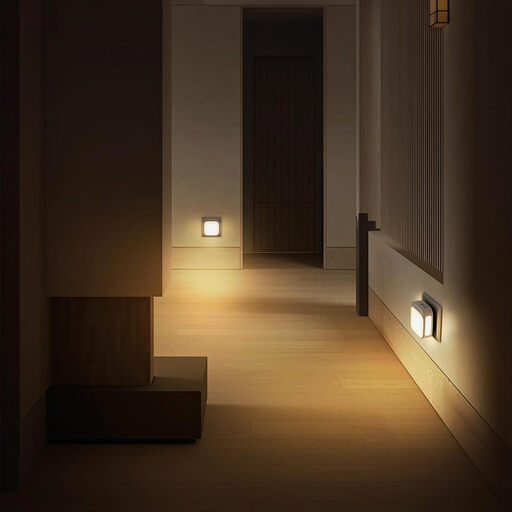
Why this fits the profile: This plug-in model is designed for hallways, nurseries and other fixed locations where you don’t want to charge a battery.
No loose batteries or charging cable needed. The automatic light sensor is ideal for a fixed orientation light.
2-pack, 0.3 W power, warm white light at 2800–3000K and dimmable from 10% to 100% according to the product specification.
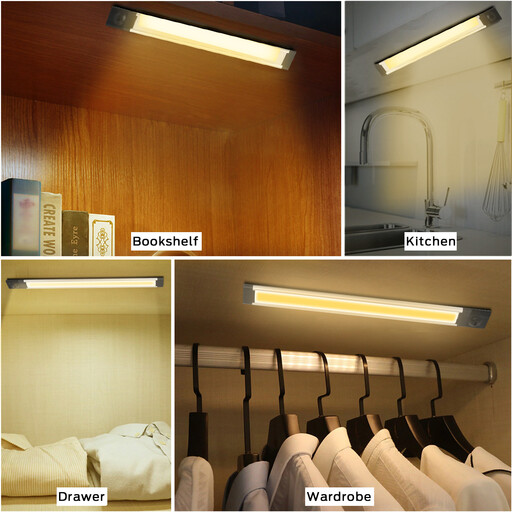
Why this fits the profile: The combination of magnetic mounting, USB charging and adjustable light suits anyone who wants to use one light flexibly across multiple rooms.
The product specification states 400 lumens and a colour temperature of 2800–6500K, making the range clearer than with a small orientation light.
36 SMD LEDs, 400 lumens, gesture control with dimming function and mounting via magnet or hanging hook.

Why this fits the profile: The 40 cm length and slim design are aimed at kitchen cupboards, wardrobes and shelves with limited space.
The PIR sensor, adhesive mounting without drilling and 2-pack make it possible to illuminate multiple dark zones precisely.
61 LEDs, detection range of 3–5 metres, 1100 mAh battery and three colour temperatures from warm to cool white.
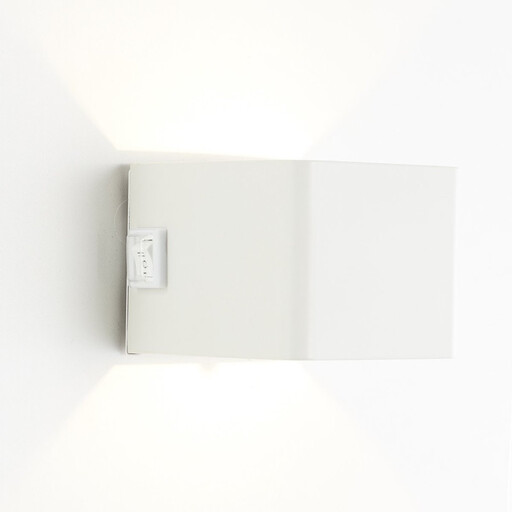
Why this fits the profile: This wireless LED wall light is designed for places such as a balcony, patio, garden or entrance where there is no fixed wiring.
The IP44 rating makes splash-water resistance concrete. The light is not suitable for immersion or powerful water jets.
300 lumens, 3000K warm white light, motion sensor, magnetic attachment and a rechargeable battery via USB.
We’ve put together a full, up-to-date list of products that fully meet these strict selection criteria and current European safety regulations.
Position the light so the sensor faces the opening or direction of movement. Clean the surface before using an adhesive strip. After installation, check that the cupboard door, shelf or clothing does not block the sensor. With a magnetic model, the fixing must be strong enough to support the weight.
The run time depends on the battery capacity, brightness, sensor settings and the number of activations. A model with 500 mAh, for example, states up to 10 hours of use in sensor mode according to the product specification. This is not a fixed run time for every usage scenario. With a mains-powered light or one with a light sensor, charging is not a factor.
Look at the stated power in watts and the number of hours it’s on. A 0.3 W light uses less electricity when left on for long periods than a 4 W model. A motion sensor can limit the number of hours the light is on, but the result depends on placement and how often the light is triggered. Also check whether the model runs on USB, batteries or mains power.
