Which setup is right for you?

Watercolour artist documenting their work

If you take portfolio or sales photos, you’ll want light washes of paint and the colour of the paper to come across accurately. Saatchi Art points out that ambient colour, colour temperature and flash can all affect colour balance.

Artist working on larger paper studies

For a larger piece, even lighting and enough room to position lights on either side are important considerations. Associated Artists of Pittsburgh describes a two-light setup at around 45 degrees for two-dimensional artwork.

Artist with a small workspace

If space is limited or you also take photos on the go, you’ll need to weigh a compact size against coverage of the entire sheet. Also check which power supply and mounting options are suitable for the version you choose.

What should you look for in LED panels?

Two similar panels

Choose this if: you want to light a larger piece from edge to edge and have room to position lights on either side.

Keep in mind: you’ll need extra space and mounting points; match the brightness and white-light settings of both lights.

One larger bi-colour panel

Choose this if: you want one independently adjustable panel for smaller studies or a limited workspace.

Keep in mind: one panel won’t necessarily light a larger sheet evenly; check the corners and see whether you need extra diffusion or a second light.

Compact rechargeable camera light

Choose this if: portability is your priority and you mainly photograph small studies or details.

Keep in mind: its compact size doesn’t prove that it will light a larger sheet evenly; check with a test shot.

What to consider What should you check? Who is this important for?
Colour rendering Check the CRI rating for the exact model and take a reference shot with the white balance set to match the lighting you’re using. I want the paint colours and paper white to come across accurately in my portfolio or sales photos. Around 31% of consumers put realistic colours at the top of their list.
Coverage of the sheet Compare the panel size and light output at the stated measuring distance; assess a shot of the entire sheet, including the corners. For a larger piece, I want to check that the light is even from edge to edge. Around 25% of consumers focus on coverage of the whole sheet.
Reflections and shadows Try positioning lights on either side at around 45 degrees and check the shot for reflections; if necessary, test diffusion again while ensuring there’s still enough light. If glare or harsh shadows could hide details in my watercolour, I want to be able to adjust the angle of the light. Around 19% of consumers focus primarily on reflections and shadows.
Space and power For the exact version, check whether mains power, a battery and the necessary mounts are included. For a small or mobile workspace, I want to know which lights and mounts will be practical for me to use. Around 13% of consumers give most consideration to portability and power.
Complete kit Check how many panels are included and whether stands, a power adapter, batteries and diffusion are supplied with that version. I want to know in advance what I’ll need to use the setup properly, not just what comes with the light itself. Around 12% of consumers focus mainly on the cost of a complete, usable kit.

Pitfalls to avoid

  • Assuming a high CRI rating guarantees colour-accurate photos

    CRI is a model specification, but how colours appear also depends on the surroundings, white balance and photo processing.

    Use CRI as one factor in your choice, then compare a test shot taken under your chosen lighting with the watercolour itself.

  • Choosing a small camera light without testing the whole sheet

    A compact size doesn’t tell you whether the light will reach the edges and corners of a larger piece.

    First, take a test shot at the size you want to photograph and compare the centre with the corners. For a larger piece, consider positioning lights on either side.

  • Comparing a single light with a complete kit

    The stands, power supply or batteries you need vary by version and aren’t necessarily included.

    Compare the contents of the box for the exact version and check that you can set up your chosen arrangement with the parts supplied.

Brands to consider

Godox

The Litemons LP series includes bi-colour and RGB panels; the manufacturer also lists kits with two or three lights.

  • According to Godox, the LP400 and LP600 versions can run on mains power and optionally on NP-F batteries. The manufacturer lists 2800–6500 K for Bi versions and 1800–10000 K for R versions.
  • These are specifications for individual versions, not measured results for watercolour photography. Check whether batteries are included with the version you choose.

amaran

The P60x is a bi-colour panel for anyone looking for one independently adjustable panel or wanting to position two similar panels.

  • Aputure lists a colour temperature range of 3200–6500 K, CRI ≥95 and an average of 5070 lux at 1 m at 5600 K for the P60x.
  • These are manufacturer figures, not measurements of watercolour photos. A battery connection doesn’t mean batteries are included in the kit; also assess how much of the paper the panel covers.

NEEWER

The RGB660 PRO II combines adjustable white light with RGB functions, making it worth considering if you also want to use the panel for other purposes.

  • NEEWER lists 3200–5600 K, CRI 97+ and a supplied mains adapter for this model.
  • According to the European product page, NP-F batteries and a light stand aren’t included. RGB effects aren’t essential for a neutral watercolour photo.

Ulanzi

The VL49 RGB is a compact rechargeable light for small artworks, detail shots or a mobile workspace.

  • Ulanzi lists a colour temperature range of 2500–9000 K and up to 800 lux at 0.5 m for the VL49 RGB.
  • Because of the measuring distance and compact size, it isn’t suitable for direct comparison with larger panels or measurements taken at 1 m. Even lighting across a full sheet has not been demonstrated. This model is not the same as the VL49 without RGB or the VL49 Pro.

Joybuy products

This product selection features a compact rechargeable camera light for small watercolour studies and detail shots.
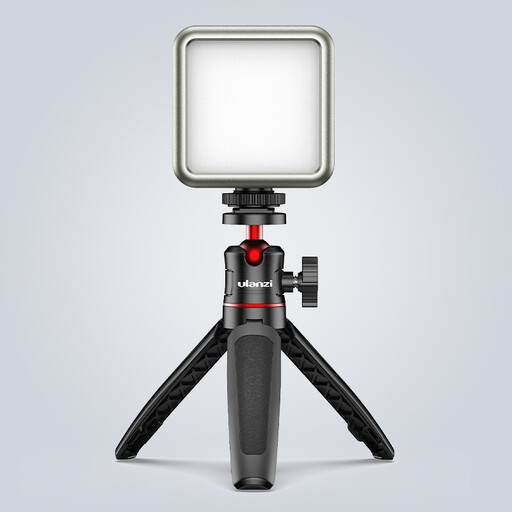
ULANZI VL49 RGB camera light with built-in battery

ULANZI VL49 RGB with 2000 mAh battery

This compact light is suitable for small studies or detail shots; take a test shot to check whether the whole piece is lit evenly.

The product information lists a built-in 2000 mAh battery, dimming, 2500–9500 K and a magnet on the back. Use only a standard 5 V adapter for charging.

View at Joybuy

Frequently asked questions

Is one light enough for my watercolour?

It depends on the size and how the light falls across the paper. For flat, two-dimensional work, Associated Artists of Pittsburgh describes using two lights at around 45 degrees; take a test shot to check that the corners are well lit too.

How can I reduce colour casts under artificial light?

Keep the lighting consistent while taking the photo and set the white balance to match. Then compare the photo with the artwork; Saatchi Art warns that factors including the colour of the room and the colour temperature of the light can affect colour balance.

Which adapter should I use for the ULANZI VL49 RGB?

Use only a standard 5 V adapter to charge this model. For other lights, follow the charging instructions for the specific version.

What are my rights when shopping online in the Netherlands?

When you buy online from a business, you generally have 14 days to change your mind, although exceptions and the circumstances of the purchase still matter. The Dutch government also states that there is no fixed statutory two-year guarantee period; if something is faulty, contact the seller.

Does an electric LED panel need to meet safety requirements?

Electrical appliances placed on the market in the Netherlands must meet the relevant European safety requirements. The Dutch government’s Ondernemersplein outlines obligations including CE marking and an EU declaration of conformity. A listing on a webshop does not, by itself, prove that a specific item meets these requirements.
