For a larger watercolour, or if you want to light the whole sheet evenly, a larger, adjustable panel is the more obvious choice. For a small study, a compact panel may be more practical, as long as you check its coverage. Test the light distribution on the artwork itself and keep the colour of the light consistent by setting an appropriate white balance. Direct the light at the watercolour and check that the dark background stays dark; also check which power supply and accessories come with the exact version.
Who is this lighting suitable for?
Watercolour artist looking to capture colours accurately
If you want to show colours and paper as consistently as possible, it helps to consider both the colour of the light and the white balance. ERCO explains that colour rendering depends on the spectral composition of the light, not just its colour temperature. Canon Europe explains how to set the white balance in challenging lighting conditions.
Artist working on a larger sheet
If you want the edges of a larger sheet to be clearly visible too, consider the panel dimensions, positioning and light coverage. Check the centre and corners with a test shot before deciding whether one light source is enough.
Artist with a small table
If you photograph small studies and have limited space to set up, a compact panel may be worth considering. Check whether you can position it close enough to the artwork and put it away after use without making the lighting uneven.
What should you look for when choosing?
First, consider the size of your watercolour and the space available. Then choose a panel and set-up whose coverage and effect on the background you can assess with a test photo.
| What matters |
What to look for |
Who it’s for |
| Colour consistency |
Check the CRI rating for the exact model, whether the colour of the light can be adjusted, and whether you can adjust your camera’s white balance. |
If I want to capture the colours of my watercolour as accurately as possible, I consider both the light and the camera settings. Around 31% of consumers prioritise colour consistency. |
| Coverage of the sheet |
Compare panel dimensions and mounting options; use a test shot to check the centre and corners of your artwork. |
When I’m working with a larger sheet, I want to make sure the edges get enough light, not just the centre. Around 31% of consumers prioritise full-sheet coverage. |
| Dark background |
Check whether you can adjust the direction of the light and whether the model comes with barn doors or a diffuser; assess the background and sheet together. |
When I photograph a watercolour against a dark background, I want to keep the light on the artwork and limit unwanted light on the background. Around 23% of consumers prioritise this. |
| Suitable set-up |
Check the exact version, power supply, battery, diffuser, stand and mounting options before choosing your set-up. |
If space is limited, I want to know whether the light will fit and what I’ll need to set it up. Around 15% of consumers prioritise ease of placement and a suitable, complete set-up. |
Common selection mistakes
-
Comparing lux figures without checking the measurement distance
A figure measured at 0.5 metres cannot be compared directly with one measured at 1 metre. On its own, this comparison won’t tell you how evenly your watercolour will be lit.
Only compare figures measured at the same distance and under the same conditions. Test the coverage at the size and distance you plan to use.
-
Assuming a stand or battery is always included
What’s included in the box can vary by version. NEEWER only lists a stand for the NL660 version labelled ‘with Stand’. Compatible NP-F batteries are not included with the NL660 versions described. The Godox LEDP260C manual says NP-F970 batteries are required separately for battery operation.
Check what’s included and how the exact version is powered before adding it to your tabletop set-up.
-
Choosing a small light based only on its CRI rating
A colour-rendering rating doesn’t tell you whether the whole sheet will be lit evenly. For a larger artwork, the panel size, distance and positioning can also affect coverage.
First, work out the size of your artwork. Then use a test photo to check both the colour and the lighting at the edges of the sheet.
Relevant brands to consider
Godox
The Godox LEDP260C is a bi-colour panel designed for a fixed set-up. The manual lists a colour temperature range of 3300–5600 K, adjustable brightness and dimensions of 360 × 240 × 27 mm.
- According to the Godox manual, the LEDP260C can run on mains power.
- NP-F970 batteries are required separately for battery operation. The stated light output is measured at 0.5 m, so it cannot be compared directly with figures measured at 1 m.
NEEWER
The manufacturer describes the NL660 Bi-Color as a panel with removable barn doors and a diffuser included.
- NEEWER lists a colour temperature range of 3200–5600 K, dimming and CRI ≥96 for this model.
- According to the manufacturer, a stand is only included with the ‘NL660 with Stand’ version. The listed NP-F batteries are not included. The CRI figure is a product specification, not an independent colour measurement.
amaran
The P60c is an RGBWW panel with adjustable white and coloured light. For photographing a watercolour, its adjustable white light is the relevant starting point.
- amaran lists an adjustable range of 2500–7500 K and a beam angle of 45° for the P60c.
- If you’re working with a larger sheet, check whether the focused beam covers the whole artwork sufficiently. The stated figures are manufacturer specifications, not the result of independent testing.
SmallRig
The P96 is a compact mini light for small studies or as an additional light when set-up space is limited.
- SmallRig lists dimensions of 72 × 89 × 31,6 mm and 150 lux at 1 m for the P96.
- These figures don’t guarantee that the light will illuminate a larger sheet evenly as the sole light source. Check the coverage in your own set-up.
Ulanzi
Ulanzi lists the VL120 RGB and the VIJIM VL120 Bi-Color as separate light models.
- The difference between RGB and Bi-Color helps you choose the version that suits the type of light you need.
- Check the full model name and product specifications for the version you’re considering.
Joybuy product selection
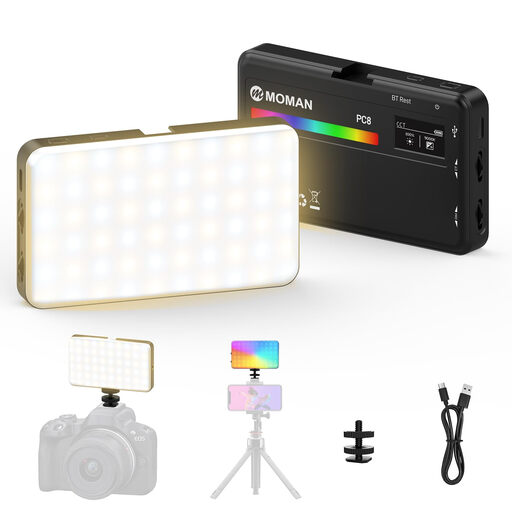
This Joybuy selection focuses on portable LED camera lights for a compact photography set-up.
 No image available
MOMAN PC8 RGB camera light
A portable LED camera light to consider if you’re looking for lighting for a moveable photography set-up. Take a test shot to check that the watercolour sheet is fully lit and the background stays dark.
Joybuy
Frequently asked questions
How do I start lighting my watercolour?
Start with an adjustable light source beside your artwork and take a test photo. Check the centre, corners and dark background. If one light source illuminates the sheet unevenly, try lighting it from two sides and assess the result again.
Will a high CRI rating automatically fix a colour cast?
No. A CRI rating won’t correct your camera’s white balance. ERCO explains that colour rendering depends on the spectral composition of the light. You should also set the white balance to suit the lighting you’re using, as Canon Europe recommends for challenging lighting conditions.
What should I check about the power supply and accessories?
Check the manual and box contents for the exact model. Godox states that NP-F970 batteries are required separately to run the LEDP260C on battery power. Don’t assume another panel uses the same power supply or includes the same accessories.
What can I do if a panel I bought online arrives faulty or incomplete?
According to the Government of the Netherlands, the seller must provide a solution if there’s a problem with a product. In many cases, distance purchases also come with a 14-day cooling-off period, although there are exceptions. Check the terms that apply to your purchase.
What safety information is relevant to electrical panels?
The Dutch Government states that businesses placing electrical appliances on the market or trading them must ensure that the applicable European rules are followed. Check the product information and documentation for the specific panel.


