What should you look for when choosing?
First decide how soft and controlled you want the reflection to be. Then check that you have enough room for the panel, its mount and its power supply.
With shiny resin, both the angle and the shape of the light source matter. Nikon describes jewellery as small and shiny, while Adobe explains how diffusion softens hard light. The result also depends on how you position the light in relation to the pendant and camera.
| What to consider |
What should you check? |
Who is this important for? |
| Reflections and diffusion |
Check whether a diffuser or softbox is included and whether you can angle the panel. |
If I want to soften harsh reflections on polished pendants, I focus above all on the shape and position of the light. Around 36% of consumers put controlling reflections first. |
| Dark background |
Check whether you can direct the light from the side and limit spill, for example with a grid if one is included with that version. |
If you want the pendant to stand out without lighting up a wide area of the background, choose directional lighting. Around 29% of consumers say this is their main concern. |
| Resin colour |
Compare the stated colour temperature and colour rendering of the exact version, and keep your lighting and white balance settings consistent throughout a series. |
If I photograph coloured or transparent pendants, I want to keep the lighting settings the same for every shot. Around 21% of consumers put colour consistency first. |
| Space and power |
Check the dimensions, mount, adapter and stand, and whether a battery is included. |
If you work on a small table, the light and all the required parts need to fit your setup. Around 14% of consumers give space, power and what’s included in the box top priority. |
Joybuy product selection
This Joybuy selection focuses on compact, portable lighting for product photography. Check that the light source and mount suit your pendant and setup.
 No image available
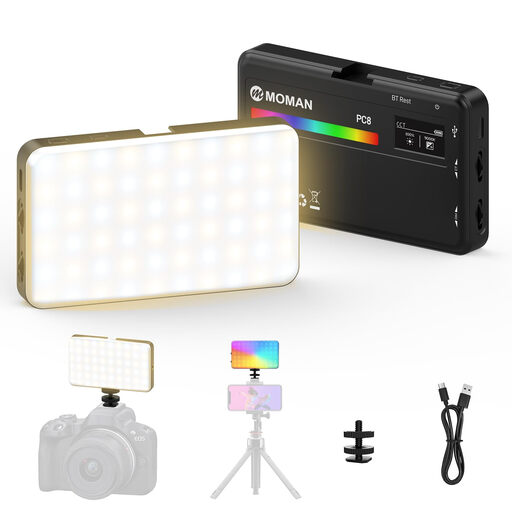
MOMAN PC8 RGB Camera Light
A portable RGB video light for product photography. See whether its light source gives you the reflection you want on your pendant.
The stated wireless runtime is up to 80 minutes at full power.
View at Joybuy
Frequently asked questions
Should I light the dark background too?
Not if you want it to look dark. Start by directing the light at the pendant, then check a test shot to see where reflections and spill fall. A grid can help limit the spread of light when used with a suitable softbox setup. This won’t guarantee the same result for every pendant.
Do you need a mains socket, battery or stand for an LED panel?
It depends on the model and version. SmallRig lists a built-in battery for the P96; NEEWER specifies a mains adapter or an NP-F battery, which isn’t included, for the NL660, and offers versions with and without a stand. Check what comes with the version you choose.
How can you keep a series of photos of coloured pendants consistent?
Use the same lighting and white balance settings throughout the series, and check the colour with a test shot. The stated colour temperature and CRI help you compare panels, but they don’t measure how your resin will look in a photo.
What rights do you have when buying online in the Netherlands?
According to ACM ConsuWijzer, the cancellation period for an online consumer purchase generally ends 14 days after delivery; legal exceptions may apply. You’re also entitled to a product that meets the standards you can reasonably expect. Check whether consumer rules apply if you’re buying on behalf of a business.
Is CE marking required for an electric LED panel in the Netherlands?
Yes. The NVWA states that CE marking is mandatory for electrical consumer products. Check the information for the specific panel and power supply; this general rule doesn’t confirm that an individual item complies.


