Who is this buying guide for?

Maker of glossy pendants

You want to control distracting reflections without losing the pendant’s shine and transparency. Nikon recommends diffused light for jewellery photography; the Dutch-language photography advice from Bonjourfoto also explains how a light tent can reduce direct reflections.

Maker using a shared workbench

You need to be able to move and pack away your photography set-up after use. So consider the weight, power supply, mounting and what’s included with the version you choose.

Maker creating a product range

You want to photograph pendants in different colours under similar conditions. An adjustable white-light setting can help you repeat the same lighting set-up, but the position of the light and camera settings matter too.

What should you look for when buying?

What to consider What should you check? Who is this important for?
Reflections and diffusion Check whether there’s room for a diffuser or light tent, and whether you can direct the light from a different angle. Assess the result with a test shot. When I photograph glossy pendants, I want to control reflections without losing the shine. Around 33% of consumers prioritise reflection control.
Consistent colour Check the adjustable colour temperature of the exact model and test it using the same lighting and camera settings. When photographing a range of pendants, I want to be able to repeat my white-light setting. Around 27% of consumers prioritise consistent colour rendering.
Setting up and packing away Measure the available table and floor space, and check the weight, mounting and what’s included with the version you choose. If the table needs to be clear again after a photo session, I want a set-up that’s easy to move and store. Around 20% of consumers prioritise practicality.
Power and kit contents Check which battery, adapter, cable, diffuser and mounting are included with the exact version. If there isn’t always a power socket available by the table, I want to know in advance which power supply and parts I’ll need. Around 20% of consumers start by looking for a complete set-up that meets their needs.

Buying pitfalls

  • Choosing based only on CRI or the stated lux value

    Manufacturer specifications describe the properties of the light, but they don’t tell you where a reflection will appear on your pendant. The shape of the pendant, the position of the light and any diffusion also make a difference.

    First, work out how you can soften and position the light. Then compare the model specifications and take a test shot with your own set-up.

  • Assuming a battery-powered light comes with a battery

    NEEWER states that NP-F batteries are not included with the NL660. According to Aputure, the D-tap-to-DC cable needed for the amaran P60x’s stated external battery power supply must be purchased separately.

    Check the packing list for the exact version and make sure the power supply is suitable for where you plan to use the light.

    If you don’t have suitable mounting, you may also need to arrange and store a stand or another suitable mount.

Brands to consider

SmallRig

The P96 is a compact panel for a small, portable table-top set-up.

  • SmallRig lists the P96 as weighing 103 g, with a built-in battery and a cold shoe mount.
  • According to SmallRig, the stated battery life of up to 100 minutes depends on use and the environment. A small panel won’t automatically prevent reflections on resin.

NEEWER

The NL660 is a larger bi-colour panel, available with or without a stand.

  • NEEWER lists a diffuser and mains adapter with the panel version; the relevant kit version includes a stand.
  • According to NEEWER, NP-F batteries are not included. The stated CRI and light output figures are manufacturer specifications, not independent measurements taken with pendants.

amaran

The P60x is an adjustable white-light panel with a fitting for a compatible softbox.

  • Aputure specifies an adjustable range of 3200–6500 K for the P60x, along with a softbox fitting.
  • According to Aputure, the D-tap-to-DC cable for the stated external battery power supply must be purchased separately. Check which parts are included with the version you choose.

Godox

The P260C Pro is a bi-colour panel with a larger light surface and various power options listed by the manufacturer.

  • Godox lists a range of 2800–6500 K for the P260C Pro, as well as DC, battery and USB-C power options and a built-in diffuser.
  • These manufacturer specifications don’t mean the panel will prevent reflections on resin without any further set-up. Don’t confuse the P260C Pro with the older LEDP260C; Godox lists different specifications for that model.

Joybuy products for a portable photography set-up

This selection includes a portable mini photo light and a portable COB video light for a moveable photography set-up; the COB light is not an LED panel.

Ulanzi LM001 portable mini photo light with built-in battery

Ulanzi LM001 portable mini photo light

Suitable for a small photography set-up that needs to be packed away after use.

The product name specifies a built-in 500 mAh battery and a magnetic LED photo light.

View at Joybuy
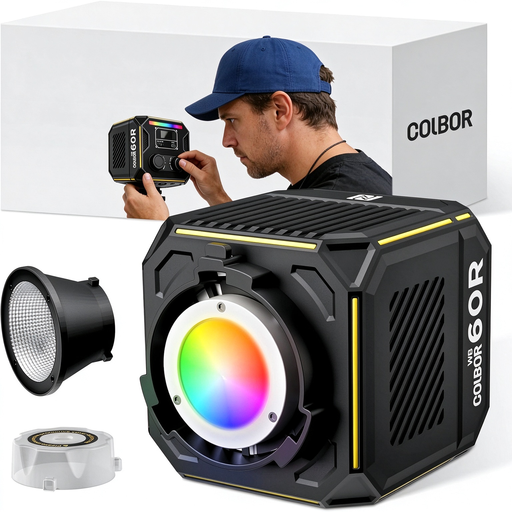
COLBOR 60W portable COB video light with built-in battery

COLBOR 60W portable COB video light

Could suit a portable set-up where you want to repeat the same white-light setting across a series of photos.

The product name specifies a built-in 59 Wh battery and adjustable light from 2700 K to 6500 K. This is a COB light, not a panel.

View at Joybuy

Frequently asked questions

Is a diffuser enough to remove all reflections from a pendant?

No. A diffuser or light tent softens the light, but it can’t guarantee that every reflection will disappear. Move the light and camera too, until the pendant’s shine is visible without distracting reflections.

What should I put away after use in a shared workshop?

Switch off the light and store the panel, power supply, cables, stand and diffuser according to the product instructions. Before buying, check how many separate parts come with the version you choose.

Who can help if an LED panel I bought as a consumer in the Netherlands is faulty?

According to the Dutch government, if a product is faulty, the seller—not the manufacturer—must provide a solution. The manufacturer’s warranty is in addition to your statutory rights; check the terms of any extra warranty separately.

Does an electric LED panel sold in the Netherlands need a CE mark?

A CE mark is required for electrical products covered by the relevant EU rules. The Netherlands Food and Consumer Product Safety Authority explains the product safety requirements for electrical products; check the markings and product details on the light and adapter. A CE mark is the manufacturer’s declaration, not proof that every individual product has been independently tested.
