
Dessert photographer with a small table
You photograph one plate at a time and want to position a light, diffuser and mount without making your setup feel cramped.


Choose an LED panel to suit the space around your plate and the width of your white backdrop. A compact panel may work well for a small setup, while larger plates call for more careful consideration of light coverage and positioning. Nikon USA describes soft, filtered light as suitable for food photography. Canon Europe explains that, without correction, a white surface can look yellow under tungsten light; Nikon USA notes that a white background can appear grey without direct light.
You photograph one plate at a time and want to position a light, diffuser and mount without making your setup feel cramped.
You photograph several desserts under similar lighting and want to reproduce colour settings and the exposure of white areas. Canon Europe explains how your chosen white balance affects the way a white surface appears.
You photograph icing or sauce, for example, and want to control the direction and softness of reflections without washing out the dessert’s texture.
First, choose a setup that suits the size of your plate and the space available. Then decide whether you need one main light or want to add fill lighting separately too.
A good fit when: you’re creating a small dessert setup and can position the light close to your subject.
The trade-off: a larger plate or wide backdrop calls for more careful attention to light coverage. RGB features are no substitute for adjustable white light.
A good fit when: you regularly photograph full plates and want to reproduce your lighting settings between shots.
The trade-off: you’ll need space for a stand, and should check that the power supply, mount and diffuser are included with your chosen version.
A good fit when: one main light gives the dessert shape, but you also want to add light to the shadow side or backdrop with precision.
The trade-off: a second light needs space and careful adjustment. A white card may be enough to fill in the shadows.
| Buying question | What to check before buying | Who is it for? |
|---|---|---|
| Soft light and visible shape | Check whether you can angle the panel and whether a diffuser is included with your chosen version. Try a white card to see if it fills in the shadows enough. | I want to soften harsh shadows while retaining the shape of icing or sauce. Around 30% of consumers prioritise soft light that preserves shape. |
| Consistent colours and a white background | Compare the stated colour temperature and colour rendering for the exact version. Take test shots using a fixed white balance and assess both the dessert and the background. | When I take menu photos under similar lighting, I want the dessert colours and background to stay consistent. Around 30% of consumers prioritise colour and white balance. |
| Light coverage and working space | Allow for the space needed for the panel and stand around your plate and backdrop. Check the dimensions, mounting options and included accessories. | I want to know whether the light will suit my plate without getting in the way of my tabletop setup. Around 20% of consumers prioritise positioning and coverage. |
| Power and what’s included | Check the exact version, adapter, battery compatibility, diffuser and stand. Compare light output only at the same measuring distance and under the same conditions. | If I want to start taking photos straight away, I want to know in advance what power supply and mounting equipment I’ll need. Around 20% of consumers prioritise a practical set of included accessories. |
A stated CRI is no substitute for the right white balance or enough light on the background. Ambient light can also affect your shot.
Compare the colour specifications for the exact version and take test shots with fixed lighting settings and white balance. Assess the dessert and background separately.
RGB features alone don’t tell you whether the light will cover your plate and the entire white background.
Consider where you can position the panel around your plate, and check that a suitable mount and diffuser are available.
What’s included varies by version. The NEEWER NL660 version NL660 Only doesn’t list a stand, and compatible NP-F batteries aren’t included.
Check the packing list for the exact version you want to order.
If your chosen kit doesn’t include a stand or compatible batteries, you may need to source these separately.
Compare the specific version and what’s included. Features of one product range don’t necessarily apply to every model from the same brand.
The LDX and LP series offer examples of different panel types, including bi-colour and RGB models.
The NL660 is a larger, dimmable bi-colour panel, available as a standalone light or in a version with a stand.
The P60x is a bi-colour panel designed to be used as a focused main light.
The VL120 RGB is a compact camera-mounted version. Take care not to confuse it with the separate VIJIM VL120 Bi-Color.
This selection at Joybuy focuses on a compact, rechargeable panel for a small or portable dessert setup.
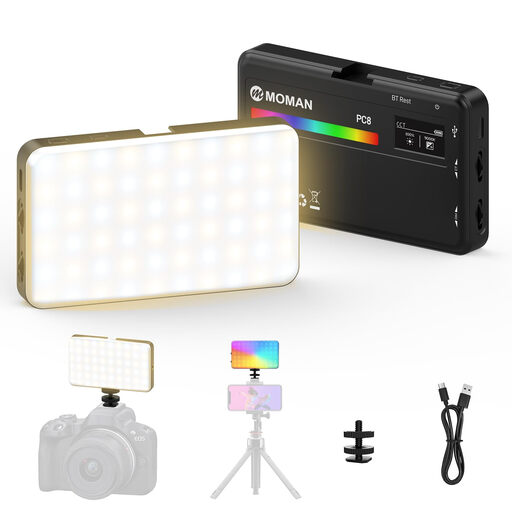 No image available
Suitable for a small or portable setup when you can position the panel close to the dessert. Assess coverage of your plate and background separately.
The product description lists adjustable colour temperature and brightness, a rechargeable battery, and cold-shoe and 1/4-inch mounts.
Try side lighting or position the light slightly behind the dessert, then soften it with a diffuser if needed. A white card opposite the light can fill in shadows. Check separately whether the background still looks white enough.
A yellow colour cast may mean the white balance isn’t suited to the available light. A white surface can look grey if it isn’t lit enough. Canon Europe describes the effect of tungsten light on white, while Nikon USA highlights the role of lighting on the background. Keep your settings the same between test shots and check both white balance and background exposure.
It depends on the model and version. For the NEEWER NL660, NL660 Only doesn’t list a stand among the included items, and compatible NP-F batteries aren’t included. So check the packing list for the exact version you’re ordering.
According to ACM ConsuWijzer, online consumer purchases generally come with a statutory cooling-off period of up to 14 days after delivery, subject to legal exceptions. The seller must also resolve any issue free of charge if, under normal use, a product doesn’t meet what you could reasonably expect from it. A manufacturer’s guarantee doesn’t replace these statutory rights.
No. Business.gov.nl explains that CE marking isn’t a quality mark. The relevant product rules and an EU Declaration of Conformity matter for electrical equipment. Check the information for the exact version and power supply.