
Creators photographing glossy covers
If you want to keep titles, illustrations and signs of wear visible, you can move and soften the light to reduce harsh highlights. Adobe explains how diffused light affects harsh highlights and shadows.


For photographing second-hand books, a panel that you can position at an angle beside the camera and soften is a practical starting point; simply increasing the brightness won’t move a reflection on a glossy cover. Adobe explains how diffused light softens harsh highlights, while the angle of the light remains key to controlling reflections on your book. A compact panel may suit a single book on a small table; for full-sized or open books, you’ll also need to consider light spread and the space available. For a consistent portfolio, keep your lighting setup and white balance consistent too. Nikon explains how to use a grey card to set white balance under mixed lighting.
If you want to keep titles, illustrations and signs of wear visible, you can move and soften the light to reduce harsh highlights. Adobe explains how diffused light affects harsh highlights and shadows.
If you photograph books on different days, a repeatable lighting setup and carefully set white balance can help. Nikon describes using a grey card to set white balance under mixed lighting.
If you photograph both small books and full-sized or open books, you’ll need to balance light spread, positioning and the workspace available. NEEWER’s product information and Nanlite’s manual describe different panel and light-modifier setups.
Start with your largest cover and the space available to position the panel beside the camera. Then decide whether reflections, consistent colours, light coverage or power is your main priority.
| Consideration | What should you check? | Who should prioritise this? |
|---|---|---|
| Reflections and legible details | Check whether you can position the panel at an angle beside the camera and whether a suitable diffuser is available. Adobe explains that diffused light softens harsh highlights. | For a glossy cover, I want to keep the title and signs of wear visible without a bright reflection across them; around 34% of consumers prioritise reflections and legible details. |
| Consistent cover colours | Check the adjustable white-light range of the specific version and set the white balance to suit the lighting you’re using. Nikon describes using a grey card under mixed lighting. | When I photograph books on different days, I want to be able to compare cover colours using the same lighting and white balance settings; around 27% of consumers prioritise colour consistency. |
| Book coverage | Measure your largest book and the available space beside the table; assess the light distribution in a test shot. Compare stated lux values only when they’re measured at the same distance. | When I photograph full-sized or open books too, I want to light the whole surface without the lamp taking up my workspace; around 20% of consumers prioritise coverage for larger books. |
| Workspace and power | Check whether the exact version includes a stand, adapter and battery. Also decide where the panel and any cables can be positioned safely. | At a small table, I want to position the panel safely and know whether I’ll need a mains socket; around 19% of consumers prioritise setup space and power. |
A higher light output won’t automatically move a reflection on a glossy cover. Manufacturers may also state values measured at different distances and settings.
Only compare values measured at the same distance and settings. Above all, assess the direction, spread and diffusion of the light with a test shot of your cover.
What’s included in the package can vary by version. A stand and NP-F batteries aren’t included with every version of the NEEWER NL660; the manufacturer lists a mains adapter.
Before buying, check what’s included and what power supply the exact version requires.
Depending on the version, you may need to buy a stand or NP-F battery separately.
A stated CRI value won’t set your camera’s white balance. Mixed lighting can affect colour rendition between shots.
For a series of photos, use the same lighting setup and take a white balance reference under the lighting you’ll be using.
The NL-116AI is a compact battery-powered panel for a small setup; the NL660 is a larger panel with a diffuser and a choice of mains adapter or separate NP-F battery.
The VL49 RGB is a small, rechargeable panel for detail lighting and portable setups.
The PavoSlim 60B is designed for setups where you want to shape the light using the included modifiers.
The P96 is a small battery-powered panel for portable detail or fill lighting.
The P60x is a bi-colour panel for setups where you want control over light direction and power.
These Joybuy products are suitable for small or portable photography setups. With the COB light, check whether you’re happy to choose a different form of light from the panel you’re looking for.
 No image available
The magnetic base and 1/4-inch thread give you options for positioning it for small-table or detail shots.
The product title lists a 500 mAh battery.
 No image available
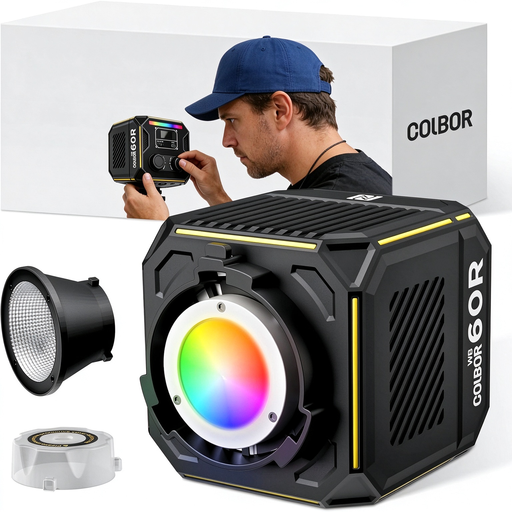
According to the product information, this is a COB light, not an LED panel, so it isn’t a direct replacement for the panel you’re looking for.
The product specifications list RGBCW light, 2700–6500 K, CRI 96+ and a built-in 59 Wh battery.
Position the panel beside the camera and adjust the angle until the reflection doesn’t fall across the title or signs of wear. If needed, soften the light with a diffuser and assess the result with a test shot of your book.
Yes. If you want to show cover colours consistently, set your camera’s white balance to match the light you’re using. Nikon explains that automatic white balance under mixed lighting can produce different colours from a grey card reading.
No. NEEWER lists a mains adapter as included with the NL660, but not an NP-F battery. A stand is only included with the relevant version that comes with one. Check the contents of the package you’ve chosen before buying.
No. Information from the Dutch government describes CE marking as a declaration that applicable EU product rules have been met, not as a quality mark or proof of photographic performance. The rules that apply to a specific panel and its power supply need to be assessed for each product.
According to the Dutch government, the seller must provide a solution if a product is faulty; there’s no fixed statutory guarantee period in the Netherlands. For many online purchases made by consumers from a business, a 14-day cancellation period applies. Check the relevant exceptions and terms of sale.