
Filming glossy timepieces
You film watch faces, glass or metal parts and want to be able to move the light or soften it when reflections appear in shot. Nikon USA describes diffusion as a way to soften light when filming small, glossy subjects.


Start with a light you can move around from your camera position and soften as needed. With a glossy watch face or case, the angle of the light can matter more than its stated brightness. A compact panel takes up less space on a small workbench; a larger panel may give you more room to shape the light, but it also needs more space and a suitable mount.
You film watch faces, glass or metal parts and want to be able to move the light or soften it when reflections appear in shot. Nikon USA describes diffusion as a way to soften light when filming small, glossy subjects.
You have limited room for a panel and stand, and need a size, mount and power supply that suit your home office. Product information from Neewer and SmallRig shows that panel dimensions and included accessories vary by model or version.
You record longer clips and want to check the power supply, any fan noise and flicker with your own camera set-up beforehand. Godox describes one fanless model; Sony USA recommends watching out for flicker or banding from LED lights when filming video.
First, choose a position and a way to soften the light that let you assess reflections from your final camera position. Then check that the panel, mount and power supply suit your workspace and recording time.
| What to consider | What to check before buying | Who is this important for? |
|---|---|---|
| Reflections and harsh shadows | Check whether diffusion is included and whether you can position the panel out of shot at different angles. | When I film glass and metal, I want to be able to move or soften distracting reflections. Around 31% of consumers prioritise controlling reflections above all else. |
| Colour and adjustability | Check the colour temperature range for the exact version and set the white balance for your final recording. | When I film details under changing ambient light, I want to be able to adjust the colour temperature. Around 25% of consumers put colour rendition and adjustability first. |
| Space and mounting | Measure the available space and check the panel dimensions, mounting options and included holder. | With a small workbench, I want to position the panel and mount without getting in the way of the camera or my hands. Around 19% of consumers make available workspace their top buying priority. |
| Continuous video recording | Record a test clip with your camera settings and check which power supply suits your planned recording time. | When I record longer repair videos, I want to check for flicker and any fan noise with my own set-up. Around 13% of consumers prioritise reliable continuous recording. |
| What's included and accessories | Check the exact version and see whether a power supply, diffuser, tripod or mount is included. | When I still need to put my lighting set-up together, I want to know which essential parts are in the box. Around 12% of consumers make a complete set of included accessories their top buying priority. |
Stated illuminance may have been measured at different distances. With glossy parts, the angle of the light can also affect reflections.
Only compare lux ratings when the measurement distance is the same, and assess the diffusion and a test recording of the watch. For example, SmallRig gives a figure measured at 0.3 m; this is not directly comparable with a figure measured at 1 m.
The Neewer NL660 is available in versions with and without a tripod; the manufacturer says the NP-F batteries mentioned are not included.
Before buying, check what comes in the box for the exact version and make sure the power supply and mount suit your workspace.
Depending on the version you choose, you may need to buy a suitable mount or battery separately.
According to the product information, the Ulanzi VIJIM VL120 Bi-Color 2029 and the VL120RGB differ in colour functions and stated temperature range.
Compare the full model code and key specifications. The RGB listing for the VL120RGB is not a substitute for information about the bi-colour version.
The NL660 is a bi-colour panel with a diffuser, designed for a set-up where you want to be able to adjust the light.
The LDX50Bi is designed for a larger set-up, with a removable diffuser.
According to the manufacturer, the P60x combines a bi-colour panel with a softbox for a fixed set-up with room to shape the light.
The P200 4066 is a compact panel for a smaller workspace and a set-up using USB-C or a compatible NP-F power supply.
The VIJIM VL120 Bi-Color 2029 is a small, rechargeable light for a portable set-up.
This Joybuy selection is suited to compact video lighting in a smaller recording set-up.
 No image available
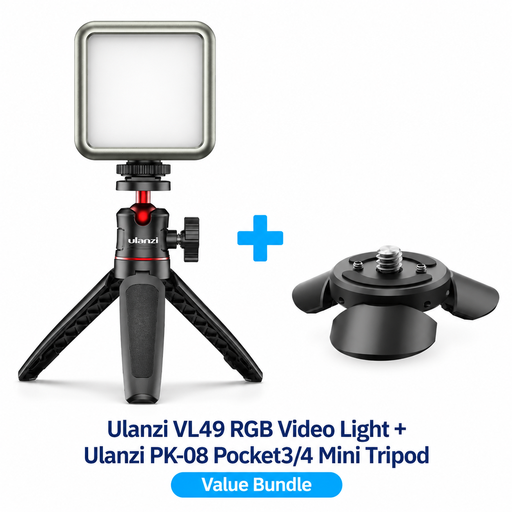
This bundle could be a good fit if you're looking for a mini tripod kit for DJI Osmo Pocket 3/4 as well as a light; check that the kit and light placement suit your recording set-up.
The product title lists an RGB LED video light and a PK-08 Mini Tripod Kit.
Position the light out of shot, soften it and check the glass and metal from your final camera position. Move the light or diffuser if you see a distracting reflection. Nikon USA describes this approach for small, glossy subjects; it is not a test of a specific LED panel.
Record a test clip using your own camera, shutter speed, dimmer setting and other lighting. Sony USA explains that LED lighting can cause flicker or banding during video; a product specification alone cannot confirm how your set-up will perform.
That depends on the exact version. Neewer offers the NL660 with and without a tripod and says the NP-F batteries mentioned are not included. So check what's in the box for the version you're considering.
For a standard online consumer purchase, you generally have a statutory 14-day cooling-off period after delivery, subject to legal exceptions; ACM ConsuWijzer explains this period. The seller is also responsible for offering an appropriate solution if a product does not meet what you could reasonably expect under normal use, as explained by the Netherlands Authority for Consumers and Markets.
Electrical equipment placed on the market in the Netherlands must comply with the relevant EU product safety rules, as explained by the Dutch Government's Ondernemersplein business portal. CE marking is only required when EU rules specify it for the product in question; where it applies, the marking is a declaration by the manufacturer, not proof of the light's performance. Check the details for the exact light and power supply you want to buy.