Start with the filming angle: choose a panel that can sit outside your work area, and position it so your hands and soldering iron tip are visible without creating distracting glare on metal. A small battery-powered panel saves space, but you’ll need to consider its light coverage and recording time. A larger panel may take up more room and need a suitable mount and power supply. Before buying, check the exact model, test your footage for flicker and ask for the relevant product documentation.
Who is this for?
Maker filming reflective soldering work
Mostly films the soldering iron tip, joints and hands, and wants to direct or soften the light without covering the work surface. NEEWER and amaran list a diffuser, softbox or light control for specific panel versions; check that the accessories are compatible with the version you’re considering.
Maker short on desk space
Has little room for a light or stand, and needs to weigh up the mounting method, size and cable routing against the lighting required. SmallRig describes the P96 as a compact panel with a cold shoe mount; a cold shoe is not automatically a desk clamp.
Maker recording longer tutorial videos
Wants to record a demonstration without interruptions to the power supply, so needs to check which power source is included with the version. Also test your own camera settings to see whether visible banding appears.
What should you look for when choosing?
First, decide how much space the light and its mount can take up. Then compare the lighting, power options and the results of a test recording of your actual soldering work.
The considerations below are for consumers filming a soldering demonstration at a small desk. Each row shows the main buying concern for that filming situation.
| Consideration |
What to look for when buying |
Who is this important for? |
| Seeing shiny solder joints clearly |
Make a test recording from your intended angle and check whether a diffuser, softbox or adjustable mount is included with the version. |
If I want to show solder joints clearly without distracting reflections, I’ll focus on the direction and softness of the light. Around 31% of consumers in this filming situation put this first. |
| Keeping desk space clear |
Measure the space for the panel and mount, and check that the mount will fit; a cold shoe is not automatically a desk clamp. |
When there’s little room beside the work surface, I want to position a light and mount without getting in the way of the camera or soldering iron. For around 25% of consumers, keeping the work area clear is the main buying concern. |
| Reliable power and recording |
Compare your planned recording time with the power source you’ve chosen, and check whether an adapter or battery is included with the exact version. Test for flicker using your own camera. |
If I want to record a longer demonstration, I want to know in advance how the light is powered and whether the video will look free from interference. Around 25% of consumers prioritise reliable recording when choosing. |
| Accurate component colours |
Check the stated colour temperature and colour rendering of the version, then film a test using the components and camera settings you’ll actually use. |
When recognisable component colours matter, I want to see how the circuit board looks in my own recording. This is the main buying concern for around 19% of consumers. |
Common buying mistakes
-
Choosing a small panel without testing the recording distance
The light output specified for the SmallRig P96 varies with distance; a figure measured at close range doesn’t necessarily tell you how much of your work surface will be visible in your setup.
Film the whole work surface from your intended camera and light positions before deciding whether one compact panel will be enough.
If the panel doesn’t cover the work surface well, you may need a different mount or a second light source.
-
Assuming a stand and battery are included as standard
With the NEEWER NL660, whether a stand is included depends on the package version, and the NP-F battery is not included. The Godox LEDP260C manual specifies two NP-F970 batteries, sold separately, for battery power.
Check the box contents and power requirements for the exact version on offer before you order.
You may need to buy a suitable battery or mount separately, depending on the version and setup you choose.
-
Assuming a CRI rating or ‘flicker-free’ label guarantees good results in your video
A colour rendering figure won’t predict how reflections will look on your circuit board. Sony Support explains that LED lighting and camera settings can cause visible banding.
Make a test recording with the actual circuit board, light brightness and shutter speed, then check the colours and look for any banding.
Brands to compare
SmallRig
SmallRig describes the P96 as a compact bi-colour panel for cold shoe mounting, designed for setups where space is limited.
- SmallRig lists dimensions of 72 × 89 × 31,6 mm, a built-in battery and 400 lux at 0,5 m.
- That light output figure doesn’t prove that one panel will light an entire desk evenly. The product page also uses different wording in different places for the maximum operating time.
NEEWER
The NL660 is a larger bi-colour panel for a fixed setup; whether a stand is available depends on the package version you choose.
- NEEWER says that a diffuser and mains adapter are included, and that the panel can be powered by an NP-F battery.
- The battery is not included, and a stand comes only with the ‘NL660 with Stand’. NEEWER also says this bi-colour version has a lower light output than the single-colour version.
Godox
According to the Godox manual, the LEDP260C is a bi-colour panel with adjustable brightness and power options via an adapter or separate batteries.
- The manual lists CRI >95 and TLCI ≥94.
- Battery power requires two NP-F970 batteries, sold separately. At intermediate colour temperatures, the minimum dimming level is 25%; at either end of the colour range, it’s 10%.
amaran
The P60x is a bi-colour panel supplied with a softbox and grid, for anyone who wants to control the direction and spread of the light.
- amaran lists CRI ≥95, TLCI ≥97 and 5.070+ lux at 1 m at 5.600 K.
- The lux figure is a manufacturer specification, not a measurement taken at a soldering desk. Check that the panel and softbox will fit outside your shot and work area.
LED lighting at Joybuy
This Joybuy selection features portable video lighting for a compact filming setup.
 No image available
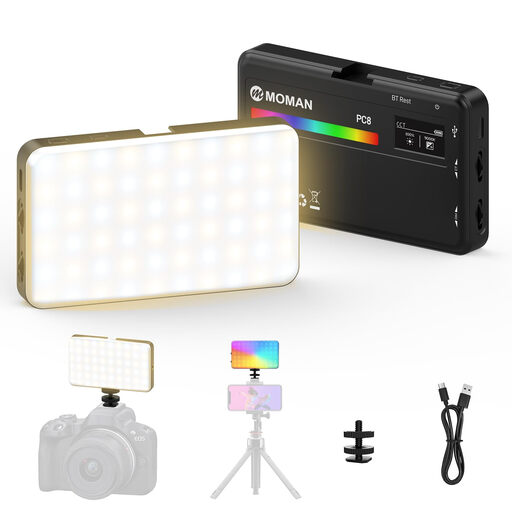
MOMAN PC8 RGB Camera Light
Portable LED video light for filming. Check that the mount will fit your desk setup, and test the light with your own camera and soldering work.
View at Joybuy
Frequently asked questions
How can I prevent lines or flicker in a soldering video?
Make a test recording using the light, brightness and camera settings you’ll actually use. Sony Support explains that LED lighting can cause banding and that changing the shutter speed may reduce this effect; the right setting depends on the combination of camera and light source. The shutter speeds of 1/50 or 1/100 second mentioned by Sony apply to regions using 50 Hz, and don’t guarantee the same results in every setup.
Can I attach a panel with a cold shoe directly to the edge of my desk?
No, not with a cold shoe connection alone. SmallRig says the P96 can be mounted on a camera, cage or compatible cold shoe fitting; check separately which desk mount your setup requires.
Do I need a battery or stand as well as the light?
It depends on the exact version. NEEWER says that the NL660 comes with a mains adapter but no NP-F battery; only the ‘NL660 with Stand’ version includes a stand. For battery power, the Godox LEDP260C manual specifies two NP-F970 batteries, sold separately.
What should I do about soldering fumes while filming?
A video light is no substitute for measures to control soldering fumes. For rosin-based flux, the UK Health and Safety Executive recommends measures including fume extraction and keeping your head out of the plume. This is safety advice about soldering, not a statement about a Dutch legal exposure limit.
Which product and warranty rules are relevant when buying in the Netherlands?
Electrical appliances placed on the market in the Netherlands must meet the applicable European product requirements; Ondernemersplein lists the required CE marking and EU declaration of conformity. For purchases made online from a professional seller, consumers generally have 14 days from receipt to cancel, subject to applicable exceptions. The statutory guarantee is separate from any manufacturer’s warranty; if a product is faulty, contact the seller. Check the documentation for the exact version.


