For a fixed tabletop setup, a dimmable panel that you can place beside your filming area is a sensible choice. A compact battery-powered panel is a better fit if you want to put the light away or move it after filming. Record a test shot of the full frame to check that your face, hands and food are lit well enough, and check the colour settings, mounting options and potential for light banding too.
Who is this guide for?
Recipe creator filming at one table
You usually film in the same place and want to get your face, hands and food all in the shot. Adobe Stock Contributor, NEEWER and Canon Europe offer useful guidance on artificial lighting, panel specifications and food photography.
Student who needs to pack everything away
Your filming area is also where you live or study, so a compact panel, battery and suitable mount all matter. SmallRig and Ulanzi list features of their models that may be useful for a portable setup.
Creator who wants to keep food colours true
You want ingredients to look consistent from one recording to the next, so pay attention to adjustable white light and test shots, not just RGB effects. MOJOGEAR describes the features of its RGB model, while Canon Europe explains how light colour affects the colours captured by a camera.
What should you look for?
Start by considering the full table setup and the space available. Then check whether you can manage the colour, mounting and power supply where you plan to film.
| What to consider |
What to look for |
Who is this important for? |
| Lighting the entire recipe shot |
Film the full frame from the distance you plan to use; only compare lux figures when the stated measurement distances are the same or comparable. |
When I film my face, hands and dish together, I want the whole frame to be well lit. Around 29% of consumers prioritise lighting the full frame. |
| Keeping food colours true |
Check the adjustable white-light colour and take a test shot using your camera's white balance. |
I want ingredients to look true to life, so I adjust the white light to suit my shot. Around 23% of consumers prioritise food colour. |
| Space, mounting and power |
Check the dimensions and the included mounting options; also find out which battery or connection you need. |
When my room is also my study space, I want to be able to put the light away after use and mount it appropriately. Around 18% of consumers prioritise a setup that can be packed away. |
| Banding in the shot |
Test the light at several brightness levels using the camera settings you plan to use. |
I want to film my recipe introduction without visible light bands, so I test the setup beforehand. Around 18% of consumers prioritise flicker-free video. |
| A complete setup |
Check which stand, mount and power supply are included with the exact version. |
I want to know in advance whether the light is ready to use with my table, phone or camera. Around 12% of consumers prioritise a complete, ready-to-use setup. |
Common mistakes when choosing
-
Comparing lux figures without checking the measurement distance
NEEWER lists 600 lux at 0.5 m for the NL-116AI; SmallRig lists, among other figures, 150 lux at 1 m for the P96. These figures are based on different measurement distances and don't directly tell you how much light will reach your table.
Only compare figures when the measurement conditions match, and record a test video of your full tabletop setup.
-
Assuming every VL120 is the same version
The Ulanzi VIJIM VL120 Bi-Color has adjustable white light. Another version in the VL120 model range may be RGB; the name alone doesn't mean the products are identical.
Before comparing, check the full product name, colour features and what’s included in the box.
-
Looking only at the light itself
Included accessories and power options vary by model and version.
Compare the exact contents of the box with what you need for your filming area.
You may still need a suitable stand, mount or power supply; check the details for the exact version.
Relevant brands to consider
NEEWER
The NL-116AI is a tabletop light for a small, fixed filming area.
- According to NEEWER, this version comes with a mini tripod, adjustable brightness and a colour temperature of 3200–5600 K. The stated 600 lux applies at 0.5 m.
- A carry case is not included. The stated light output isn't a measurement of your tabletop setup.
SmallRig
The P96 3286 is a compact panel for portable camera or rig setups.
- SmallRig lists a built-in battery, USB-C charging and a colour temperature of 2700–6500 K. The stated light output is 150 lux at 1 m.
- Record a test shot to see whether the panel lights your entire recipe frame.
Ulanzi
The VIJIM VL120 Bi-Color 2029 is a compact panel with adjustable white light for a setup you can pack away.
- Ulanzi lists a colour temperature of 3200–6500 K, a diffuser and a 3100 mAh battery.
- Don't confuse the Bi-Color version with an RGB version; check the full product name.
Godox
The P260C Pro is a larger panel to consider if you're looking for a fixed setup with several power options.
- Godox lists a colour temperature of 2800–6500 K, with DC, battery and USB-C power options.
- The stated weight is 1032 g without the handle. The claim that the diffuser produces softer light comes from Godox; also check the setup, power options and contents of the version on offer.
MOJOGEAR
The Lumi RGB Medium is worth considering if you want to add colour accents as well as use white light.
- MOJOGEAR lists RGB, adjustable light from 2500–9000 K, a 4000 mAh battery and an included cold-shoe mount. The stated 660 lumens is a product specification, not a measurement of the light on your table.
Joybuy products for a portable filming setup
These Joybuy products are portable LED video lights for a flexible recipe-filming setup. Record a test shot to check that the light covers the entire tabletop scene.
 No image available
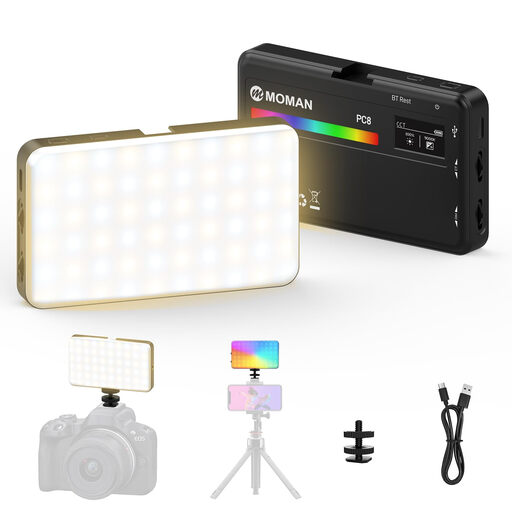
MOMAN PC8 RGB Camera Light
A portable video light for anyone who wants to move or pack away their filming setup.
The product description lists adjustable brightness and a colour temperature of 2500–9000 K, a built-in battery, and 1/4-inch mounts with a cold-shoe adapter. The stated weight is 125 g; battery life is up to 80 minutes at full power.
View at Joybuy
 No image available
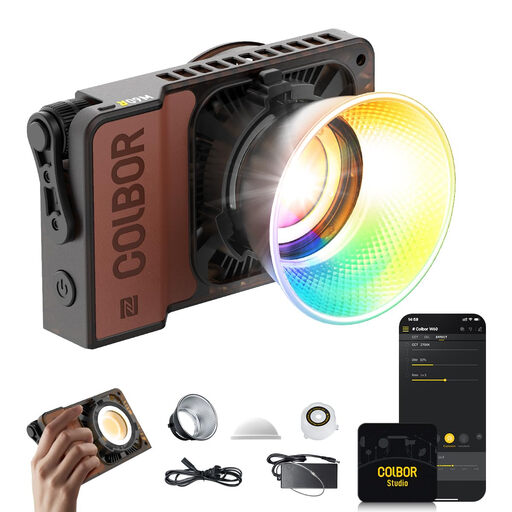
COLBOR W60R RGB video light, 60 W
A portable, flat panel to consider if you want to use RGB as well as adjustable white light.
The product description lists adjustable brightness from 0–100% and white light from 2700–6500 K. The stated weight is 345 g.
View at Joybuy
Frequently asked questions
Where should I position the panel for a recipe introduction?
Place the panel beside your filming area and record the full frame, including your face, hands and food. Move or dim the light if any part looks too dark; the best position depends on your table and camera. Adobe Stock Contributor recommends artificial light when daylight is unavailable or not bright enough for video recording.
Should I choose an RGB panel for filming food?
Not necessarily. First, choose a white-light setting that keeps ingredients looking true to life in your test shot, then adjust the white balance to match. RGB can add colour accents, but it won't automatically solve issues with food colour. Canon Europe explains that the colour temperature of the light affects how the camera captures colours.
What can I do if I see bands in my video?
Record a test shot using the camera settings you plan to use and try the relevant brightness levels. Canon Europe explains that LED light can cause bands in the image with certain electronic recording settings; a lamp's specifications alone can't rule this out.
Who should I contact if a lamp I bought online is faulty?
If a product is faulty, contact the seller. According to the Dutch government, there is no fixed statutory guarantee period that applies to all products in the Netherlands; what you can expect depends partly on the product. Online purchases also generally come with a 14-day cooling-off period from delivery, subject to legal exceptions, according to ACM ConsuWijzer.
Is CE marking relevant for an LED video panel in the Netherlands?
Yes. Applicable product safety requirements apply to electrical and electronic devices. The Dutch government's Ondernemersplein explains that, where required, manufacturers apply a CE mark and draw up an EU declaration of conformity. A statement on a product page alone doesn't prove that a specific item meets all the requirements.


