Choose a panel that fits beside your small table and lets you adjust the colour temperature and positioning. Also check whether the diffuser, power supply and mount are included with the version you’ve chosen. A compact tabletop panel takes up less space, while a larger panel with a diffuser may need more room and sometimes a separate stand. Keep your lighting setup and white balance consistent throughout a photo series: a panel alone cannot guarantee true-to-life colour.
Who is this buying guide for?
Makers who want to show product colours accurately
You photograph knitted gloves for a shop or portfolio and want to minimise colour differences between shots. Canon Europe explains that you can adjust the white balance in difficult lighting. A consistent lighting setup will help you keep the whole series looking alike.
Photographers with a small table
You want to position a panel and mount without filling up your shooting area. A table kit with a mini tripod needs a different layout from a larger panel that may require a separate stand.
Makers who move their setup around
You don’t always take photos near a power socket, so you’ll want to know whether the light has a built-in battery, needs a separate battery or runs via an adapter. NEEWER lists a built-in battery for the NL-116AI kit; the power supply and accessories for the NL660 vary by version.
What should you look for?
Start with the space available and how clearly you want to show the stitches. Then check the colour settings and power supply for the exact version you’re considering.
| What to consider |
What should you check? |
Who should pay particular attention? |
| Colour of the knitting |
Check the adjustment range of the exact model. Take a test shot in the same lighting and set the white balance accordingly. |
If I want the yarn colour to look consistent across a series of product photos, I focus on having control over the colour temperature and white balance. Around 29% of consumers rank colour control as their top priority. |
| Light on the knitted texture |
Check whether a diffuser is included and whether you can move the panel and glove separately. Compare test shots taken from different lighting angles. |
If you want to show the stitches without distracting shadows, it helps to be able to control the diffusion and lighting angle. Around 29% of consumers prioritise how clearly the texture shows. |
| Space around the table |
Measure the available space and check the dimensions, mount and contents of the set you’ve chosen. |
When I have little room beside the table, the panel and its mount need to fit into the setup without getting in the way of the work surface. Around 21% of consumers give practical space their highest priority. |
| Power supply and kit contents |
Check which adapter, battery and stand are included with each version. Don’t assume it comes with accessories supplied in a different kit. |
If I’m taking photos somewhere without a convenient power socket, I want to know in advance exactly which power supply and mount I’ll need. Around 21% of consumers start by considering how practical the complete kit will be at the shooting location. |
Common buying pitfalls
-
Comparing lux figures without checking the measurement distance
NEEWER gives a maximum illuminance figure for the NL-116AI at 0.5 m and one for the NL660 at 1 m. Without measuring at the same distance and using the same lighting setup, these figures aren’t a fair way to rank the panels for your table.
Only compare illuminance under the same measurement conditions, and assess the effect of any diffuser separately.
-
Assuming a panel version is a complete kit
The contents of the NL660 vary by version. According to NEEWER, a stand is included only with the relevant kit; the NP-F battery is not included.
Before buying, check the contents of the exact version you’ve chosen.
-
Using coloured light when you need the yarn colour to look accurate
An RGB effect is different from neutral product lighting. Canon Europe explains that you may need to adjust the white balance in difficult lighting to get the colour rendering you want.
For accurate product colours, use a white-light setting, keep the lighting setup the same throughout a series and check the white balance.
Brands to consider
NEEWER
The NL-116AI kit is a compact tabletop panel, while the NL660 is a larger bi-colour panel available in different kit versions.
- NEEWER lists a mini tripod and built-in battery for the NL-116AI kit.
- For the NL660, NEEWER lists a diffuser and adapter; whether a stand is included depends on the version.
- The NP-F battery is not included with the NL660. Check the contents of the specific kit.
Godox
The P260C Pro is a larger bi-colour panel to consider if you want adjustable colour temperature and a choice of power options.
- Godox lists a colour temperature range of 2800–6500 K and USB-C power for the P260C Pro.
- Godox’s claims about soft light and colour rendering are manufacturer statements. Check that the size and power supply suit your setup.
SmallRig
The P200 Beauty Panel Video Light (Universal) is a slim 10-inch panel that SmallRig also positions for still-life photography.
- SmallRig lists USB-C power and a connection for an NP-F battery.
- The description of softer light is a manufacturer claim. Also check the power supply and mount included with the version on offer.
Ulanzi
The VL49 RGB is a small, rechargeable panel worth considering as a portable light or accent for a compact shooting area.
- Ulanzi lists a built-in battery, magnetic mounting and adjustable white and coloured settings for the VL49 RGB.
- Its compact size alone doesn’t tell you whether one light will illuminate the whole table sufficiently.
amaran
The P60c is a 60W RGBWW panel for makers who want colour control as well as white light.
- amaran lists a folding softbox and grid as included; NP-F power is optional.
- The stated 5900 lux at 1 m applies at 5600 K and with the specified optical setup. It isn’t a comparable result at every distance or when light passes through the softbox.
Joybuy product pick
This Joybuy pick is a rechargeable LED video light for a small product photography setup.
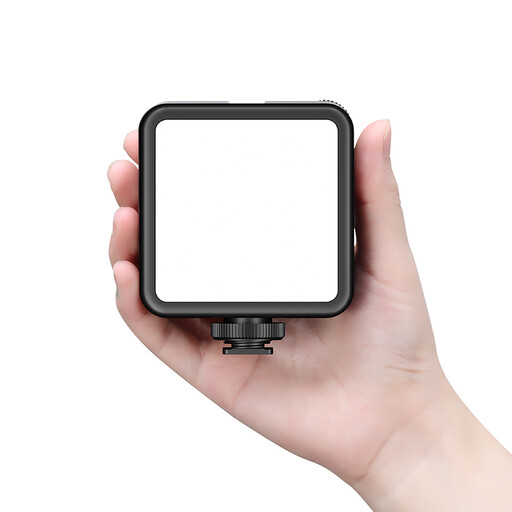 Image unavailable
Ulanzi VL81 Rechargeable LED Video Light Black
The product name describes a rechargeable LED video light, which could suit anyone who wants to move their light source around a small shooting area. Before buying, check that the lighting settings and mount on this version work with your table setup.
View at Joybuy
Frequently asked questions
Do I always need an LED panel to photograph gloves?
No. If you have enough soft light from a window, you can start with that. Canon Europe mentions natural light from a large window as one possible light source. A panel is useful when you want to position the light yourself or work more consistently as the ambient light changes. Check the results with test shots.
How do I get started with one panel on a small table?
Place the panel beside the shooting area and adjust the lighting angle until the stitches are visible without distracting shadows. Use a diffuser if needed, and check the white balance before taking a whole series of photos.
Which power supply and accessories should I check before buying?
Check the contents of the exact version you’ve chosen. According to NEEWER, the NL-116AI kit has a built-in battery and mini tripod. The NL660 is listed with an adapter, but the NP-F battery is not included, and a stand is only supplied with the relevant kit version.
What are my rights as a consumer when buying online in the Netherlands?
When you buy from a business at a distance, you usually have a 14-day cooling-off period, although exceptions may apply depending on the circumstances. You’re also entitled to a product that works as it should. The Dutch government states that the Netherlands has no fixed statutory warranty period. If something is faulty, contact the seller.
Does a CE mark prove that an LED panel takes good product photos?
No. According to Business.gov.nl, CE is not a quality mark. Applicable European product rules cover electrical equipment, but the mark doesn’t assess how suitable the panel is for your photos. Test your lighting setup with a few shots.


