What should you look for when buying?
First, check whether you can spread the light across the card and move reflections. Then compare colour settings, available workspace and what’s included with the version you choose.
| What to consider |
What should you look for? |
Who is this important for? |
| Even lighting and reflections |
Check whether you can angle and move the panel, and whether a diffuser is included in the set you’re considering. |
If I photograph glossy cards, I want to be able to move reflections away from text and foil. Around 36% of consumers prioritise even lighting without distracting reflections. |
| Paper and print colours |
Compare the stated colour temperature and CRI. Take a test shot and check the white balance with the light you’ll be using. |
If I want the paper and print to look true to life, I consider both colour control and my camera’s white balance. Around 29% of consumers give colour accuracy top priority. |
| Space, mounting and power |
Measure your workspace and check the mounting point, power connection, and whether you’ll need a holder or battery. |
For a small or temporary photo set-up, I want a light that’s easy to position and store. Around 21% of consumers prioritise a compact set-up and practical power options. |
| Complete set-up |
Check what’s included in the exact set, including any holder, diffuser and required power supply or battery. |
If I want to get set up straight away, I want to know in advance which components are included with the version I’m buying. Around 14% of consumers give a complete set-up top priority. |
Brands worth comparing
Compare the stated features for the exact model and set variant. These specifications are provided by the manufacturers, not measurements of your card photography set-up.
Godox
The LEDP260C is a larger bi-colour panel that Godox lists for uses including product photography.
- According to the manual, the colour temperature is adjustable from 3300–5600 K, the CRI is over 95 and the brightness can be dimmed from 10–100%.
- Check the power supply and what’s included in the set on offer. These manufacturer specifications don’t show how evenly the panel will light your card.
NEEWER
The NL660 is an adjustable bi-colour panel for a tabletop set-up with room for a larger light.
- NEEWER lists a colour temperature of 3200–5600 K, a diffuser, mains power and a swivel bracket.
- Whether a stand is included depends on the set variant; according to NEEWER, NP-F batteries are not included. The colour and light figures are manufacturer specifications.
SmallRig
The P96 3286 is a compact, rechargeable bi-colour panel for a small or temporary photo set-up.
- SmallRig lists a built-in battery and an adjustable colour temperature of 2700–6500 K.
- The stated 150 lux at 1 m doesn’t tell you whether a whole card will be lit evenly enough without testing your set-up.
Ulanzi
The VL49 1672 is a compact battery-powered panel with a fixed light colour; the VL49 RGB is a different version.
- For the VL49 1672, Ulanzi lists a diffuser, a fixed colour temperature of 5500 K and USB-C charging.
- A fixed light colour gives you less flexibility to match other artificial lighting in the room. Check that the version works with the light sources you use.
Joybuy product selection
This selection is intended for product photography of cards in a small or temporary workspace.
 No image available
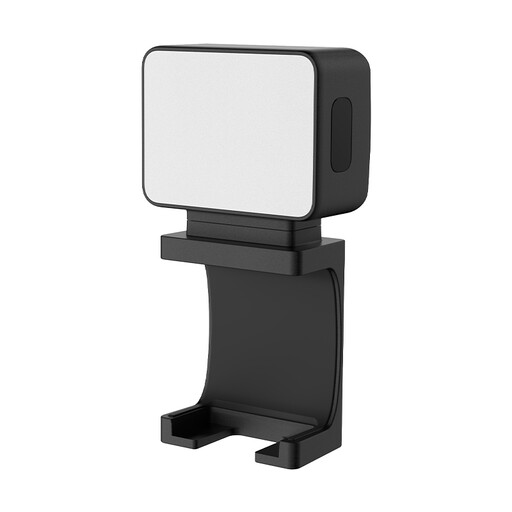
Ulanzi LM001 Portable Mini Fill Light, Magnetic LED Photography Light
The product description mentions soft, even light for product photography and a portable light with magnetic mounting. Check whether it lights your entire card evenly in your own set-up.
The product name lists a 500 mAh battery; the description mentions a built-in battery and a 1/4-inch thread for mounting.
Before buying, check whether the exact version is covered by the relevant EU rules and, where required, bears the CE marking.
Joybuy
Frequently asked questions
How do I photograph a card with a glossy or metallic area?
Take a test shot and move the light source until the reflection no longer falls across important text or details; try diffusion if needed. Nikon discusses reflections and hotspots when photographing small, shiny objects, not greeting cards specifically, so adapt the set-up to your paper.
Is a high CRI enough to capture card colours accurately?
No, a high CRI doesn’t replace setting the white balance. Check your camera’s white balance and assess a test shot of the paper and print under the artificial light you use.
What should I check before I can use the panel?
It depends on the model and set variant. NEEWER states that NP-F batteries are not included with the NL660 and that a stand is only included with certain versions. SmallRig lists a built-in battery and USB-C charging cable for the P96 3286.
What are my rights when buying online in the Netherlands?
For distance purchases made by consumers from a business, there is usually a 14-day cooling-off period, with some exceptions. You’re also covered by the legal guarantee if a product doesn’t do what you could reasonably expect under normal use; the ACM doesn’t specify a general fixed two-year period for this.
Is CE marking relevant for an LED photography panel?
CE marking is required for equipment covered by EU rules that require the marking. Your Europe explains these EU rules; a model name or product listing alone doesn’t confirm that a specific version meets the applicable requirements.


