
Jar photographer looking to control reflections
You photograph glass jars and want the contents, rim and label to remain visible. Proshoots describes diffusion and careful positioning as ways to control how glass is lit.


For glass jars, start with a panel that’s easy to reposition and add diffusion if needed: where you place the light affects where reflections appear. A compact, adjustable panel suits a single jar on a small table, while a larger panel may be more practical for a more spacious setup. RGB is mainly useful if you want to add deliberate colour accents. Check whether the exact version includes a power supply, stand and diffuser.
You photograph glass jars and want the contents, rim and label to remain visible. Proshoots describes diffusion and careful positioning as ways to control how glass is lit.
You occasionally photograph a single jar or a detail and want a panel that can sit close to your setup and is easy to adjust.
You photograph several jars of preserves under artificial light and want to assess colour and exposure consistently from one shot to the next. Canon Europe explains why white balance matters in challenging lighting conditions.
Start by considering the space around your jars and where you can position the light. Then look at the white-light settings, power options and what’s included with the version you’ve chosen.
| What to consider | What to look for | Who is this important for? |
|---|---|---|
| Reflections and visibility | Check whether you can place the panel beside or behind the jar, and which diffuser comes with that version. Test the light with the jar and label you plan to photograph. | If I want the glass and label to remain clearly visible, I need to be able to reposition the light and soften it if necessary. Around 36% of consumers say controlling reflections is their top priority. |
| Colour of the contents | Check the adjustable white-light settings of the exact model and take a test shot using a fixed or custom white balance. | When photographing fruit or vegetables, for example, I want to be able to assess the colours in the image and adjust them if needed. Around 29% of consumers prioritise natural-looking food colours. |
| Size and workspace | Measure the space available around the jars and check the panel dimensions and mounting options. | On a small photography table, I want to be able to place the panel close to a single jar; for a larger setup, there also needs to be room for mounting and diffusion. For around 21% of consumers, choosing a size that suits their workspace is the main consideration. |
| Power and what’s included | Check whether the panel has a built-in battery or needs a separate power source, and see whether a stand is included. | If I want to take photos away from a mains socket or get started straight away with a complete setup, the power and mounting options need to suit my plans. Around 14% of consumers say power and included accessories are their top priority. |
A colour-rendering rating doesn’t tell you where the panel will be reflected in curved glass. A reflection can still obscure important details or the label.
First, work out where you can position the panel and whether you can diffuse the light. Then compare the colour and lighting specifications of the exact models.
NEEWER lists the light output of the NL-116AI at 0.5 m; amaran lists a figure for the P60c at 1 m and 5600 K. These figures aren’t directly comparable.
Only compare light output at the same measurement distance and with relevant settings. Also take into account any diffusion you use with the jars.
NEEWER offers the NL-116AI with or without a mini tripod. For battery operation of the NL660, NEEWER specifies NP-F batteries, which aren’t included; whether a tripod is included varies by version.
Check what’s included and the power specifications for the exact version. You may need to buy a compatible battery separately for battery-powered use.
NEEWER offers compact and larger bi-colour panels for different tabletop setups.
The Godox P260C Pro is a bi-colour panel with a colour temperature range of 2800–6500 K, according to Godox.
The amaran P60c is an RGBWW panel for anyone looking to combine adjustable white light with deliberate colour effects.
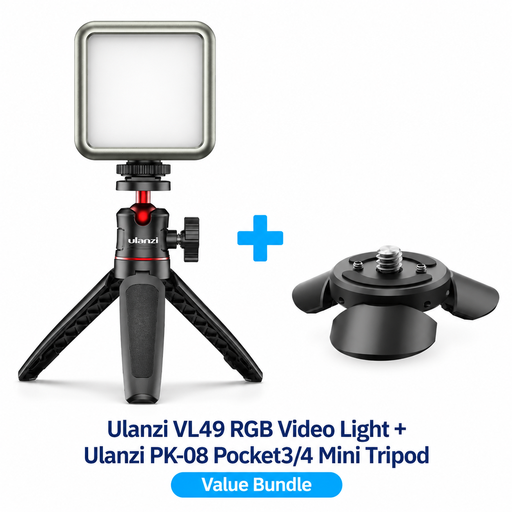
The VL49 RGB is a compact panel for accent lighting or a small product setup.
This Joybuy selection focuses on compact RGB lighting for product photography and deliberate colour accents.
 No image available
This compact RGB light suits a small product setup; RGB is most useful if you want to add deliberate colour accents.
The product name lists a PK-08 mini tripod in the kit.
Start with a stable setup and move the light in relation to the jar until the reflection no longer obscures important details. Proshoots describes placing diffusion between the light and the glass, and using white or black cards to control the lighting and contours. Assess the result with your own jar and label.
No. Adjustable colour temperature alone doesn’t guarantee accurate colour reproduction. Canon Europe explains that the colour temperature of the light affects how the camera records colours, and that white balance needs attention in challenging lighting conditions. Take a test shot of the product before photographing a whole range.
It depends on the model and version. NEEWER offers the NL-116AI with or without a mini tripod and lists a built-in battery; battery operation of the NL660 requires NP-F batteries, which aren’t included. Check what comes with the version you’re considering.
For distance purchases, the Rijksoverheid says you generally have a 14-day cooling-off period, depending on the type of sale and any exceptions. ACM ConsuWijzer also states that if a product doesn’t do what you could reasonably expect, the seller must put things right when it has been used normally.
For electrical equipment covered by the EU Low Voltage Directive, EUR-Lex sets out CE marking and conformity requirements. The directive specifies limits of 50–1000 V AC and 75–1500 V DC. The applicable rules depend on the panel and any mains adapter; don’t assume that the whole kit falls outside product regulations based on the panel’s operating voltage.