
Maker with limited desk space
You’re filming stitches while your hands and tools also need room. So consider the size of the panel and how you can attach it outside your work area.


For filming at a small desk, a compact panel is practical if you can attach it outside your work area and angle it so your hands don’t block the stitches. A larger panel may work if you have room for a separate setup; check which stand and power supply come with the version you choose. Only compare light output figures taken at the same distance, and consider diffusion and colour settings.
You’re filming stitches while your hands and tools also need room. So consider the size of the panel and how you can attach it outside your work area.
You want the thread and leather texture to show clearly on camera, without your hands or tools casting shadows over the stitching. Pay attention to where you position the light and whether a diffuser is included.
You film at different times and want to adjust the panel to suit the light in the room. Check the adjustable colour temperature of the exact version you’re considering.
Best if: there’s little space beside your sewing table and you can attach the light close to your work.
Bear in mind: according to Ulanzi, the Ulanzi VL49 1672 has a fixed colour temperature of 5500 K; SmallRig lists a range of 2700–6500 K for the P96. These are different versions.
Best if: you have room to set up the panel beside or above your work area and want to adjust the colour temperature to suit changing ambient light.
Bear in mind: size, stand and power supply vary by model and version. For example, whether a stand is included with the NEEWER NL660 depends on the version you choose; the NP-F970 battery for the Godox LEDP260C is sold separately.
| What to consider | What should you check? | Who should pay particular attention? |
|---|---|---|
| Space and mounting | Check the dimensions, mounting options and any stand you’ll need for the spot where you plan to put the panel. | If I want to keep my hands, camera and tools free, I’ll look for a panel that fits outside the stitching line. Around 36% of consumers prioritise work space. |
| Visibility of stitches and shadows | Check whether a diffuser is included and look at the light output at the stated measurement distance. | I want the thread and stitches to stay visible when my hands cast shadows. Around 29% of consumers prioritise soft lighting. |
| Colour matching | Compare the colour temperature range of the exact version with the lighting conditions you film in. | When the light from a window or room changes, I want to be able to adjust the panel’s colour. Around 21% of consumers prioritise colour matching. |
| Power and recording time | Check whether a battery, adapter and cable come with the version you choose, and what battery life the manufacturer states. | If I want to record for longer, I want to know in advance what power options are available and whether I’ll need to recharge. Around 14% of consumers prioritise power and recording time. |
A stated lux figure at 0.5 metres isn’t directly comparable with one measured at 1 metre. On their own, these figures don’t tell you how the stitches will be lit in your setup.
Only compare figures measured at the same distance, and check the light where you’ll be filming.
Whether a stand is included with the NEEWER NL660 version we reviewed depends on the version; an NP-F battery isn’t included. The NP-F970 battery for the Godox LEDP260C is sold separately.
Check what’s included with the specific version before choosing.
According to Ulanzi, the Ulanzi VL49 1672 has a fixed colour temperature of 5500 K. The VL49 RGB is a different version with an adjustable colour range.
Check the full model name and specifications before assuming product listings are for the same item.
The VL49 1672 we reviewed is a small, rechargeable panel for a cramped workspace. The VL49 RGB is a different version.
The P96 we reviewed is a compact bi-colour panel for anyone short on space who wants to adjust the colour temperature.
The NL660 is a larger bi-colour panel for a permanent setup with space beside the workbench.
The LEDP260C is a larger bi-colour panel. The separate P260C Pro has different specifications.
The P60x is a bi-colour panel with a softbox, suited to anyone with room for a more extensive lighting setup.
These Joybuy products are portable LED video lights for a compact filming setup.
 No image available
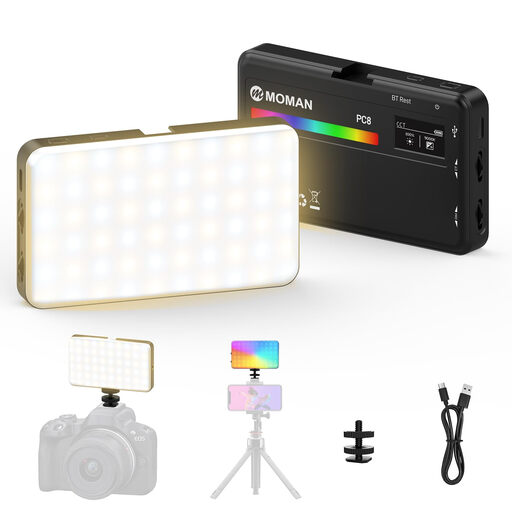
Its multiple mounting options and adjustable colour temperature make it a good fit for filming in a small workspace or in changing ambient light.
Stated weight: 125 g. Colour temperature: 2500–9000 K; brightness: 0–100%. The product description lists 1/4-inch screw mounts and a cold shoe adapter, CRI 95+ and TLCI 96+.
The stated wireless battery life is up to 80 minutes at full power.
 No image available
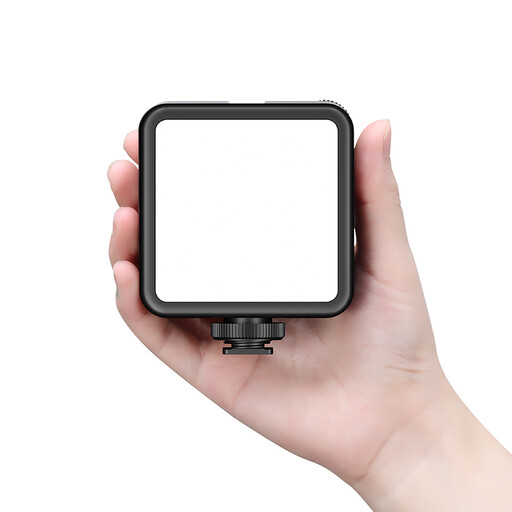
This compact light has a built-in cold shoe mount, making it an option for attaching to a camera or tripod when you want to keep your desk clear.
The product description lists 81 LEDs, USB-C charging and continuously adjustable colour temperature from 3200–5600 K. The brightness is also continuously adjustable.
Try placing the panel beside or above your work area, then check in a test recording whether your hands block the stitching line. Diffusion can soften harsh shadows, so check whether a diffuser is included with the version you choose.
That depends on the panel and its settings. Ulanzi states that the VL49 1672 has a battery life of 120–300 minutes, depending on use. NEEWER says the NL660 can also run from the included adapter. Check the power options and stated battery life for the version you’re considering.
For online consumer purchases in the Netherlands, you generally have a 14-day cooling-off period after delivery, with some exceptions; ACM ConsuWijzer explains how this works. You’re also covered by the statutory guarantee if a product, when used normally, doesn’t meet the standard you could reasonably expect. The seller is responsible, as ACM ConsuWijzer explains.
That depends on the electrical design and the product rules that apply, including those for any mains adapter. The Netherlands Food and Consumer Product Safety Authority outlines the low-voltage rules for electrical equipment with a rated AC voltage of 50–1000 V or DC voltage of 75–1500 V. The European Union states that CE marking is only required for products covered by applicable harmonised rules. So don’t assume a specific light needs a CE mark based on its product name alone.