
Photographer of colour-critical swatches
You want to document fabric colour variations as consistently as possible, so you pay attention to both the light source and the white balance.


Choose soft, adjustable fill light if your main aim is to soften shadows; choose more directional light if you want to control how the weave or folds appear. Neither option guarantees an accurate colour match: compare the colour-rendering data and colour temperature of the exact model, then take a reference shot with a grey card under your final lighting setup.
You want to document fabric colour variations as consistently as possible, so you pay attention to both the light source and the white balance.
You want to show threads, texture or folds, so you need to choose between soft fill light and a more directional angle of light.
You regularly move the swatch or light, so you pay attention to the mounting, power supply and what’s actually included in the kit.
Choose this when: your main aim is to brighten the darker side of a swatch beside a window.
Bear in mind: more fill light can soften shadows that help bring out texture. A fixed panel setting won’t guarantee a colour match when the window light changes.
Choose this when: you want to control the direction of the light to bring out folds or weave texture. According to amaran, the P60x has a 45° beam angle; Cameranu lists a softbox and grid for the version in question.
Bear in mind: a directional beam needs careful positioning to light the entire swatch evenly.
Choose this when: the window light on its own is bright and even enough for your shot.
Bear in mind: natural light changes with the conditions. Canon Europe explains how daylight can look warmer or cooler at different times.
| Point to consider | What to look for when buying | Who this matters to |
|---|---|---|
| Colour rendering | Check the stated colour-rendering data for the exact model, but don’t treat it as a guarantee for every fabric colour. Also check the colour temperature range and whether brightness is adjustable. ERCO distinguishes colour rendering from colour temperature; Canon Europe explains that white balance is how a camera processes the colour of the available light. | If you want to compare colour variations beside a window, you’ll want to keep the lighting and white balance consistent and repeatable; around 36% of consumers put consistent colour at the top of their list. |
| Shadows and texture | Check whether a diffuser, softbox or grid is included with the version you’re considering. Also look at how you can direct the panel and whether the light will reach the whole swatch. | If you want to bring out texture or weave, you’ll need control over the angle of the light while keeping the shadow side visible; around 29% of consumers prioritise visible texture. |
| What’s included in the kit | Check whether a stand or holder, diffuser and mains power supply are included with the exact version. Make sure the mount can hold the light at the angle you want. | If you want to set up without needing extra parts, you’ll want to know in advance what’s in the box; around 21% of consumers prioritise a complete, straightforward setup. |
| Power and portability | Check which battery type is compatible and whether the batteries you need are included. Also check which mains adapter and connection come with the version on offer. | If you work in different locations without access to a socket, battery power is important; around 14% of consumers prioritise portability. |
Colour temperature and colour rendering are different properties. ERCO explains that colour rendering is linked to the spectral composition of the light; white balance also affects how the camera processes that light.
Check the colour-rendering data for the exact panel and take a reference shot with a grey card under your final lighting setup.
Neewer sells the NL660 with or without a stand and states that NP-F batteries are not included. Cameranu also notes that the batteries mentioned are not supplied with the P60x version.
Compare what’s included with the exact kit before deciding which additional parts you need.
amaran lists 5.070 lux at 1 metre at 5600 K and a 45° beam angle for the P60x. This figure doesn’t automatically tell you how much light will reach your entire fabric swatch, or how evenly it will be lit.
Also consider the beam, diffusion, distance and the size of your working area.
The Litemons LP600Bi is a bi-colour panel with a diffusion panel. Godox lists a colour temperature range of 2800–6500 K for the Bi version.
Neewer describes the NL660 as a bi-colour panel with adjustable brightness, a white diffuser and a colour temperature range of 3200–5600 K.
The P60x is a directional bi-colour panel. amaran lists a colour temperature range of 3200–6500 K and a 45° beam angle.
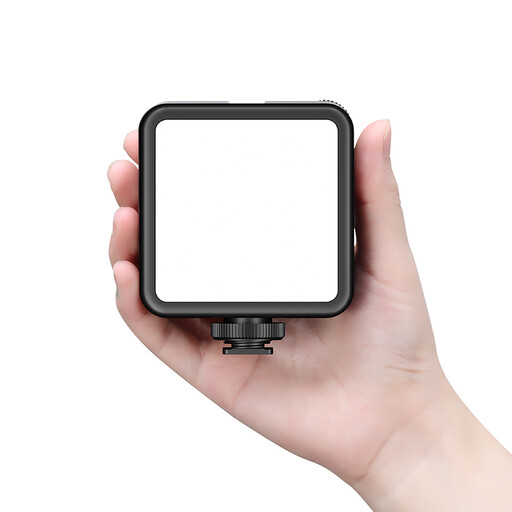
This selection is intended for product photography of a fabric swatch, using a light you can use in different locations.
 No image available
This selection is suited to product photography of a fabric swatch when you need a portable setup.
The product name describes a rechargeable black LED video light.
Not without checking if you want to document colours consistently. Window light changes with the conditions, and white balance affects how the camera processes the available light. Take a shot with a grey reference under the lighting you’re using, and keep the settings consistent across a series.
Start by taking a test shot in window light, then move or turn the panel. Compare soft fill with more directional light and choose the position that keeps both the shadow side and the texture you want visible. Check whether your version includes the diffuser or light modifier you need.
It depends on the version. Neewer offers the NL660 with and without a stand and states that NP-F batteries are not included. Cameranu states that the batteries mentioned are not supplied with the P60x version. So check what’s included with the exact kit.
According to ACM ConsuWijzer, consumers who buy online generally have up to 14 days after delivery to change their mind, subject to legal exceptions. Your statutory guarantee is separate from any limited manufacturer’s warranty: if a product doesn’t perform as you could reasonably expect when used normally, the seller is responsible for putting things right.
The NVWA states that CE marking is compulsory for electrical consumer products. This is not the same as a compulsory independent inspection. Check the identity of the panel on offer and the relevant conformity information; a manufacturer’s declaration for a named model is not proof that every unit bears the marking.