Start with indirect window light and add a dimmable LED panel if the paper is unevenly lit or the daylight changes while you’re taking photos. For an overall view of the tonal values, it’s worth considering a larger, diffused lighting setup; if necessary, capture the paper texture separately using raking light. The Canadian Conservation Institute and Associated Artists of Pittsburgh stress the importance of suitable lighting and avoiding direct sunlight. Before buying, check the mounting, power supply, included accessories and product information for the exact version.
Who is this buying guide for?
Artist looking to capture tonal values
You want to photograph a whole sheet evenly for a portfolio or archive, without a darker corner looking like a difference in the charcoal drawing. The Canadian Conservation Institute describes lighting setups for illuminating objects evenly.
Creator working with changing window light
You take photos beside a window and want to be able to dim or adjust the fill light as the daylight changes. Associated Artists of Pittsburgh advises avoiding direct sunlight on your work, as it can cause glare and affect the colours in your photos.
Photographer working at a small desk
You have limited space for lights and stands, and want to know whether a compact panel will provide enough fill light or whether you need a larger setup to illuminate the whole sheet.
What should you look for when choosing?
| What to consider |
What to look for when buying |
Who is this important for? |
| Even tonal values |
Check that all the corners of the sheet can be lit properly, and compare panel size, diffusion and dimming controls. For an overall shot, the Canadian Conservation Institute describes using two lights on either side at around 45 degrees. |
If I want to avoid lighting differences looking like variations in the charcoal tones, I prioritise even lighting. Around 36% of this group prioritise tonal values. |
| Adjustable fill light |
Check whether brightness and white-light colour can be adjusted on the exact model. Take a test shot and set the white balance for the final combination of window and lamp light. |
If the window light changes while I’m taking photos, I want to be able to adjust the fill light without overpowering the daylight. Around 29% of this group prioritise control over changing window light. |
| Space and positioning |
Compare the panel dimensions with the sheet and your workspace. Check the mounting and power supply, and whether a battery or stand is included with the version you’ve chosen. |
If my desk has limited space, I want a light that fits, even if that means I may not be able to light the whole sheet evenly in one go. Around 21% of this group prioritise limited setup space. |
| Paper texture |
First assess a shot lit evenly, then take a separate test shot with raking light if needed. For raking light, the Canadian Conservation Institute describes a low angle of incidence of around 5–10 degrees. |
If I also want to document the paper’s texture, I want to capture it separately rather than treating the overall shot as a texture shot. Around 14% of this group prioritise paper texture. |
Buying pitfalls
-
Assuming a high lux or CRI rating guarantees a good photo
A panel’s rating doesn’t prove that the whole sheet will be lit evenly. Positioning and camera settings also play a part.
When checking lux claims, look at the stated measurement distance and take a test shot of the whole sheet, including the corners and the paper’s white areas.
-
Assuming a standalone light comes with everything you need
What’s included varies by version. Godox states that the LEDP260C requires a separately purchased NP-F970 battery for battery-powered use; NEEWER describes the NL660 as available as a light on its own or with a stand.
Compare what’s included with the mounting, power supply and accessories you need for the exact version.
-
Assuming models with almost identical names are the same
The stated colour temperature can vary between versions. The VL49 RGB and VL49 Pro are different model names.
Check the full model name and the key specifications of the version on offer before comparing it with another model listing.
Brands to consider when choosing a panel
These examples illustrate differences in panel sizes and versions; a brand being mentioned here does not in itself indicate availability from a particular retailer.
Godox
The LEDP260C is an adjustable bi-colour panel worth considering for a fixed setup with additional window light.
- According to the Godox manual, the LEDP260C has a range of 3300–5600 K and a CRI of >95.
- Godox states that a separate NP-F970 battery is required for battery-powered use. These stated features are not an independent test of charcoal reproduction.
amaran
The P60x is a bi-colour panel to consider if you have room to position the light and diffusion as needed.
- Aputure specifies a colour temperature of 3200–6500 K and a CRI of ≥95 for the P60x; the included accessories include a softbox.
- Stated illumination levels apply at the specified distance and setting; they don’t prove that your whole sheet will be lit evenly.
NEEWER
The NL660 is an example of a bi-colour panel where you can choose between the light on its own and a version with a stand.
- According to NEEWER, the NL660 has a diffuser, a range of 3200–5600 K and a CRI of ≥96.
- NEEWER specifies mains power; NP-F batteries are not included. Check which version and accessories come with the product on offer.
Ulanzi
The VL49 RGB is an example of a small battery-powered panel for extra light in a limited space, not a proven replacement for a larger setup.
- Ulanzi lists a built-in battery and adjustable white light for the VL49 RGB.
- The stated colour temperature differs between the manufacturer’s specifications for the VL49 RGB and a Joybuy listing. Check the exact version and product specifications.
Joybuy products for extra light
These products are compact lights for extra illumination in a small workspace. Positioning still matters for an evenly lit overall shot; also check the product information for the exact version.
 Image unavailable
Ulanzi LM001 portable mini fill light, magnetic, 500 mAh
A compact fill light to consider if your workspace is short on room; it has not been shown to replace a larger setup for evenly lighting a whole sheet.
The product name specifies a magnetic mount and a 500 mAh battery. Before buying, check the conformity documentation and marking applicable to the exact version and relevant EU rules.
View at Joybuy
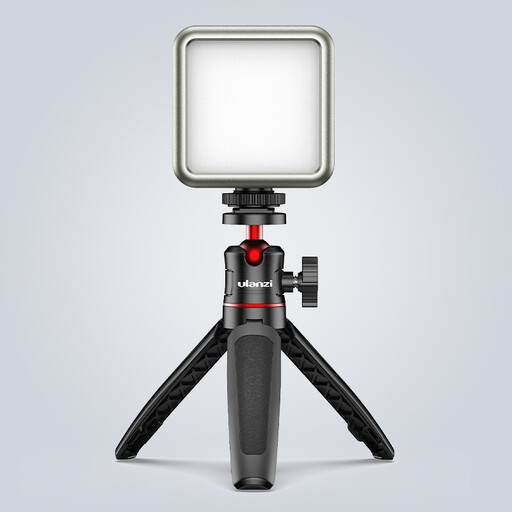 Image unavailable
Ulanzi VL49 RGB compact LED video light, 2000 mAh
A compact fill light to consider when portability and limited setup space are important; the available information doesn’t show that this light can replace a larger setup for evenly lighting a sheet.
The product listing specifies a built-in 2000 mAh battery, dimming, a range of 2500K–9500K and a magnet on the back. This range differs from Ulanzi’s manufacturer specifications for the VL49 RGB; check the full model variant. Also check the documentation and marking applicable to the exact version and relevant EU rules.
View at Joybuy
Frequently asked questions
Do I always need two panels?
No, first try indirect window light to see if it illuminates the sheet evenly. The Canadian Conservation Institute describes using two lights on either side at around 45 degrees as a way to achieve even lighting, not as a general requirement when buying lights.
How can I capture both the tonal values and the paper texture?
Take an evenly lit overall shot and, if needed, a separate shot using raking light. According to the Canadian Conservation Institute, raking light can emphasise surface texture, while even lighting for an overall photo serves a different purpose.
What should I check when setting up and maintaining the light?
Check that the mount, stand, adapter and any battery are compatible with the version you’ve chosen. Follow the instructions for the exact model; for the P60x/P60c, Aputure advises unplugging the light before cleaning and using a dry microfibre cloth.
What are my rights when buying online in the Netherlands?
For many distance sales to consumers by a business, you have a 14-day cooling-off period, subject to exceptions outlined by the Dutch government; the examples given do not include online purchases from private sellers. In the Netherlands, statutory guarantee rights apply without a fixed statutory guarantee period. If a product is faulty, contact the seller.
Is a CE marking enough to tell me whether a panel is suitable for my drawing?
No, a CE marking doesn’t tell you whether a panel is suitable for photographing your drawing. Your Europe explains that the manufacturer uses the marking to indicate that the product complies with the applicable EU product rules; you should also check the product identity and documentation for the exact version.


