
Vandaag of morgen in huis

Kwaliteit gegarandeerd

Welkomstaanbiedingen ontgrendelen: GRATIS bezorging | Tot 80% korting | Gratis 30 dagen JoyPlus-proefperiode
Download de app
An LED outdoor wall light can provide practical lighting for an entrance, façade, balcony, shed or patio. However, not every light is suitable for every location. A solar model works differently from a 230-volt light, and a motion sensor is not automatically convenient if it is constantly triggered by passing traffic or pets.
If you only consider the appearance or the number of lumens, you could therefore make the wrong choice. Below, we explain which points to check before buying an LED outdoor wall light.
IP44 outdoor lighting is protected against solid objects larger than 1 millimetre and against splashing water from different directions. This makes a light suitable for many sheltered outdoor locations, such as a covered front door, patio or balcony. However, IP44 does not mean that the light can be submerged or withstand a direct, powerful jet of water.
You should therefore preferably install the light under a canopy or in a location where rainwater will not remain directly on the housing for long periods. Also check that the cables, connection points and fixing materials are suitable for outdoor use.
A solar outdoor wall light needs sufficient daylight during the day to charge its integrated battery. A north-facing façade, deep canopy or position beneath a tree can limit its charging capacity. In winter, the days are also shorter and there is less direct sunlight.
So do not just look for the word “solar”. Also consider the desired light output, battery capacity and the amount of sunlight available at the installation location. A wireless light with USB charging may be more practical if the façade receives little sunlight.
A 180-lumen light produces softer accent lighting than a 500-lumen model. A lower light output may be sufficient for a garden path or decorative façade lighting. More light can be more convenient beside a front door or in a dark passageway.
The colour temperature determines the atmosphere:
The number of lumens indicates how much light the lamp emits according to its product specifications. Compare this figure between models, but also consider the shape of the fitting and how the light is distributed. A light that mainly shines downwards illuminates a path differently from a model that shines upwards and downwards.
An outdoor light with a motion sensor switches on when movement is detected. Check whether the sensor can be adjusted and whether the light has different settings. A wide detection angle can be useful on a driveway. On a balcony, however, an overly sensitive sensor may switch on frequently because of movement outside the intended area.
There are three common solutions:
A rechargeable outdoor light with magnetic mounting is convenient for tenants or for locations where you do not want to run a cable. However, check that the surface is flat, clean and sturdy enough. A magnetically mounted light must not be installed where falling could cause injury or damage.
A black outdoor light made from metal and plastic often suits modern façades, but the material alone does not determine how long the light will last. Check the IP rating, dimensions and installation instructions. A fitting measuring around 20 centimetres can look large on a narrow façade, while a compact model may fit better beside a door frame.
Integrated LED lighting requires little maintenance, but on several models the light source cannot be replaced by the user. According to the product descriptions of some Brilliant models, the stated LED lifespan is 10,000 or 20,000 hours. This is a manufacturer’s product specification and not a guarantee of the actual service life under all conditions.
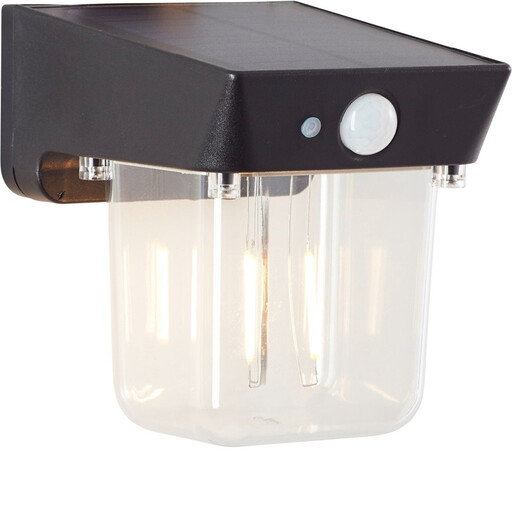
Why it suits this profile: This compact solar outdoor wall light is suitable for an entrance, garden path or small façade where there is no power point.
The product specifications clearly state 180 lumens, 2700 K and IP44. This means you can see in advance that it is mainly atmospheric accent lighting rather than powerful area lighting.
Solar power, integrated motion sensor, dimming function and compact dimensions of 11.5 × 10 × 11 cm.
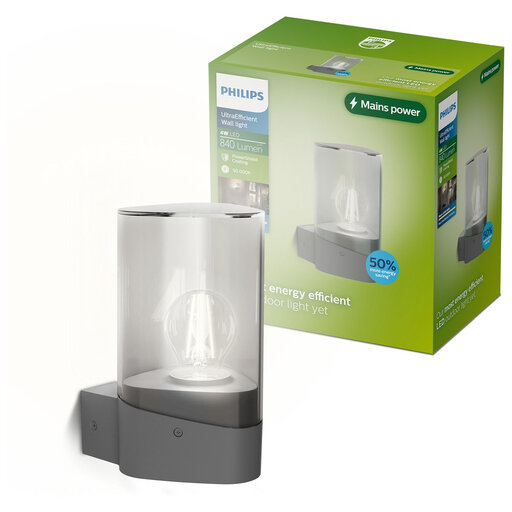
Why it suits this profile: For anyone looking for a fixed wall light with a replaceable E27 lamp holder and warm light for a façade, patio or front door.
The E27 lamp holder allows you to choose or replace the light source yourself, in line with the product specifications. The light runs on 230 volts, so it is not dependent on sunlight.
840 lumens per light point, 2700 K warm white light, aluminium housing and IP44 protection according to the product information.
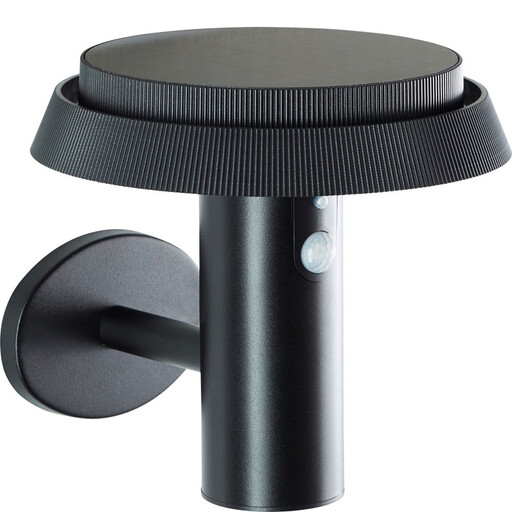
Why it suits this profile: A suitable choice for entrances, garden paths and patios where automatic lighting with a higher light output is preferred.
The combination of 500 lumens, 3000 K and an integrated sensor gives a more specific indication of the light function than a general claim about “safety”. IP44 still means protection against splashing water, not complete waterproofing.
4 W integrated LED, 500 lumens, 3000 K, solar power, dimming function and dimensions of 21 × 20 × 18.2 cm.

Why it suits this profile: This wireless outdoor wall light is suitable if you do not want to install permanent wiring and would like to remove the light occasionally for charging.
You are not dependent on sunlight and do not need to install a 230V connection. The magnetic mounting does, however, require a sturdy, flat surface.
300 lumens, 3000 K, USB-C charging, integrated motion sensor, IP44 and compact dimensions of 8 × 10.3 × 10.1 cm.
Install an LED outdoor wall light on a stable wall and use the supplied fixing materials in accordance with the instructions. If it is a solar light, position the panel towards the available daylight as far as possible. Do not place the motion sensor directly opposite a busy road if you want to minimise unnecessary activation.
A fixed 230V light must be connected safely. Switch off the power and have the installation carried out by someone suitably qualified and competent if you are not certain about the connection. Clean the fitting with a soft, dry cloth and do not use harsh liquids.
We have put together a complete, up-to-date list of products that fully meet these strict selection criteria and the applicable European safety regulations.
IP44 is suitable for many sheltered outdoor areas and means protection against splashing water. The light must not be submerged and is not designed to withstand direct jets of water. Always check the installation instructions for the specific model.
For atmospheric lighting, around 180 to 300 lumens may be sufficient. For an entrance that also provides practical guidance lighting, a model offering around 350 to 500 lumens may be more suitable. The right choice also depends on the light distribution, installation height and area.
A solar outdoor wall light uses sunlight during the day to charge an integrated battery. No fixed mains connection is required. However, its performance depends on the amount of daylight, positioning and the battery’s charge level. A USB-rechargeable model also does not need a fixed connection, but must be charged manually.
