
Vandaag of morgen in huis

Kwaliteit gegarandeerd

Welkomstaanbiedingen ontgrendelen: GRATIS bezorging | Tot 80% korting | Gratis 30 dagen JoyPlus-proefperiode
Download de app
Choosing a new light for your façade, garden or terrace may seem straightforward. Yet many buyers fall into the same traps. For example, a light may be advertised as “for outdoor use” while offering limited protection against rain. Or the colour temperature may turn out to be much cooler in practice than expected. A solar garden light can also disappoint when the panel receives little direct sunlight.
Use these practical checks to make a more informed choice when buying LED outdoor lighting. Consider the right IP rating, colour temperature, power supply and installation method. You can then decide more easily which type of outdoor light suits your situation.
An IP44 outdoor light is protected against solid objects larger than 1 millimetre and against splashing water from different directions. This does not mean the light can withstand a high-pressure jet, immersion or prolonged exposure to driving rain.
So check where you intend to install the light:
Don’t just look at a product’s title. Also read the safety instructions and installation requirements.
Colour temperature is measured in Kelvin (K). A lower value generally produces a warmer, more yellow-toned impression:
For a seating area, 2700 or 3000 K is usually more relaxing than cool white light. For a dark passage, slightly more neutral light may provide better visibility. Also consider the light output in lumens (lm). Wattage mainly indicates energy consumption and does not directly tell you how much light the lamp produces.
Outdoor lighting with a sensor does not always switch on in the same way. Check whether it uses a motion sensor, day–night sensor or both. Also look at the detection range and installation height, if this information is available.
With solar lighting, output depends on the amount of direct sunlight. In a shady garden, on a north-facing balcony or during darker days, the lighting time may be shorter. A model with USB charging provides an additional charging option.
The IP code consists of two digits. The first digit refers to protection against solid particles; the second refers to water. IP44 means protection against splashing water, not a guarantee that a light will continue to work perfectly in all weather conditions.
Preferably install an IP44 outdoor light in a sheltered location and follow the manufacturer’s instructions. According to the product information, a fixed wall light connected to 220–240 V must be installed by a qualified electrician.
A light with an integrated LED does not have a separate bulb fitting. This makes the design compact, but the light source usually cannot be replaced by the user. With a GU10 or E27 fitting, you can choose a suitable LED bulb yourself. Check the following:
For example, the Brilliant Jelani wall light has a GU10 fitting, a maximum of 10 W per light point and is supplied without a light source. According to the product information, this light has IP44 protection and is intended for sheltered outdoor locations.
A fixed outdoor light generally provides a predictable power supply, but requires wiring. A solar garden light is easier to install, but needs sunlight. A rechargeable USB light offers greater flexibility, but needs to be recharged regularly.
For balcony lighting or a rented property, a wireless model can be practical. For an entrance you use every day, a sensor light may be more convenient than one that you have to operate manually each time.
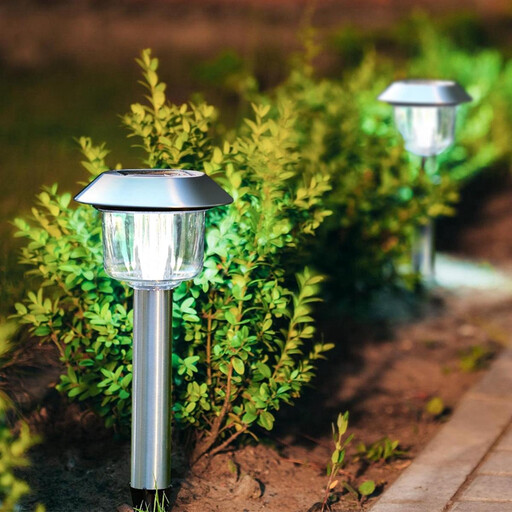
Why it suits this profile: This lamp runs on solar power and is designed for gardens or terraces. That means no fixed connection is required.
The power supply is clearly specified as solar. However, bear in mind the stated colour temperature of 6500 K and position the lamp somewhere with sufficient sunlight.
36.6 cm high, made from stainless steel and plastic; solar-powered without a fixed cable.
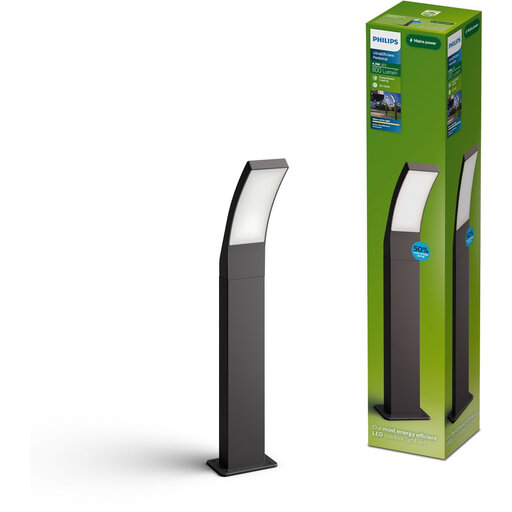
Why it suits this profile: This type of pedestal light is suitable for paths, borders, terraces and balconies when you want a fixed, warm lighting solution.
The specifications state IP44, an integrated LED and 2700 K. This means you know in advance that it provides warm white outdoor lighting, but also that the light source is not a separate replaceable bulb.
4.3 W, 2700 K, IP44 and a stated lifespan of 50,000 hours according to the product description.

Why it suits this profile: This wireless wall light is suitable for a balcony, terrace or entrance where you do not want to run a cable and need light when movement is detected.
The product information specifies a motion sensor, USB-C charging and IP44. Please note: IP44 means splash-resistant, not waterproof; the magnetic mount must be securely attached.
300 lm, 3000 K, integrated LED, rechargeable 18650 batteries and wireless magnetic mounting.
We have put together a complete, up-to-date list of products that fully meet these strict selection criteria and the applicable European safety regulations.
Also consider the dimensions. A compact wall light around 10 cm high is less noticeable next to a narrow door frame. A 60 cm-high light works more effectively as an accent along a path or border. For table lamps, also check the base size so that the lamp stands securely and is not easily blown or knocked off a table.
For ambience on a terrace, balcony or beside a seating area, 2700–3000 K is generally a practical range. This is usually experienced as warm white lighting. For functional lighting by a shed or passageway, more neutral light may be a better fit. As well as Kelvin, consider the number of lumens.
Lifespan varies depending on the product and conditions of use. Some integrated LED lights state a specified lifespan, such as 50,000 hours for the Philips Splay. This is a product specification, not a guarantee that every individual light will last exactly that long. Moisture, heat, switching frequency and installation all affect performance.
LEDs generally use little power. Check the wattage and, for electrical models, the stated energy consumption. Solar and rechargeable lights do not use a fixed mains connection while switched on, but their operation depends on sunlight or the battery’s charge level. So don’t just check energy consumption; also consider the expected lighting time and charging method.
