
Vandaag of morgen in huis

Kwaliteit gegarandeerd

Welkomstaanbiedingen ontgrendelen: GRATIS bezorging | Tot 80% korting | Gratis 30 dagen JoyPlus-proefperiode
Download de app
An LED night light may seem like a simple purchase, but small differences can determine whether you enjoy using it every day. A light may be too bright for a nursery, switch on unexpectedly because of a pet or run out of charge after a short time. Terms such as “energy-efficient” and “long battery life” are also not always measured under the same conditions.
Joybuy Product Recommendation Officer therefore helps you compare the most important specifications. This makes it easier to choose the right night light for a bedroom, children’s room, hallway or bathroom.
Low wattage does not automatically mean the light is suitable. Also check the number of lumens. A 20-lumen light produces a different result from a 40-lumen model, even if both use very little electricity. Slightly more light is often practical for finding your way through a dark hallway, while a softer brightness may be more comfortable for night-time feeds.
A night light with a motion sensor will generally only work when it is dark enough. Pay attention to the stated light threshold, detection range and operating mode. With some models, the sensor only activates at a maximum of 20 lux and detects movement from approximately 3 to 5 metres away. A light that keeps reacting during the day may be less suitable for a busy passageway.
With a rechargeable night light, the maximum operating time is usually measured at the lowest brightness setting. Battery life at maximum brightness can be much shorter. For example, a VAVA model states up to 100 hours at the lowest setting, but approximately 7 hours at maximum brightness. Always check which setting the stated operating time applies to.
For a night light with warm white light, colour temperatures of approximately 2600 to 3200 kelvin are common. This creates a softer appearance than cool white light. A lamp with three colour temperatures can be more practical if you want to use the same model in several rooms:
Also consider the lumens and dimming function. A night light with a dimmer or stepless adjustment gives you more control than a model with just one brightness setting.
A light sensor switches on when the surroundings become dark. A motion sensor responds to movement, often within a specified range. These functions are not the same. In a hallway where you only need light when someone walks past, motion detection can help save energy. In a nursery, a constant, very low light setting may be simpler.
A timer is useful if you do not want the light to stay on all night. Also check whether it is operated with a switch, touch controls or a remote control. Touch controls are practical on a bedside table, while a sensor is well suited to a passageway.
A plug-in light is immediately available from a socket. A portable model with USB charging is more flexible, but it does need to be recharged regularly. Check:
Use a light with a lithium battery in accordance with the supplied instructions. Keep it away from heat sources and water, and never allow a baby or young child to operate an electronic product without supervision.
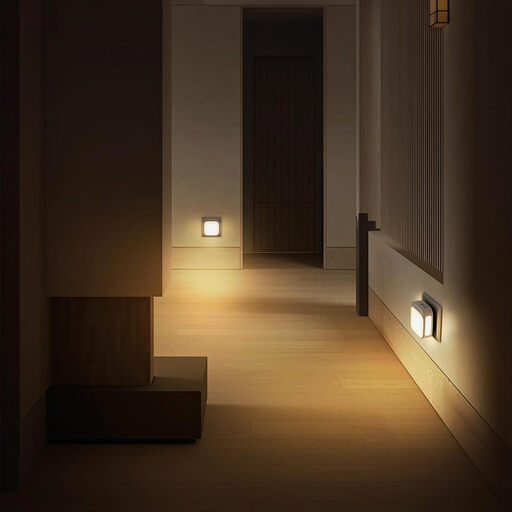
Why it suits this profile: Two lights provide a simple solution for areas such as the hallway and nursery. The fixed connection means there is no need to manage batteries.
The light sensor prevents you from having to switch the lights on and off manually in the dark. The dimming setting can be adjusted steplessly from 10% to 100%.
0.3 W power consumption, warm white light of 2800–3000 K, 20 lumens and two lights per pack.
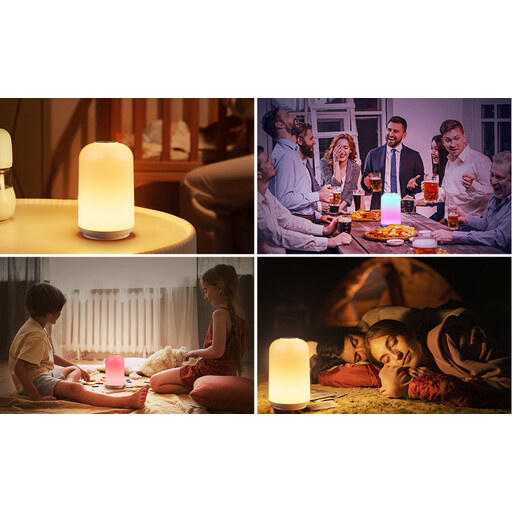
Why it suits this profile: This portable model combines warm white light with seven RGB colours for use in a bedroom, children’s room or while travelling.
The product description lists the warm white dimming function and RGB modes separately. This makes it clear which settings are available.
40 lumens, stepless dimming in warm white mode, USB charging via 5 V/1 A and a light sensor that activates at a maximum of 40 lux.
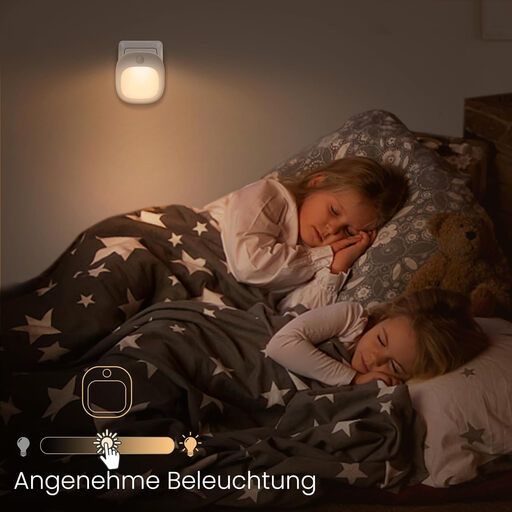
Why it suits this profile: Suitable for households that want light in a hallway, bedroom or nursery at night without having to use a socket continuously.
The specifications state a sensor range of 3–5 metres, activation at a maximum of 20 lux and a separate normal light mode.
500 mAh battery, up to 10 hours of use in sensor mode, 30 lumens and five brightness levels.
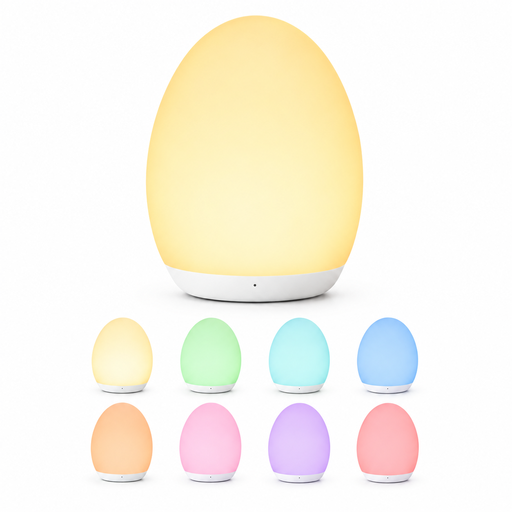
Why it suits this profile: The combination of touch controls, warm light, timer and portable design is ideal for night-time feeds, changing and bedtime.
The timer switches the light off after one hour. The stated battery life is also broken down by maximum and minimum brightness.
Dimmable warm white light, eight colour modes, 2000 mAh battery and a compact size of 9.2 × 9.2 × 11 cm.
We have put together a complete, up-to-date list of products that fully meet these strict selection criteria and the applicable European safety regulations.
An LED night light is intended for orientation or soft lighting, not necessarily for illuminating an entire room. For a living room or workspace, an LED bulb with an E27 fitting may be more suitable. Pay attention to the brightness: an Aigostar E27 bulb states 2100 lumens, 3000 K and 20 W. According to its product specifications, a decorative Nedis filament bulb has 250 lumens, 2100 K and a dimmable E27 fitting. The latter is better suited to ambient lighting than general room lighting.
For illuminating an entire room, a ceiling light with remote control may be more convenient. The Philips SuperSlim has integrated LED lighting, 2000 lumens, 16 W and adjustable colour temperatures from 2200 to 6500 K. When installing, always check the fixings, switch off the power and follow the manufacturer’s instructions.
For gentle orientation, a model offering approximately 20 to 40 lumens is a sensible choice. More light is needed for reading or illuminating a larger part of the room. As well as lumens, consider the placement and whether the light is dimmable.
Power consumption depends on the wattage and the number of hours the light is on. A 0.3 W light uses less electricity over extended use than a 1 W model. A motion sensor or timer can reduce the number of hours it operates even further.
Place it somewhere the sensor can detect the route people take, such as at floor level in a hallway or beside a bed. Do not point it directly at a window or strong light source, as this may affect how the light sensor responds. Do not use the product in a damp room unless its product specifications state that it is suitable for this.
