
Vandaag of morgen in huis

Kwaliteit gegarandeerd

Welkomstaanbiedingen ontgrendelen: GRATIS bezorging | Tot 80% korting | Gratis 30 dagen JoyPlus-proefperiode
Download de app
An LED night light may seem like a straightforward purchase, but the differences between models can be significant. Some lights switch on in daylight, while others produce more light than is comfortable in a bedroom. Terms such as “smart”, “energy-efficient” and “long battery life” are also not always explained using the same measurements.
So pay particular attention to these three common pitfalls:
The right choice therefore depends on the room, how you want to operate the light and how you intend to power it.
Brightness is measured in lumens (lm). For a bedroom or nursery night light, a modest brightness is usually more practical than a powerful lamp. A light of around 20 to 40 lumens may be sufficient for a quick check during the night. More light may be preferable for a kitchen cupboard, staircase or dark hallway.
Also consider the colour temperature:
A product claim about pleasant or soft operation comes from the manufacturer. Therefore, focus mainly on verifiable information such as lumens, Kelvin and dimming settings.
An LED night light with sensor can have different types of sensors:
Check the conditions in the product information. For example, a model may only respond at a maximum of 20 or 40 lux and have a motion range of 3 to 5 metres. Position the light so that the detection area is not blocked by a cupboard door or piece of furniture.
A rechargeable night light can be positioned flexibly, but it needs to be charged regularly via USB. Check the battery capacity and whether the stated operating time depends on the sensor setting, brightness or colour mode.
A plug-in light does not need charging, but it does require a suitable socket. For cupboards, magnetic mounting, an adhesive strip or a slim profile can be useful. When mounting the light, check that it is securely attached and cannot fall.
An ordinary indoor light is not suitable for outdoor use. A solar outdoor light with motion sensor should have a suitable IP rating. According to the product specification, IP65 means protection against dust and water jets; immersion is not permitted. Also position a solar light where the panel receives enough direct daylight.
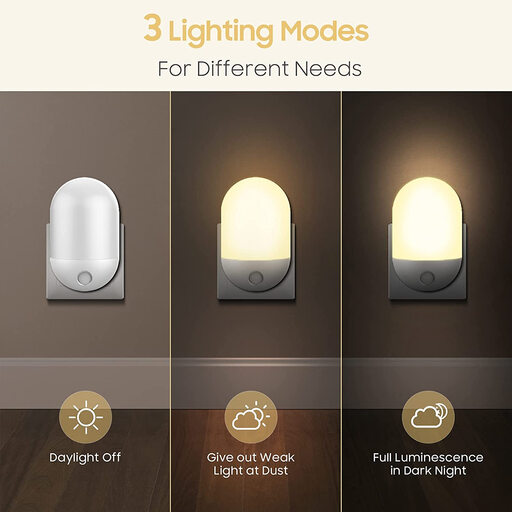
Why it suits this profile: This model is designed for anyone looking for a simple warm white night light for a bedroom, nursery or hallway, without a battery or complicated controls.
The product details specify a light sensor, warm white light of 2800–3200 K and a brightness of 20 lumens. This makes it clearer what the light is intended for.
Plug-in design, 0.5 W power consumption and a warm white light colour according to the product specification.
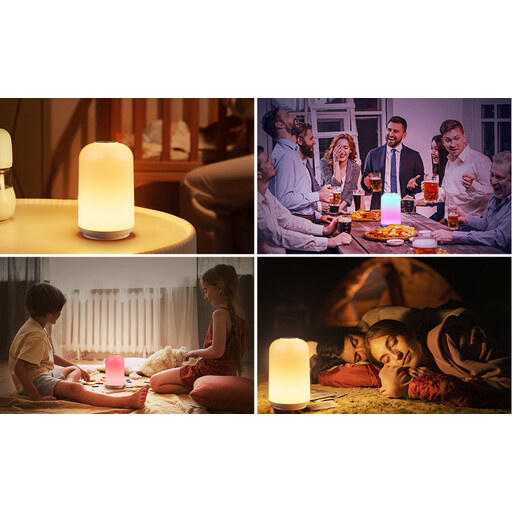
Why it suits this profile: A suitable choice for anyone who wants to combine ambient lighting with practical controls in the bedroom or children's room.
The description specifies separate warm white and RGB modes, stepless dimming for warm white and an ambient light sensor of up to 40 lux.
12 SMD LEDs, 40 lumens, USB charging via 5 V/1 A and a built-in rechargeable battery.

Why it suits this profile: This model is well suited to use in kitchen cupboards, wardrobes, hallways or underneath shelves where a longer light bar is needed.
The product information specifies a PIR range of 3–5 metres, automatic switching on and off, and three clearly defined colour temperatures.
61 LEDs, 40 cm length, 1100 mAh battery and adhesive-strip installation without drilling according to the product specification.
We have compiled a complete, up-to-date list of products that fully meet these strict selection criteria and the applicable European safety regulations.
Place the light where the sensor has an unobstructed view of the route people use. Do not point it directly at a strong light source, and take the specified range into account, for example 3 to 5 metres. Test the light both during the day and in the dark before finalising the installation.
Operating time depends on battery capacity, brightness, colour mode and the number of activations. According to the product specification, a light with a 500 mAh battery can operate for up to 10 hours in sensor mode. This is an estimate from the product specifications; actual usage time may vary.
LED lights generally use very little power. For example, the models in this selection range from 0.5 to 1 watt. With a sensor light, consumption usually depends on how often the light switches on. A plug-in model remains connected to the socket, whereas a rechargeable model uses electricity while charging.
