
Vandaag of morgen in huis

Kwaliteit gegarandeerd

Welkomstaanbiedingen ontgrendelen: GRATIS bezorging | Tot 80% korting | Gratis 30 dagen JoyPlus-proefperiode
Download de app
An LED night light may seem like a simple purchase, but the differences in ease of use can be significant. A light that switches on unnecessarily during the day, gives off too much light or needs recharging after a short time offers little comfort in practice. This applies to bedrooms and nurseries, as well as hallways, bathrooms, cupboards and staircases.
Pay particular attention to these common pitfalls:
A night light with a sensor may have a light sensor, motion sensor or a combination of both. A light sensor switches on when the surroundings become dark. A motion sensor responds to movement within a specified range. Product information for various models, for example, states a range of 3 to 5 metres and activation at up to 20 lux.
For practical use:
The stated sensor performance is based on product specifications. Actual performance also depends on positioning, direction of movement and the amount of ambient light.
Colour temperature is expressed in kelvin (K). Warm white light of approximately 2600 to 3200 K generally creates a softer appearance. Cooler white light of approximately 5000 to 6500 K is clearer and more functional, for example in a storage room or bathroom.
The number of lumens is also relevant:
A dimmable night light gives you more control when a single fixed brightness setting is not enough. Check whether the lamp dims continuously or only has a few settings. A model with five brightness levels is easy to operate, while continuous dimming allows more precise adjustment.
A lamp rated at 110-220 V or 100-240 V works via a mains socket, while a rechargeable model usually uses a USB connection and lithium battery. With a rechargeable night light, check the stated operating time, charging time and compatibility with a 5 V-1 A USB charger.
Also pay attention to:
Smart LED lighting or an RGB night light is worth considering if you want colour, schedules or app control. For night-time orientation alone, these features are not always necessary.
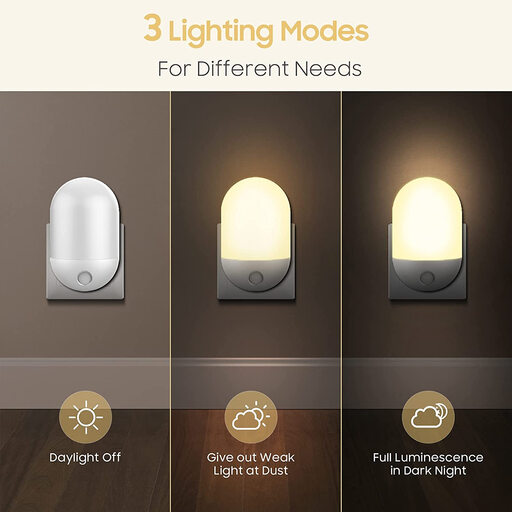
Why it suits this profile: This plug-in model is easy to use in a bedroom, nursery or hallway. The light sensor is suitable for anyone who does not need motion detection or app control.
The product information states a warm colour temperature of 2800-3200 K and a power consumption of 0.5 W. This means you do not have to pay for unnecessary RGB or smart features.
Light sensor, warm white light, 20 lumens and a compact ABS and metal housing for indoor use.

Why it suits this profile: Suitable for anyone who wants to create ambience as well as functional lighting behind a bed, cupboard or television, and considers app or voice assistant control important.
The strip is dimmable and, according to the product description, can be cut to size. However, check the required length and positioning beforehand.
10-metre length, colour changing, dimming function, app control, remote control and Matter support according to the product information.
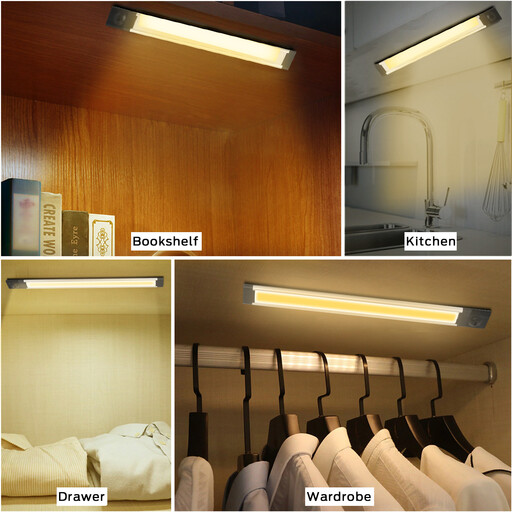
Why it suits this profile: A practical choice for a long hallway, cupboard, staircase, garage or another area that needs more light than standard bedroom lighting.
The magnetic mounting and included hooks mean you do not have to drill straight away. However, the lamp may be more powerful than necessary for a dark bedroom.
400 lumens, adjustable colour temperature from 2800-6500 K, gesture control and a rechargeable design according to the product description.
LED lighting generally uses little power. However, check the stated wattage and operating time. A 0.5- or 1-watt lamp has limited energy consumption when used occasionally. A lamp that stays on continuously will naturally use more power than a model with a sensor or timer.
Place the sensor where it can clearly detect your body or direction of travel, for example along a hallway wall or underneath a cupboard. Avoid direct obstruction by furniture. For a nursery or bedroom, warm white light at a low brightness is often more practical than bright, cool white light.
An RGB night light is mainly intended for ambience and colour accents. For finding your way around at night, a soft warm white setting and dimming function are usually simpler. Check whether the lamp can remember a fixed colour and whether a timer is available if you do not want the light to remain on all night.
We have compiled a complete, up-to-date list of products that fully meet these strict selection criteria and the applicable European safety regulations.
