
Vandaag of morgen in huis

Kwaliteit gegarandeerd

Welkomstaanbiedingen ontgrendelen: GRATIS bezorging | Tot 80% korting | Gratis 30 dagen JoyPlus-proefperiode
Download de app
An LED night light with a sensor can be useful in a dark hallway, nursery, bedroom, bathroom or toilet. The light switches on automatically when needed, so you do not have to search for a switch in the middle of the night. However, sensor lights vary considerably in how they are operated, their light colour and their energy consumption.
Pay particular attention to these three common pitfalls:
A sensor that is unsuitable for the room
A light sensor responds to darkness, while a motion sensor only switches on when someone walks past. Motion detection can be practical in a hallway or toilet. For a nursery or bedroom, a night light with a light sensor is often calmer, as it does not switch on with every movement.
Light that is too bright or too cool
A high light output is not automatically helpful when you need to pop to the bathroom during the night. Check the number of lumens and the colour temperature. A warm white night light of around 2800 to 3200 K generally creates a softer atmosphere than cool daylight.
Incomplete product information
Check whether the product page provides information about voltage, wattage, dimensions, material, sensor range and installation. It is also important to know whether the light plugs into a socket or is battery-powered. A battery-powered model requires periodic maintenance, while a plug-in light works directly from the socket.
A night light with a light sensor switches on when the ambient light falls below a certain level. The model with an automatic light sensor in this selection, for example, states that it switches on at a maximum of 20 lux and off in daylight. This suits a light that can remain available throughout the night.
A night light with a motion sensor responds to activity. For one selected model, the stated detection range is 3 to 5 metres, and movement is detected in low ambient light. This may be suitable for a hallway, toilet or landing where you only need lighting while passing through.
Also consider positioning. A sensor light behind a cupboard door, next to a bed or low down near the floor needs a different viewing angle from a light in an open hall.
The number of lumens indicates how much light the lamp produces according to the product specification. A model with 20 lm is intended as modest orientation lighting. An Aigostar model states 40 lm and a 120-degree beam angle. This can be useful when a larger part of the room needs to be visible.
A dimmable night light gives you greater control. The selected 2-pack models state a stepless dimming function from 10% to 100% or touch dimming, depending on the model. Check in advance whether the dimming function is operated by touch, a switch or another control.
For a bedroom or night light for a nursery, many households choose a warmer colour temperature. A lamp of 2800-3000 K or 2800-3200 K is listed as warm white in the product specifications. Other models specify 4000-4500 K or 6500 K. The latter colour is noticeably cooler and may be better suited to a cupboard, storage area or room where functional light is more important.
An energy-efficient night light usually has a low wattage. This selection includes ratings of 0.3 W, 0.5 W and 1 W. Actual energy consumption depends on how long the lamp is on, how often the sensor switches it on and whether the lamp stays on continuously.
Pay attention to the voltage information:
The listed materials for several models are ABS and metal. Do not use a plug-in lamp where it may come into direct contact with water or high levels of moisture. Follow the safety warnings on the product page and unplug the lamp before cleaning it.
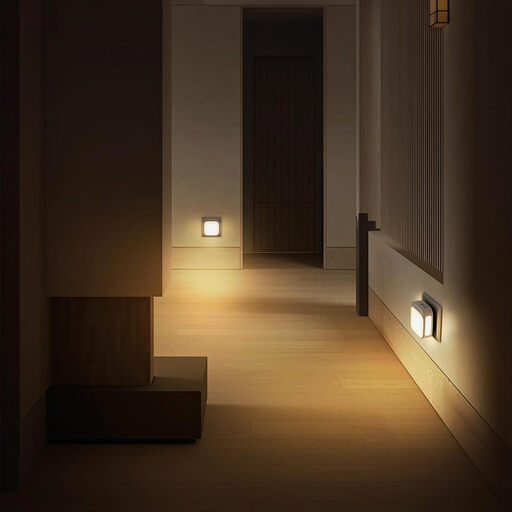
Why it suits this profile: Two lights provide an easy starting point for, for example, the hallway and nursery. The automatic light sensor and low stated wattage of 0.3 W mean all you need to do is set them up and plug them in.
The light sensor means you do not have to switch the lights on manually each time. The 10%-100% dimming range helps prevent the setting from being too bright.
2-pack, warm white 2800-3000 K, 0.3 W, 110-240 V and stepless dimming according to the product description.
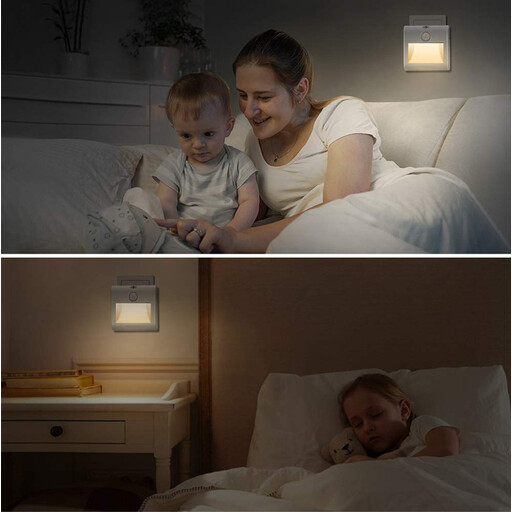
Why it suits this profile: This model combines a constant light setting with automatic motion detection. The touch control and memory function are practical when you regularly want to use the same brightness level.
The two operating modes clearly distinguish between continuous lighting and sensor control. Detection is stated to work at a maximum of 20 lux and over 3-5 metres.
2 lights, 20 lm, touch dimming, memory function and 100-240 V according to the product details.
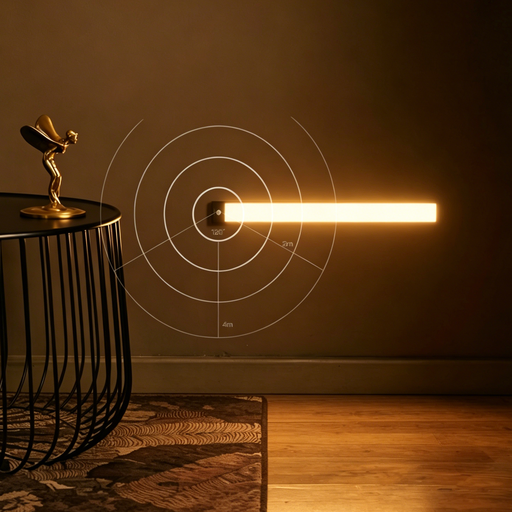
Why it suits this profile: At 20 cm long, this model is an interesting sensor light for a cupboard, shelf or another narrow space where a plug-in light is less suitable.
The product name specifies the size and sensor function. Before buying, check the exact power supply and installation method for your cupboard.
20 cm length and a black finish; designed for targeted lighting in a cupboard or similar space.
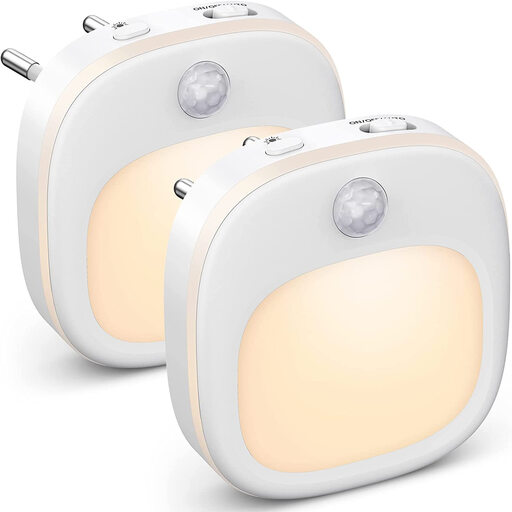
Why it suits this profile: The combination of two lights, three colour temperatures and five dimming levels offers flexibility for, for example, the bedroom, landing and hall.
You are not limited to a single light colour or brightness level. Check which sensor setting is most practical for each room.
2-pack, 3 colour temperatures, 5 dimming levels and 1 W power according to the product name and description.
We have compiled a complete, up-to-date list of products that fully meet these strict selection criteria and the applicable European safety regulations.
That depends on the set light threshold. According to the product description, models with an automatic light sensor switch on when it gets dark and off in daylight. Do not place the lamp directly next to another light source, as this may affect the sensor.
A light sensor is suitable when you want fixed orientation lighting throughout the hours of darkness. A motion sensor is more practical when the light should only come on when someone gets out of bed or walks through the room. For a night light in a toilet or hallway, motion detection can save energy because the lamp does not remain on unnecessarily.
Check the stated wattage and usage time. A 0.3 W lamp uses less energy during continuous operation than a 1 W model. With sensor control, the lamp is often on for shorter periods, but exact consumption depends on the number of activations and the selected light setting. Also check whether the model runs on mains power or batteries.
