
Vandaag of morgen in huis

Kwaliteit gegarandeerd

Welkomstaanbiedingen ontgrendelen: GRATIS bezorging | Tot 80% korting | Gratis 30 dagen JoyPlus-proefperiode
Download de app
An LED night light with sensor may seem straightforward: the light comes on when it gets dark or when someone walks past. However, there are clear differences between models. The wrong sensor can switch on too brightly in the middle of the night, a plug-in model may block another socket, and a cupboard light may be less suitable as general hallway lighting.
The main pitfalls are:
Confusing a motion sensor with a light sensor
A night light with a light sensor responds to the amount of ambient light. A night light with a motion sensor responds to movement, usually within a certain range. These functions are not the same. Motion detection is practical in a hallway; a light sensor may be more convenient for a socket beside the bed.
Light that is too bright or too cool
High light output is not always desirable in a bedroom or nursery. Check the colour temperature and the number of lumens. Warm white light around 2800-3200 K generally looks softer than cool daylight. If you want to adjust the brightness, it is better to look for a dimmable LED night light.
Not paying enough attention to placement and energy consumption
A 1 W model uses very little energy, but a sensor that stays on during the day is less efficient than a night light that switches off automatically. Also check whether the product plugs directly into a socket, runs on batteries or is intended as cupboard lighting.
First consider what you need the light for:
Placement affects how the sensor works. Do not point a motion sensor directly at a busy passageway if you do not want the light to keep switching on. In a nursery, a light sensor may be more comfortable than a sensor that activates with every small movement.
For a night light for a bedroom or night light for a nursery, 20 lumens is often enough for gentle orientation lighting. Product 1 uses warm white light at 2800-3200 K and specifies 20 lumens at 0.5 W. Product 8 offers adjustable brightness from 10 to 100 per cent and a colour temperature of 2800-3000 K.
Bear in mind that terms such as “soft” or “comfortable” in product descriptions are subjective. Therefore, focus mainly on:
Warmer light can suit a bedroom. For a cupboard or worktop, neutral white light may be more practical. Product 3, the Yeelight Closet Sensor Light A20, is 20 cm long and is intended as Yeelight cupboard lighting.
A plug-in night light is ready to use straight away and does not require batteries. However, check that its size leaves enough room for other plugs. Product 1 has a power consumption of 0.5 W and a housing made from ABS and metal. Product 8 uses 0.3 W and comes as a set of two.
Battery-powered models can be positioned more flexibly, but they require periodic maintenance. With every model, it is advisable to follow the instructions, avoid covering the product and only use it in damp areas if the manufacturer states that it is suitable. A product intended for indoor use is not automatically suitable for direct contact with water.
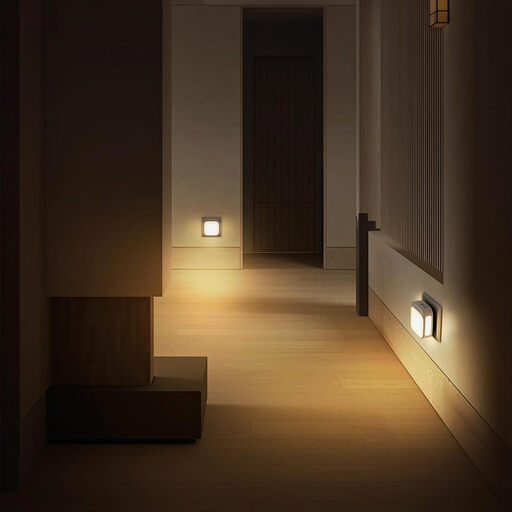
Why it suits this profile: The set of two is practical for, for example, a bedroom and hallway. The light sensor works automatically in the dark, without manual operation.
The specifications state 0.3 W, warm white light at 2800-3000 K and dimming from 10 to 100 per cent. This means you do not have to rely solely on general marketing terms.
Two lights, 20 lumens, an automatic light sensor and compact dimensions of approximately 7 x 2.5 x 6.12 cm per light.
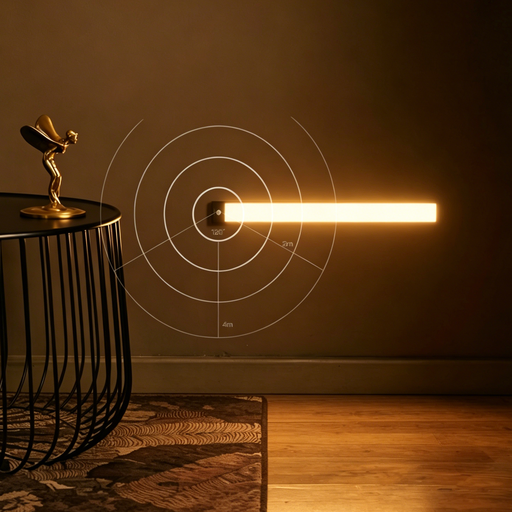
Why it suits this profile: This model is designed for targeted lighting in a cupboard or piece of furniture, making it suitable for anyone looking for a compact sensor light rather than a lamp for an entire room.
The 20 cm length makes it clear that this is a dedicated cupboard lighting solution. Do not choose it as general hallway lighting without first checking the dimensions and installation location.
20 cm length, sensor function and a choice of black finish. A silver version is also available.
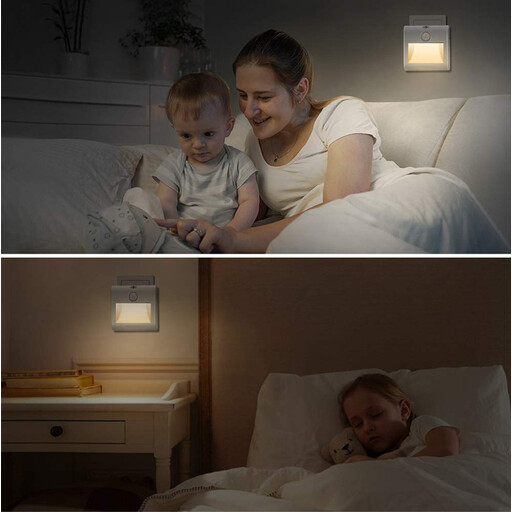
Why it suits this profile: The combination of motion detection, continuous lighting and touch dimming is suitable for several areas around the home, such as the bedroom, toilet and hallway.
The product information specifies a range of 3-5 metres, a maximum threshold of 20 lux in automatic mode and a memory function for the last selected brightness.
Set of two, 1 W per light, stepless touch dimming, 20 lumens and a choice between continuous light and sensor mode.
We have compiled a complete, up-to-date list of products that fully meet these strict selection criteria and the applicable European safety regulations.
That depends on how it is used. A light sensor may stay on throughout the entire dark period. A motion sensor usually switches on only when someone passes by. For hallway lighting with a sensor, motion detection can therefore be practical. In a nursery or beside the bed, a light sensor may be less likely to activate unexpectedly.
Plug the night light into a suitable socket and check that the sensor is not covered. Position it close to the floor if it is intended for a hallway or toilet, so that the path is visible without the light shining directly into your eyes. Keep it away from water and follow the manufacturer's safety instructions.
Look at the wattage and the number of hours it is switched on. A 0.3 W lamp uses approximately 0.3 kWh over 1,000 operating hours. A 1 W model uses approximately 1 kWh under the same conditions. The actual cost depends on the electricity price and how often the sensor activates. Therefore, do not just look for the words energy-efficient night light; also check the stated wattage and sensor function.
