
Vandaag of morgen in huis

Kwaliteit gegarandeerd

Welkomstaanbiedingen ontgrendelen: GRATIS bezorging | Tot 80% korting | Gratis 30 dagen JoyPlus-proefperiode
Download de app
An LED night light with sensor can be useful when you do not want to search for a switch every night. In a nursery, hallway, on the stairs or in the toilet, the light comes on automatically when it gets dark or when someone walks past. However, not every sensor night light is suitable for every room.
Pay particular attention to three common pitfalls:
A night light with light sensor generally switches on as soon as the ambient light falls below a certain threshold. For the 2-pack with warm white light, this threshold is specified as ≤20 lux. The light can therefore remain on throughout a dark night without you needing to walk past the sensor.
A night light with motion sensor responds to movement within a specific range. The set of two motion sensor lights has a stated range of 3 to 5 metres and operates at an ambient light level of no more than 20 lux. This can be practical in a hallway, on the stairs or in the toilet, where you only need lighting for a short time.
When buying, therefore check:
For a night light for a bedroom or nursery, it is not just the number of lumens that matters. The colour temperature determines how the light looks:
The models listed provide approximately 18 to 40 lumens. This is intended for orientation rather than lighting an entire room. A dimmable night light gives you extra control. The 0.3 W 2-pack offers stepless dimming from 10% to 100%, while the rechargeable model with warm white and RGB lighting is steplessly dimmable in warm white mode.
A higher CRI value, such as CRI >85, means that colours are rendered more naturally according to the product information. Treat this as a technical product specification, not as a guarantee of any particular sleep or health effect.
An energy-efficient night light uses very little electricity, but the difference between models can still be relevant when the light stays on for long periods every night. According to the product specification, the 2-pack with light sensor uses 0.3 W per lamp. The 0.5 W model also uses little power and is designed for connection to 110-220 V.
A rechargeable night light works without a permanent power socket. The RGB model has a built-in battery and is charged via 5 V/1 A USB. This is handy when you want to place the light temporarily on a bedside table, shelf or child’s furniture. The trade-off is that you need to charge the battery in good time.
Also consider the dimensions and positioning. Plug-in lights must not block sockets, switches or ventilation openings. Keep all models away from water and excessive moisture. Clean them with a soft, dry cloth and unplug a plug-in light before cleaning it.
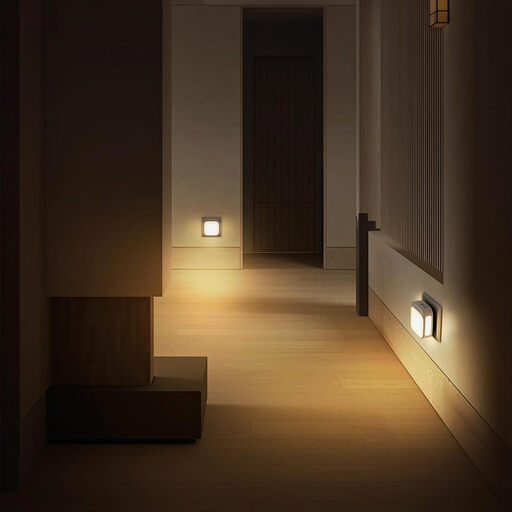
Why it suits this profile: Two compact plug-in lights provide a simple solution for, for example, the nursery and hallway, with no battery or separate installation required.
The light sensor is clearly specified to switch on at ≤20 lux. The dimming range of 10%-100% is also stated, allowing you to adjust the brightness.
0.3 W power per lamp, warm white light of 2800-3000 K and a set of 2 night lights.
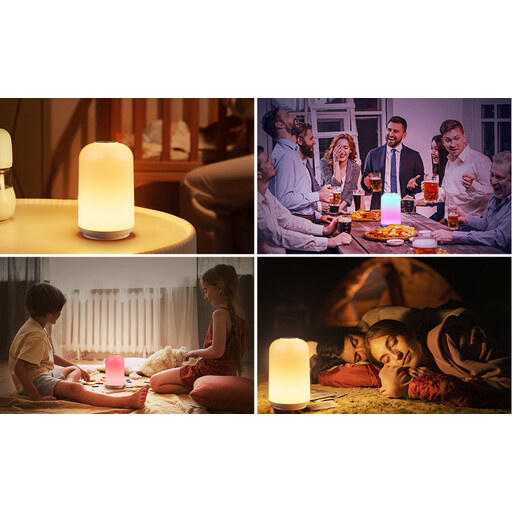
Why it suits this profile: This model is suitable for anyone who values flexible positioning and multiple light modes, for example in a child’s bedroom or on a bedside table.
You are not tied to a single power socket. The lamp is rechargeable via USB and offers an RGB mode as well as warm white. However, check in advance how often it will need charging in your situation.
12 SMD LEDs, 40 lumens, warm white light of 2600-2800 K, stepless dimming in warm white mode and seven RGB colours.
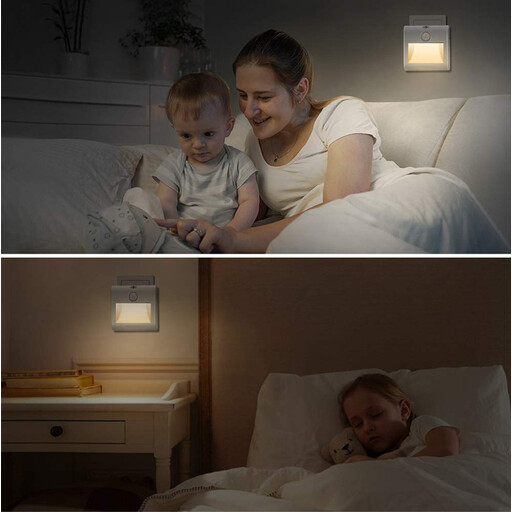
Why it suits this profile: This set is ideal for families who want to light several passageways, such as the bedroom, landing, hallway and toilet.
As well as the motion sensor, a constant-light mode is specified. The touch controls and memory function mean you do not have to set your preferred brightness again and again.
Two lamps, motion detection over 3-5 metres, stepless dimming and a stated power consumption of 1 W per lamp.
We have put together a complete, up-to-date list of products that fully meet these strict selection criteria and the applicable European safety regulations.
For a nursery night light, position the lamp so that the light does not shine directly into anyone’s eyes. A low power socket can be convenient for soft orientation lighting, but check that cables, plugs and the light remain out of children’s reach.
In a hallway or near the stairs, a motion sensor is often practical. Point the sensor towards the route people take and make sure that furniture does not obstruct the detection area. For the toilet, a light sensor may be sufficient if you want a continuous low level of light. A rechargeable model is useful in places without a suitable power socket, but requires more maintenance because it needs charging.
An RGB night light is mainly intended for creating ambience or variety. If you only want to see where you are walking at night, choose a model where warm white light can be set separately.
The sensor detects movement within the specified range and switches the light on when it is dark enough. The exact operation varies by model. Therefore, check the detection range, the lux threshold and whether the lamp switches off again after a certain period.
This depends on the power rating and how long the light is on. According to a straightforward power calculation, a 0.3 W lamp uses less energy than a 1 W model when both are switched on for the same length of time. With a motion sensor, actual consumption may be lower if the lamp is only active for short periods. With a rechargeable model, you do not pay for electricity continuously while the lamp is operating, but you do need to charge the battery.
The operating time per charge depends on the brightness, selected light mode and battery capacity. An Aigostar model is specified as having a battery life of 6 hours. This is the manufacturer’s product specification; actual operating time may vary depending on the settings. Also check the charging voltage and only use a compatible USB charger.
