
Vandaag of morgen in huis

Kwaliteit gegarandeerd

Welkomstaanbiedingen ontgrendelen: GRATIS bezorging | Tot 80% korting | Gratis 30 dagen JoyPlus-proefperiode
Download de app
An LED night light with sensor can be useful in the bedroom, nursery, hallway, bathroom or toilet. The light comes on automatically when needed, so you do not have to search for a switch in the middle of the night. However, these lights vary considerably in how they work, their brightness and their installation.
Marketing copy often focuses on “smart” sensors or long battery life. Always check the technical specifications carefully. This helps you avoid a light that is too bright for the bedroom, switches on unexpectedly or needs recharging again after a short time.
A night light with motion sensor responds to movement within a certain distance. A night light with light sensor, on the other hand, monitors the amount of ambient light. Some models combine both functions: they only switch on when it is dark and movement is detected.
Pay attention to the stated values. A sensor range of 3 to 5 metres and an activation level of, for example, 20 lux or lower, give you a clearer picture than the word “automatic” alone.
A light for a hallway can provide clear illumination, but a high light output may be impractical beside a bed. Check the number of lumens (lm) and the dimming options:
A dimmable night light gives you greater control. Also check whether the dimming is continuous or controlled using fixed settings.
A wireless night light may have a built-in rechargeable battery, but it may also simply mean that there is no separate cable during use. A rechargeable model can be placed flexibly, but its operating time depends on the selected brightness and the number of activations.
A plug-in light does not need recharging, but it does require an available socket. When using a light in a bathroom or near a washbasin, always check the moisture warnings. The models described are not automatically suitable for wet areas when no IP rating is provided.
For a bedroom night light or LED nursery night light, it is useful to have a sensor that does not react to every minor change. Look out for:
A light with only a light sensor will generally remain on for as long as it is dark. This can be useful in a hallway, but less suitable when you only need light briefly.
Colour temperature is measured in kelvin (K):
According to the brands’ own product information, some models offer several colour temperatures. Treat this as an adjustment option, not a guarantee of a particular effect on sleep or health.
An LED light of 0.3 W or 1 W uses relatively little power when connected to a socket. Actual consumption depends on how long it is used. For a rechargeable night light, battery capacity and runtime are more important.
Also check:
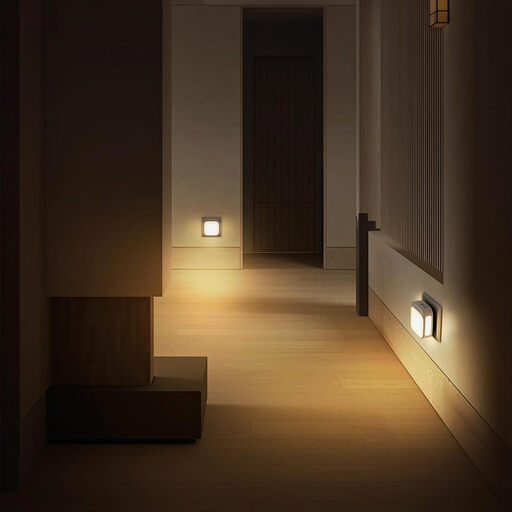
Why it suits this profile: This 2-pack of night lights is practical for two locations, such as the bedroom and hallway. The automatic light sensor switches on in the dark and off in daylight.
The specifications state a power rating of 0.3 W, a light output of 20 lm and a dimming range of 10–100%. This lets you adjust the light instead of relying on a single fixed setting that may be too bright.
2 lights, warm white 2800–3000 K, continuously variable dimming and power via a standard socket.
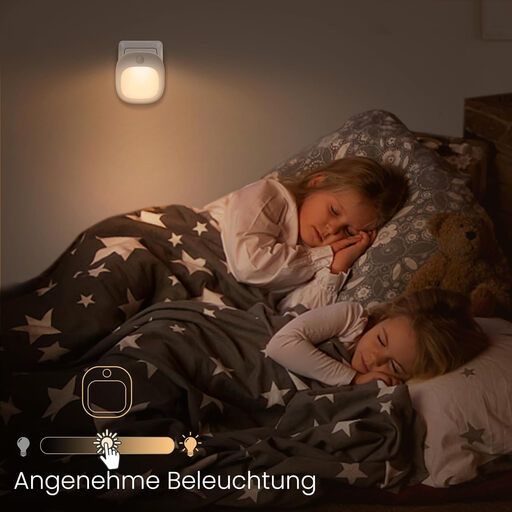
Why it suits this profile: If there is no socket near the desired location, these rechargeable lights can be placed wherever you need them. They are suitable for a nursery, bedroom, cupboard or landing.
According to the product information, the motion sensor only operates in low ambient light and has a range of 3–5 metres. This helps prevent unnecessary activation during the day.
500 mAh battery, USB charging, 3 colour temperatures, 5 brightness settings and, according to the product specifications, up to 10 hours of use in sensor mode.
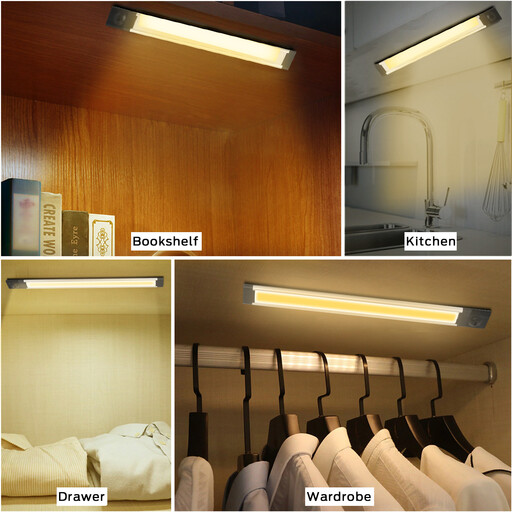
Why it suits this profile: This model is designed for areas where more light is needed, such as a staircase, wardrobe, garage, cellar or longer hallway. It can be installed without drilling, using magnets or hooks.
The product specifications state 400 lm, a range of 2800–6500 K and gesture-controlled dimming. This means the light is not limited to a single fixed colour or brightness level.
36 SMD LEDs, USB rechargeable, magnetic mounting and an elongated size of 26 × 4 × 1 cm.
We have put together a complete, up-to-date list of products that fully meet these strict selection criteria and the applicable European safety regulations.
For a simple solution that plugs into a socket, a model with a light sensor is sufficient. The Aigostar LED Sensor Night Light 1W states 40 lm, a day/night sensor, 230 V and consumption of 0.5 kWh per 1000 hours. See the Aigostar light product information for the exact version.
Would you like to operate two sockets remotely, for example for a lamp or decoration? A wireless remote-control socket works differently from a sensor light. According to the product description, the Dewenwils set has an RF range of up to 30 metres, a maximum load of 3680 W and a wall-mounted transmitter with no cable. Only use the system within the stated electrical rating and check the power consumption of the connected light.
Place a plug-in model directly into a suitable socket. With a rechargeable model, charge the battery via USB and select the sensor mode, colour temperature and brightness. Do not place the light behind furniture if the sensor needs to detect movement. Keep the openings and sensor unobstructed.
This varies depending on the battery, brightness and number of activations. The stated 2-pack has a built-in 500 mAh battery and offers up to 10 hours of use in sensor mode. Treat this as a product specification under the stated conditions; everyday use may produce different results.
Consumption depends on the power rating and how long the light is on. A 0.3 W or 1 W light uses little energy compared with much larger lights, but the exact cost depends on your electricity tariff. A light or motion sensor can help prevent the light from staying on unnecessarily long.
