
Vandaag of morgen in huis

Kwaliteit gegarandeerd

Welkomstaanbiedingen ontgrendelen: GRATIS bezorging | Tot 80% korting | Gratis 30 dagen JoyPlus-proefperiode
Download de app
An LED night light with a motion sensor can be useful in a dark hallway, bedroom, nursery, wardrobe or kitchen. The light switches on automatically when it detects movement, so you don’t have to search for a switch. However, these lights can vary considerably in how they’re powered, their sensor range, light colour and running costs.
Look out for these common pitfalls:
A PIR motion sensor responds to movement within a particular range. According to the product information, the models available often have a range of around 3 to 5 metres. That’s suitable for a hallway or wardrobe, but where you position the light still matters. Point the sensor towards the area where you walk, and don’t fit the light behind an obstacle.
A light sensor works differently. It switches on when the ambient light falls below a certain level, for example around 20 lux, and switches off again in daylight. A combination of light and motion detection stops the light switching on unnecessarily during the day.
A plug-in night light with a sensor is suitable for a fixed socket and doesn’t need to be charged. However, check that the socket is in a convenient place and that the plug won’t block other sockets.
A rechargeable LED night light gives you more flexibility. Models with a 500 mAh battery are compact, while a version with 1100 mAh has a higher capacity. Actual running time depends on the brightness, number of activations and mode selected. Any stated running time is therefore a guide, not a guarantee for every situation.
When charging via USB, check the stated input, such as 5 V or 5 V-1 A, and use a compatible charger. A light with magnetic or adhesive fixing is handy for a wardrobe, but it needs to be securely attached to prevent it falling.
For a night light in a bedroom or nursery, warm white light at around 2800-3200 K is often more soothing than cool white light. In a kitchen or wardrobe, neutral or cool light may be more practical, as it makes colours easier to see.
Some lights offer three colour temperatures, such as warm white, neutral and cool white. A dimmable night light with several brightness settings is versatile enough for different rooms. Also check the light output in lumens. A 20-lumen model is suitable for orientation lighting; a version with 30 lumens or more provides a little more light for a wardrobe or passageway.
A stated CRI value, such as CRI >85, indicates how accurately colours are rendered. Also check whether the product is suitable for a damp room. The models described are not designed to be exposed to water or excessive moisture, so don’t use them right beside a shower or washbasin unless they have the appropriate protection rating.
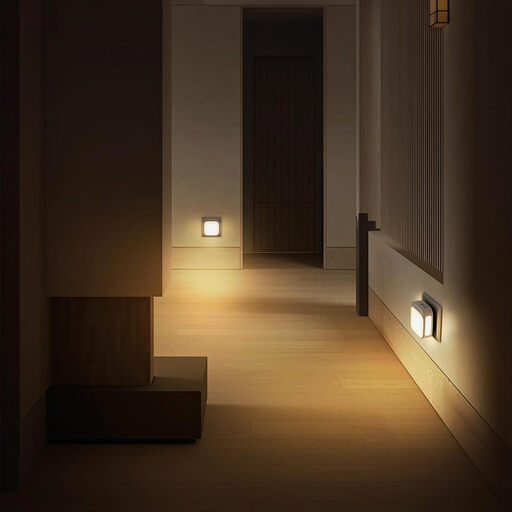
Why it suits this type of buyer: This set is ideal if you want automatic warm white lighting in two fixed locations, such as a hallway and nursery.
According to the product information, the light sensor switches the light on when ambient light is low, so you don’t have to switch it on manually.
Two lights, 0,3 W per light, warm white light at 2800-3000 K and stepless dimming from 10 to 100 per cent.

Why it suits this type of buyer: Its long, slim design is made for wardrobe shelves, kitchen cupboards and other narrow surfaces where even lighting is needed.
The product description lists PIR detection with a range of 3-5 metres, USB charging and drill-free fixing. Check beforehand that the adhesive strip is suitable for your surface.
Two 40 cm lights, 61 LEDs, three colour temperatures and a built-in 1100mAh battery.
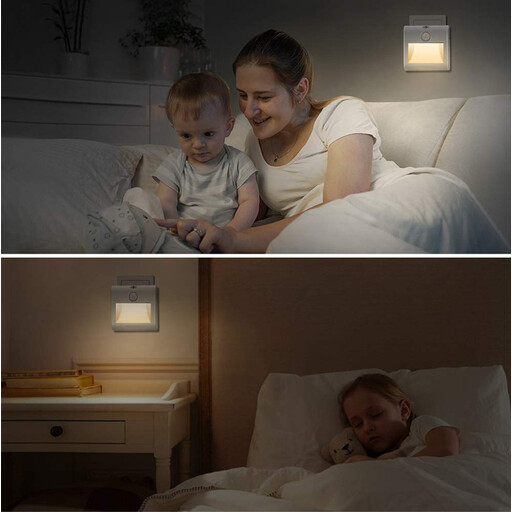
Why it suits this type of buyer: This set is a good fit for households looking to combine fixed lighting with automatic activation in places such as a bedroom, toilet or hallway.
As well as sensor mode, there’s a constant-light mode. The touch controls and memory function save you from having to reset the brightness each time.
Two lights, 1 W power, 20 lumens, 20-lux light detection and stepless dimming with a memory function.
We’ve put together a complete, up-to-date list of products that meet these strict selection criteria and the applicable European safety regulations.
The running time between charges depends on the battery capacity, brightness setting and number of movements detected. According to the product information, a 500 mAh model can be used for up to 10 hours in sensor mode. A 1100 mAh battery has a higher capacity, but the exact running time still depends on how it’s used.
LED lighting generally uses little power. The plug-in models in this selection, for example, are listed as using 0,3 W or 1 W. A sensor can help reduce consumption by keeping the light off when it’s not needed. Actual usage depends on how often and for how long the light switches on.
In a hallway, position the light at around eye or hip height, pointing towards the route you walk along. In a wardrobe, it often works better when fitted inside or underneath a shelf. Always test the sensor range first, and avoid locations where direct daylight or an obstacle could affect detection.
