
Vandaag of morgen in huis

Kwaliteit gegarandeerd

Welkomstaanbiedingen ontgrendelen: GRATIS bezorging | Tot 80% korting | Gratis 30 dagen JoyPlus-proefperiode
Download de app
An LED night light can make a dark hallway, nursery or bedroom feel more comfortable without switching on the main light. However, models vary considerably in terms of controls, brightness and battery life. A light that looks convenient in the product photo may be too bright in practice, run out of power quickly or fail to respond properly to movement.
So don’t just focus on the number of LEDs or colour options. Think about how you’ll use the light: do you want soft lighting for a night-time feed, automatic light in a dark hallway or wireless cupboard lighting with a sensor?
The stated operating time often applies only to the lowest brightness setting. For example, the VAVA Baby Night Light is advertised as offering up to 100 hours, but according to the product information, this applies at the lowest brightness and not in night light mode. At maximum brightness, the stated operating time is approximately 7 hours.
So check:
A night light with a motion sensor usually only works when it is dark enough. On some models, the light threshold is around 20 lux or 40 lux. The range is also limited. The models described, for example, have a detection range of approximately 3 to 5 metres.
So don’t place the light behind a cupboard door, curtain or large piece of furniture. A sensor light can be useful in a hallway, while constant lighting or touch controls may be more practical on a bedside table.
An RGB night light offers a range of colours, but warm white light is generally more practical for night-time care or finding your way around calmly. Check the colour temperature and whether the light can be dimmed. A bright, cool-toned lamp can produce unnecessarily harsh light in a dark bedroom.
For an LED light for a nursery, bedroom or night-time care, warm white light is often the obvious choice. Product specifications may describe warm white as approximately 2600–2800K or 2800–3200K. A lower colour temperature generally looks warmer than bright white light at, for example, 6500K to 7000K.
A dimmable night light gives you greater control. Stepless dimming offers plenty of intermediate settings, while models with five brightness levels are simpler and often quicker to operate.
A rechargeable night light with a built-in battery is portable and suitable for a bedside table, changing table or travel. Check the battery capacity and stated operating time. A 500mAh model is compact, but according to the product description of one of the models, it can run for up to 10 hours in sensor mode.
A battery-powered light, such as the Koopman LED Table Lamp Carousel, uses 2 AAA batteries, which are not included. This can be useful if there is no USB connection nearby, but remember to factor in ongoing battery costs.
Measure the space where you intend to place or hang the light. An ultra-thin 10mm light is suitable for narrow kitchen cupboards, while a portable light on a bedside table can take up a little more room.
Also consider:
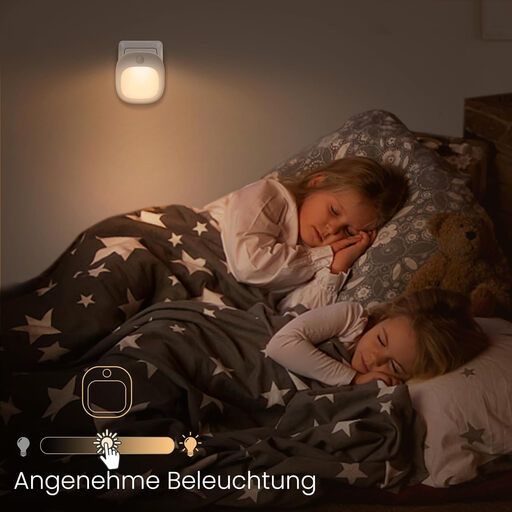
Why it suits this profile: This wireless night light combines two lighting modes with three colour temperatures and five brightness levels. This allows you to illuminate several dark areas around your home without needing a mains socket nearby.
According to the description, the sensor works in low ambient light and within approximately 3–5 metres. The stated operating time of up to 10 hours applies specifically to sensor mode.
Built-in 500mAh battery, USB charging, 30 lumens, three colour temperatures and five dimming levels.
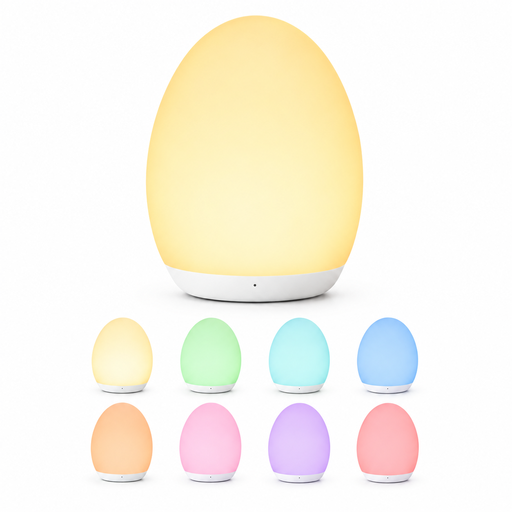
Why it suits this profile: The controls are designed for use beside the bed or during a night-time feed. You get warm white light, eight colour modes, touch controls, a memory function and a one-hour timer.
The product information distinguishes between a maximum of 7 hours at full brightness and up to 100 hours at the lowest setting. This makes the battery claim easier to assess.
2000mAh battery, dimmable warm light, 1-hour timer and compact dimensions of 9,2 × 9,2 × 11 cm.

Why it suits this profile: This 2-pack is designed for longer surfaces such as kitchen cupboards, wardrobes and shelves. At 40 cm long, with 61 LEDs per light, it offers a practical solution for sensor-activated cupboard lighting.
The dimensions, 3–5 metre sensor range and three colour temperatures are clearly specified. This allows you to check in advance whether the light is suitable for your cupboard and intended use.
Two 40 × 3,8 × 1 cm lights, 1100mAh battery per light, USB charging, PIR detection and a choice of warm, neutral or cool light.
We’ve put together a complete, up-to-date list of products that fully meet these strict selection criteria and the applicable European safety regulations.
That depends on its placement, brightness and controls. Ideally, choose a model with dimmable warm white light and keep it out of your child’s reach. A light with a charging cable must also be kept out of reach while charging. Always follow the manufacturer’s safety instructions and do not use the light in a damp environment unless this is permitted.
Operating time varies depending on battery capacity, brightness setting and mode. A sensor setting generally uses less power than continuous lighting, but you should always check the stated operating time in the product information. According to VAVA’s own product information, the quoted 100 hours can only be achieved at the lowest brightness.
Many models have a low stated power rating, such as 0,5 to 1 watt. Actual consumption depends on how long the light remains on. With a rechargeable model, you mainly pay for recharging the battery; with a model using AAA batteries, replacement costs are an ongoing consideration. For an accurate comparison, check the stated wattage and the number of hours the light is used per day.
