
Vandaag of morgen in huis

Kwaliteit gegarandeerd

Welkomstaanbiedingen ontgrendelen: GRATIS bezorging | Tot 80% korting | Gratis 30 dagen JoyPlus-proefperiode
Download de app
An LED night light might seem like a simple purchase, but the wrong model can quickly disappoint. Sometimes the light is too bright for the bedroom, the sensor reacts to every tiny noise, or the battery needs recharging far too often. For a night light in the nursery or a child's room, material, placement and supervision also play a key role.
Pay particular attention to these three common pitfalls:
For a night light in the bedroom or nursery, soft light is usually more pleasant than a bright white lamp. Colour temperature is expressed in kelvin (K):
A dimmable night light gives you more control. A model with multiple brightness levels is handy when you need more light during the day than at night. Also check whether the product information mentions a lumen value. A lamp of 20 lumens is generally intended as orientation lighting, not as general room lighting.
A night light with a sensor can switch on automatically when it gets dark. This is practical in a hallway or bathroom, where you don't want to fumble for a switch every time. A night light with a motion sensor is more suitable for short passages, for example past a wardrobe or on the way to the toilet.
Pay attention to the range and placement. A PIR sensor on a particular model might, according to the product specification, detect movement within 3 to 5 metres. In a small nursery that can be sufficient, but in a long hallway the coverage may be limited.
A timer prevents a lamp from staying on all night. For children's lighting, an automatic switch-off after 30 minutes is a useful feature, as long as the child isn't then left in complete darkness if that's not desired.
A plug-in lamp is ready to use straight away and doesn't need charging. A rechargeable night light, on the other hand, is more flexible to place. Check:
For a lamp intended for children, rounded shapes and clear age recommendations are important. A product description might mention BPA-free silicone or ABS/PC, but always follow the official warnings. A lamp with small parts or loose batteries should not be within reach of young children. Do not use a lamp as a toy if the manufacturer does not indicate it is suitable.
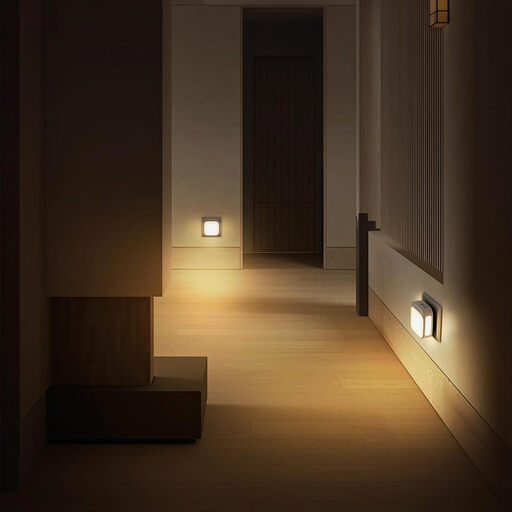
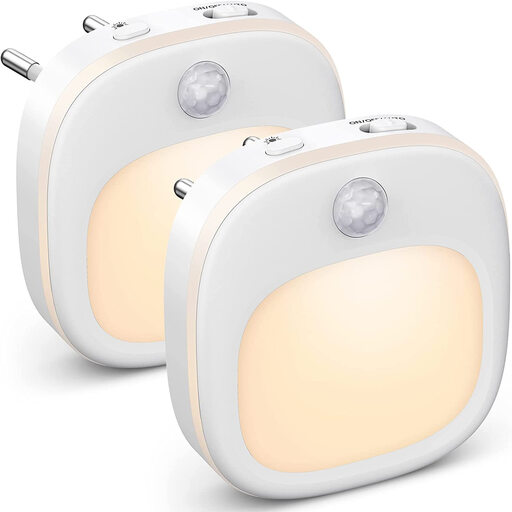
Why this fits the profile: A set of two plug-in lamps is practical for, say, the hallway and nursery. The automatic light sensor works without manual operation.
The specifications state 0.3 W, 20 lumens and a dimming range of 10-100%. This allows you to assess energy consumption and light level separately.
Warm white light at 2800-3000 K, stepless dimming and supplied as a 2-pack.
Why this fits the profile: If you want to set up different rooms, you get three colour temperatures and five dimming levels. This makes the model flexible for the bedroom, hallway and nursery.
The product name makes it clear this is about motion detection, not just a light sensor. Do check whether your chosen location falls within the detection range.
SMD LED at 1 W, three colour temperatures and five levels of dimmability.

Why this fits the profile: This rechargeable night light is designed for LED cabinet lighting, kitchen cupboards and dark shelves. The slim housing measures 300 x 38 x 10 mm.
The PIR sensor is specified with a range of 3-5 metres. Additionally, no permanent power connection is needed, but the 1100mAh battery does need to be recharged.
41 LEDs, three colour temperatures, USB charging and adhesive strip mounting without drilling.

Why this fits the profile: This children's night light is portable and has a soft silicone housing, touch control and a timer. It suits a child's bed or bedside table.
The three brightness levels and the 30-minute timer prevent you from being stuck with a single, fixed bright setting. Follow the age and supervision instructions in the product information.
1200mAh rechargeable battery, stated usage time of 8-10 hours and three dimming levels.
We've put together a full, up-to-date list of products that fully meet these strict selection criteria and current European safety regulations.
That depends on the wattage and the duration of use. Models of 0.3 to 0.5 W use relatively little electricity when running continuously. A sensor or timer can further limit consumption. Always compare the stated power with the light output in lumens.
The usage time varies depending on the battery, brightness setting and sensor activity. A product might, for example, state 8-10 hours of use per charge, but that's not a fixed guarantee for every setting. Also check the charging time and charge the lamp before using it for long periods unattended.
A night light can be used as orientation lighting, but pay attention to the age warning, loose parts, battery compartment and placement. Choose a model with low brightness if possible and place it out of the baby's reach. Check the product specifications and instructions for use before purchasing.
