
Vandaag of morgen in huis

Kwaliteit gegarandeerd

Welkomstaanbiedingen ontgrendelen: GRATIS bezorging | Tot 80% korting | Gratis 30 dagen JoyPlus-proefperiode
Download de app
An LED night light can be useful in a nursery, bedroom, hallway, cupboard or toilet. However, not every model is equally practical. A light that appears soft in the product photo may be too bright in reality. A motion sensor may switch on unexpectedly, while a wireless model may run out of charge sooner than expected.
Joybuy Product Recommendation Officer helps you assess the key differences. Pay particular attention to brightness, controls, power supply and where the light will be used. That way, you can choose a bedroom night light or nursery night light that suits your daily routine, without relying solely on marketing terminology.
More LEDs do not automatically mean that a light is more comfortable to use at night. A model with a high light output may be suitable for a hallway or cupboard, but less appropriate beside a bed. So check the stated luminous flux in lumens. A 20 lm light provides a different type of orientation lighting from a 400 lm model.
A night light with a motion sensor is practical when you do not want to search for a switch. However, the sensor may also respond to pets, people walking past or changing light conditions. Check the detection range and whether you can choose between automatic operation and constant lighting.
A wireless night light or rechargeable night light avoids having a loose cable beside the bed, but it still needs to be charged. With a battery-powered model, you will need to allow for battery replacement. Also check that the mounting is secure enough and whether the product is intended for use in a damp room. The models discussed here are not a substitute for dedicated bathroom lighting and must be kept away from water.
For soft orientation lighting, a low brightness is often sufficient. Products in this selection specify, for example, 20 lm, while a 400 lm model is intended for a larger or darker area, such as a cupboard, staircase or hallway.
Colour temperature is measured in kelvins:
A warm white night light is often chosen beside a bed or in a child’s bedroom because of its calming appearance. This is a usage preference, not a medical effect. RGB lighting is particularly appealing if you want to choose between several colours.
Decide in advance whether you need a night light with a timer, sensor, touch controls or a fixed switch. A sensor that switches on when the ambient light is low may be suitable for a hallway or toilet. Touch controls are useful beside the bed, while gesture control can be practical when you do not want to touch the light.
Look out for these verifiable details:
A plug-in model is immediately available from a socket and does not need charging. A USB model gives you more flexibility when positioning it. For a rechargeable product, check the specified connection and operating time; these details are not listed for every product.
Power consumption is also relevant. A light rated at 0.5 W or 1 W uses relatively little electricity when left on continuously. A 1 W light theoretically uses 0.001 kWh per hour, excluding charging losses. The actual cost depends on how long it is switched on and your energy tariff.
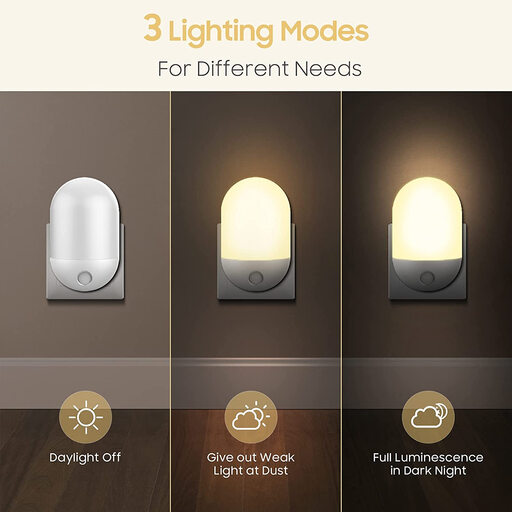
Why it suits this profile: This plug-in model has a simple light sensor and warm white light. It is suitable as basic lighting in a bedroom, nursery or hallway without additional controls.
The specifications state 0.5 W and 20 lm. This makes it clear from the outset that it provides modest orientation lighting, rather than general room lighting.
Warm white 2800–3200 K, light sensor, ABS/metal construction and a low stated power consumption of 0.5 W.
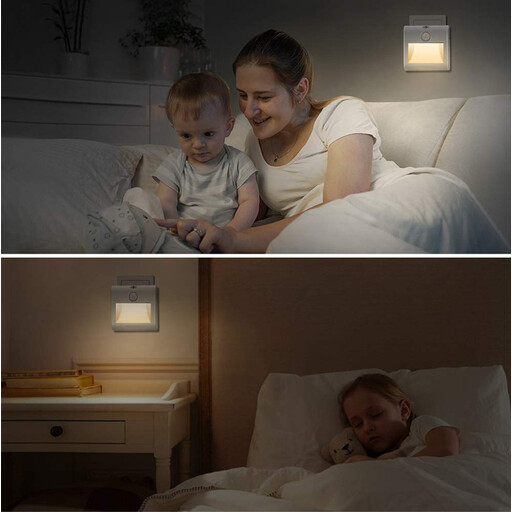
Why it suits this profile: This set combines automatic detection with constant lighting, touch controls and a memory function. That gives you more adjustment options for different areas of your home.
You are not reliant on the sensor alone: the light also has a constant-light mode. Brightness can be adjusted steplessly using the touch controls.
2-pack, 20 lm, 4000–4500 K, touch dimming with memory function and a stated power consumption of 1 W.
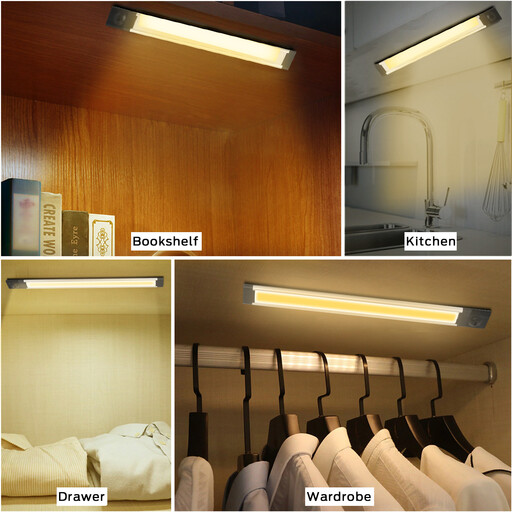
Why it suits this profile: This rechargeable model is designed for flexible use in cupboards, hallways, staircases and other places without a nearby socket.
The product information specifies both motion and clap control, as well as a dimming function. This gives you several ways to activate or adjust the light.
36 SMD LEDs, 400 lm, colour temperature 2800–6500 K, USB rechargeable and mounting with magnets or hooks.
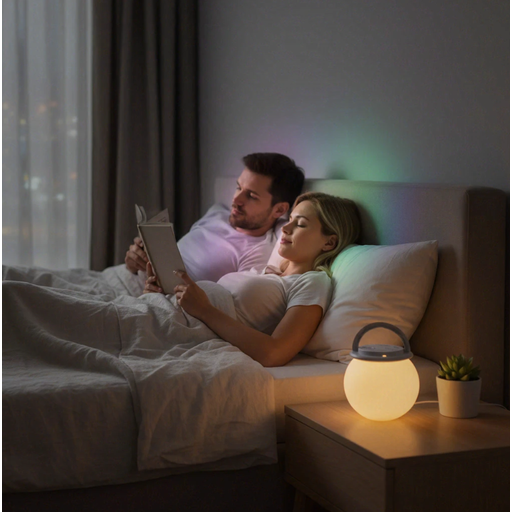
Why it suits this profile: This model offers a timer, warm white light and seven RGB colours. It is ideal for users who want to adjust their bedroom or child’s bedroom night light flexibly.
The timer can prevent the light from staying on unnecessarily. You can also choose between warm white and RGB, rather than being limited to a single light colour.
Rechargeable, timer function, warm white plus seven RGB colours, stepless dimming and 0.9 W at 5 V–1 A.
We have put together a complete, up-to-date list of products that fully meet these strict selection criteria and the applicable European safety regulations.
Only use a plug-in model with a suitable socket, and do not block any other connections. Do not place a light beneath blankets or textiles, as this can prevent heat from dissipating properly. In a nursery, keep the cable out of a child’s reach and securely mount any freestanding light.
For models with a sensor, make sure the sensor remains unobstructed. Clean the surface with a soft, dry cloth and unplug a plug-in model before cleaning it. Product information may vary between versions, so always check the latest instructions and safety warnings on the product page.
This mainly depends on the wattage and the number of hours it is switched on. A 0.5 W model uses less energy during continuous operation than a 1 W model. A timer, sensor or manual switch-off can reduce consumption further. Calculate the cost using: power in kW × operating hours × your electricity tariff.
Place it where you can make use of its detection range, for example along a hallway, near a toilet or beside a bed. Avoid positioning it directly opposite a strong light source, as this may affect how the ambient light sensor responds. Also check that the sensor is not covered.
The lifespan depends on the LED components, electronics, operating time and heat dissipation. With a rechargeable model, the capacity of the built-in battery also plays a role. When buying, do not look only at a stated lifespan; also consider the warranty, charging method, mounting and whether the light can be replaced or moved easily in practice.
