
Vandaag of morgen in huis

Kwaliteit gegarandeerd

Welkomstaanbiedingen ontgrendelen: GRATIS bezorging | Tot 80% korting | Gratis 30 dagen JoyPlus-proefperiode
Download de app
An LED night light may seem like a simple purchase, but the differences between models are noticeable in everyday use. A light may be too bright for a nursery, a motion sensor may switch on unnecessarily during the day, or a rechargeable battery may not last as long as expected. Checking a few technical details in advance can help you avoid making the wrong choice.
An RGB night light with several colours sounds versatile, but colour choice is not the only factor that matters. For use at night, brightness, colour temperature and dimmability are more important. Bright or cool light can be unpleasant when you get up briefly during the night. Warm white light around 2700–3000 K generally creates softer-looking illumination than cool white light of 5000 K or above.
A night light with a motion sensor should not switch on with every movement during the day. Check whether the product description specifies a light threshold in lux. Some models, for example, switch on at a maximum of 20 or 40 LUX. Detection range is also important: a sensor with a range of 3 to 5 metres is better suited to a hallway or landing than to a small bedside table.
A rechargeable night light is flexible, but it does need charging regularly. Check whether it charges via USB-A or another connection, and how long it is stated to operate in the selected mode according to the product specifications. With a light that stays on continuously, the operating time may differ from the stated time in sensor mode.
Lumens (LM) indicate how much light a lamp emits according to the product specification. A compact night light rated at 20–40 LM is designed for orientation or ambient lighting. An LED table lamp with, for example, 140–210 LM is more suitable for a table, desk or patio.
Also pay attention to the colour temperature:
A CRI value above 80 provides information about colour rendering. This does not automatically mean that the light will be equally comfortable for everyone. Also check the brightness settings and whether the lamp can be dimmed.
An automatic light sensor or motion sensor is practical in a hallway or toilet. Look out for the following:
A dimmable night light with several settings gives you more control in the bedroom. Touch controls are convenient on a bedside table, while automatic activation is better suited to a passageway.
A USB night light or rechargeable night light can be placed without needing a mains socket. Check the battery capacity and stated operating time. A model with a built-in lithium battery must not be opened or modified; follow the supplied charging and safety instructions.
For a plug-in model, a set of 2 night lights is useful if, for example, you want to light the bedroom and hallway at the same time. Do not use indoor lamps in damp areas unless a protection rating is specified. A product rated IP20 is intended for dry indoor spaces. IP44 provides protection against splashing water, but it does not mean that the lamp may be submerged or exposed to heavy rain.
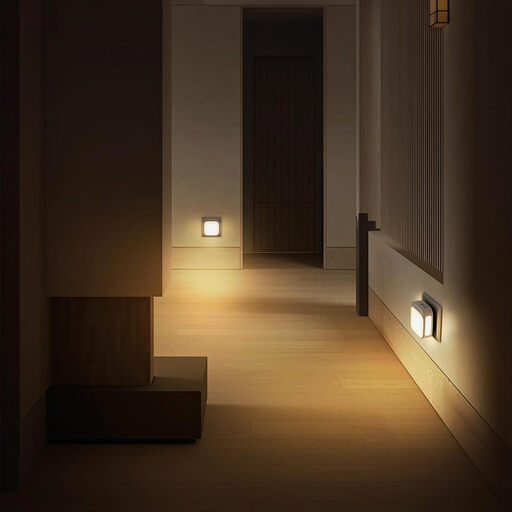
Why it suits this profile: This set is designed for anyone who wants to provide two dry indoor spaces with warm white light without having to recharge a built-in battery.
According to the specifications, the light sensor switches on at a maximum of 20 LUX and off in daylight. The 0.3 W power rating makes energy consumption easy to understand.
2 lamps, stepless dimming from 10–100%, warm white light at 2800–3000 K and connection to 110–240 V.
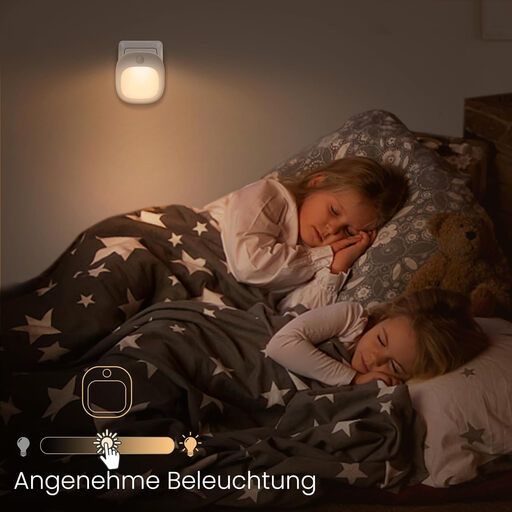
Why it suits this profile: A practical choice for families who want to place lighting in a nursery, bedroom or hallway without leaving both lamps permanently plugged into a socket.
The product specifications state a motion detection range of 3–5 metres, activation at a maximum of 20 LUX and five brightness settings. This allows you to adjust the settings to suit the room.
Built-in 500 mAh battery, USB charging at 5 V–1 A, three colour temperatures and a stated operating time of up to 10 hours in sensor mode.
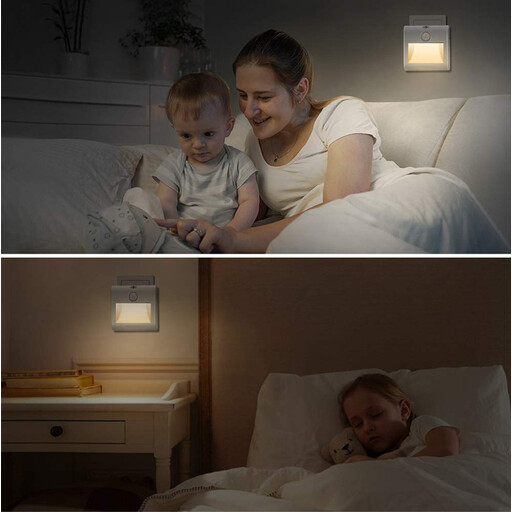
Why it suits this profile: This set is well suited to households that use several passageways or rooms and need both a continuous and an automatic mode.
The combination of a continuous mode, motion detection at a maximum of 20 LUX and a range of 3–5 metres means you are not solely dependent on manual operation.
Stepless touch dimming, memory function, 20 LM brightness and 4000–4500 K warm white light according to the product description.
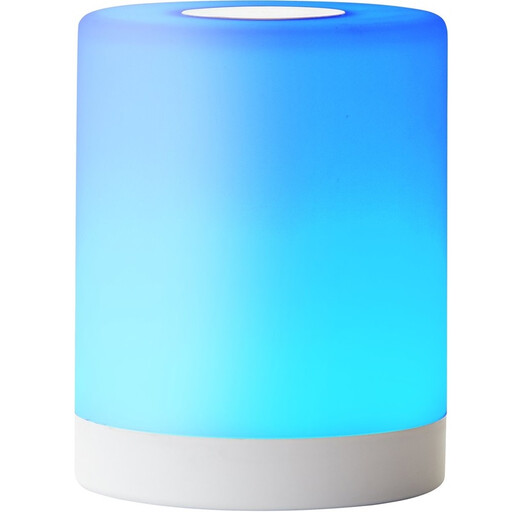
Why it suits this profile: Ideal if you want to use one portable LED lamp on a table, balcony or patio and be able to choose between warm white and RGB lighting.
The IP44 rating indicates protection against splashing water. This is suitable for careful outdoor use, but not for submersion or direct jets of heavy rain.
140 LM, 1 W, USB charging, touch dimmer, RGB and warm white at 3000 K. The lamp has a built-in battery.
We have put together a complete, up-to-date list of products that fully meet these strict selection criteria and the applicable European safety regulations.
This depends on its power rating and operating time. A 0.3 W model uses less energy during continuous operation than a 2 W table lamp. With a motion sensor, the lamp only comes on when the set light and motion conditions are met. For an accurate comparison, check the stated wattage rather than relying solely on the term ‘energy-efficient’.
The operating time per charge varies depending on the brightness setting and mode. The 500 mAh model states up to 10 hours in sensor mode. This is a product specification for operating time, not the total service life of the battery or LED. With an integrated, non-replaceable light source, you should also bear in mind that user replacement is not предусмотрено.
