
Vandaag of morgen in huis

Kwaliteit gegarandeerd

Welkomstaanbiedingen ontgrendelen: GRATIS bezorging | Tot 80% korting | Gratis 30 dagen JoyPlus-proefperiode
Download de app
An LED night light may seem like a straightforward purchase, but small differences can determine whether it works well for you. For example, one model may be too bright for the bedroom, respond awkwardly to movement or need recharging again after only a short time. Terms such as ‘smart’, ‘energy-efficient’ and ‘atmospheric’ also mean little on their own without specific details.
The Joybuy Product Recommendation Officer therefore focuses on verifiable features: brightness, colour temperature, power supply, sensor range, dimensions and controls. This makes it easier to compare a night light with a motion sensor fairly with a rechargeable night light, LED mood light or smart LED bulb.
A lamp with a high light output is not automatically more comfortable. Extra brightness can be useful in a hallway or bathroom, while beside the bed you will usually want a softer setting. So look at lumens, rather than just the wattage. Watts indicate energy consumption; lumens indicate how much light the lamp produces.
A dimmable LED night light with several settings offers greater flexibility. For a nursery or child's bedroom, a warm colour temperature is often more practical than cool white light, as it looks less harsh in a dark room. Keep the lamp out of reach of young children and follow the manufacturer's safety instructions.
A sensor light should not switch on unnecessarily whenever it detects a shadow or movement. Check the following:
A sensor that, according to the product description, activates at a maximum of 20 lux is intended for dark conditions. In a hallway with light from the street or a bathroom with night lighting, performance may differ. Position the lamp so that pets, people walking past or moving curtains do not directly affect the sensor.
A rechargeable night light eliminates the need for a loose cable beside the bed, but the battery still needs to be recharged regularly. Check the capacity, stated operating time and type of connection. A model with USB charging can be convenient when connected to a laptop, phone adapter or power bank, but only use a compatible charger.
With a mains-powered lamp, positioning is easier if there is a socket nearby. A solar hanging light, on the other hand, will only work reliably when the solar panel receives sufficient daylight. For outdoor use, you should also check the IP rating. A product without a suitable IP rating should not be used in a damp outdoor environment.
For orientation lighting, a low light output is often sufficient. A product offering, for example, 20 to 40 lumens may be suitable for a bedside table, shelf or passageway, depending on the space. Also check the colour temperature in kelvin:
An RGB night light adds colour settings, but check whether the brightness of the white setting can be adjusted separately. With some lamps, RGB is primarily intended as a mood-lighting feature.
An on/off switch is straightforward and works without an app. Touch controls can be convenient beside the bed. A smart LED bulb offers additional options such as app control, timers, voice assistants or automation. However, check whether a bridge or hub is required.
The Philips Hue LED bulb in this selection, for example, works via Bluetooth and supports control through the Hue app. According to the product description, a Hue Bridge is required for more advanced functions, such as control when you are away from home and additional accessories. This is an extra component to factor into the total purchase cost.
Measure the space around the socket or bedside table before ordering. A compact lamp measuring approximately 7 to 8 centimetres takes up little room, while a decorative table lamp has more visual presence. ABS and metal are commonly used for compact LED lamps. Check whether the lamp is moisture-resistant, whether the cable is long enough and whether the light source can be replaced.
A visible CE mark indicates that the responsible party declares compliance with relevant EU requirements. However, it is not a reason to overlook technical details such as voltage, fitting or IP rating. For many products, consumers are also entitled to a legal guarantee of at least two years; check the terms on the product page.

Why it suits this profile: A set of two rechargeable lamps is practical for use in, for example, the bedroom and hallway. The lamps can be used without a permanently occupied socket.
The product specification states a motion range of 3–5 metres, activation at a maximum of 20 lux and five dimming settings. However, check where you will position the sensor beforehand.
Two lamps, USB charging, three colour temperatures, five brightness levels and a stated operating time of up to 10 hours in sensor mode.
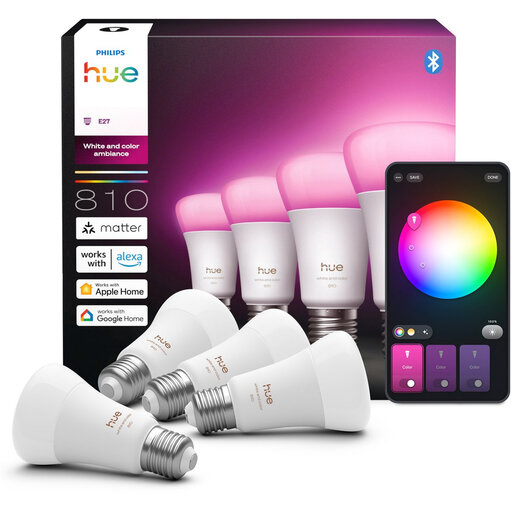
Why it suits this profile: Suitable for anyone looking for a smart LED bulb for the living room, bedroom or mood lighting, and who values control via an app, voice commands or automation.
The product information states that it can be dimmed and controlled via a wall switch, app and remote control. Check that the E27 fitting is compatible with your light fitting.
RGBW colour lighting, 810 lumens per bulb, Matter support and a pack containing four bulbs.
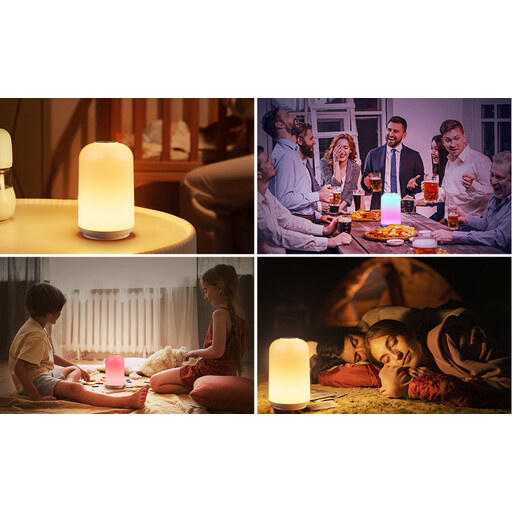
Why it suits this profile: This compact model is ideal for anyone wanting a wireless LED mood light for a bedside table, shelf or child's bedroom, with both white and coloured light.
The stated specifications mention stepless dimming for warm white light and a sensor that responds at a maximum of 40 lux. The lamp must be charged via USB.
12 SMD LEDs, 40 lumens, warm white light at 2600–2800 K, seven RGB colours and a built-in battery.
We have put together a complete, up-to-date list of products that fully meet these strict selection criteria and the applicable European safety regulations.
For soft orientation lighting, a low brightness is often sufficient. A little more light can be useful in a hallway or bathroom. As well as lumens, look at dimmability and colour temperature, as these determine how bright the light feels in the room.
It can be, because the lamp only activates when movement is detected and it is dark enough. Actual energy consumption depends on the wattage, operating time and how often the sensor switches on. A continuous light setting generally uses more energy than sensor mode.
This depends on the design, positioning and safety instructions. Choose a stable model without loose parts within the child's reach. Keep the light away from water, use a suitable USB charger and do not allow young children to operate the device unsupervised.
