
Vandaag of morgen in huis

Kwaliteit gegarandeerd

Welkomstaanbiedingen ontgrendelen: GRATIS bezorging | Tot 80% korting | Gratis 30 dagen JoyPlus-proefperiode
Download de app
A motion sensor light seems simple: someone walks past and the light comes on. Yet many buyers fall into the same traps. A sensor light may switch off too quickly, fail to provide enough light or work less effectively outdoors than expected. Terms such as “waterproof”, “energy-saving” and “long battery life” are not always used consistently either.
This guide helps you compare LED lighting with a motion sensor using specifications you can check. That way, you can find the right option for a hallway, cupboard, bedroom, nursery, kitchen, garden, patio, driveway or entrance.
A high lumen count means more light output, but it doesn’t automatically make a product the better choice. A lower light level is often more comfortable for cupboard lighting or a night light. For a driveway or garden, you’ll need a wider spread of light and greater brightness.
So don’t look at lumens alone. Also consider:
A wireless sensor light usually runs on batteries, solar power or a rechargeable battery. This means no wiring, but you’ll still need to keep an eye on it. A solar outdoor light with a motion sensor needs enough daylight. A rechargeable LED sensor light needs to be charged regularly via USB.
Before buying, check the power source, how it charges and whether the light will still work reliably in limited sunlight or with frequent use.
The IP code indicates how well a product is protected against dust and moisture. IP44 is suitable for splashes and sheltered outdoor locations, but not for direct jets of water or immersion. IP65 offers greater protection against dust and jets of water, but you should still follow the installation instructions.
An outdoor motion sensor light under a canopy has different requirements from a light on an exposed wall. Also consider the mounting, cables and exposure to rain.
A sensor can detect movement within a certain distance and angle. According to the product specifications, the Aigostar PIR-360 has an adjustable light sensitivity of 10 to 2000 lux and a delay of 10 seconds to 7 minutes. This is useful for hallways, stairs and entrances where you don’t want the light to switch off straight away.
A long range can be useful for outdoor lighting, but a sensor that’s too sensitive may also react to passers-by, pets or movement beyond your property. So check the installation height and the direction the sensor faces.
Integrated LED lighting generally uses little energy, but the actual running costs depend on how long it stays on and how it’s powered. A light that only comes on when it detects movement usually uses less energy than one that stays on all evening.
There are four practical options:
Warm white light at around 2700–3000 K is often a good choice for bedrooms, patios and entrances. Neutral or cooler light can work better in a cupboard, kitchen or utility room where you need to see details clearly. Dimming or a choice of colour temperatures makes a light more versatile, but check whether these settings are manual or automatic.
Adhesive or magnetic mounting is handy in rented homes and cupboards. Just check that the surface is clean, flat and sturdy enough. For a heavy light, a magnet alone may not be enough if the mounting plate isn’t secure.
A fixed 230V wall light, such as a model with an E27 fitting, must be installed according to the instructions and applicable electrical safety regulations. Switch off the power, and if you’re unsure, have the work carried out by a qualified installer.
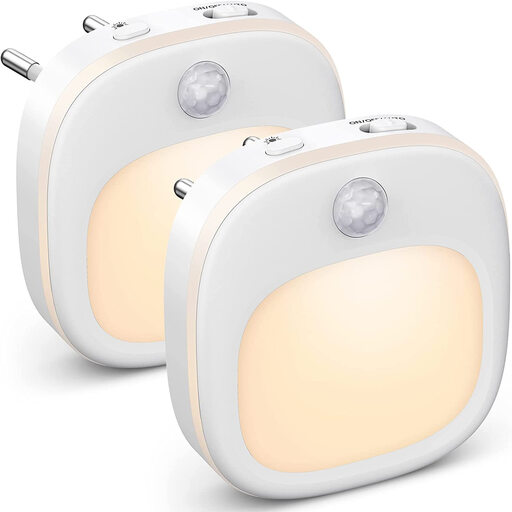
Why it suits this profile: A set of two lights is handy for places such as a hallway and bedroom. With motion detection, three colour temperatures and five dimming levels, you get flexibility without fixed wiring.
Adjustable light colour and dimming help prevent a night light from being too bright or uncomfortable.
Two lights per pack, a 1 W SMD LED and a 100–240 V power supply, according to the product information.

Why it suits this profile: This solar outdoor light with a motion sensor is designed for a wall, entrance or patio without a power cable, where it can receive enough sunlight during the day.
The product information lists two lighting modes, a motion sensor and an IP44 rating. This makes the limits of where it can be used clearer than a general claim such as “for all weather”.
1000 lumens, integrated LED and 3000 K according to the stated specifications; no connection to the electricity supply needed.

Why it suits this profile: For a large garden, garage, driveway or rear courtyard, a wide spread of light may be more useful than a compact LED wall light with a sensor.
The stated specifications include a 180° detection angle, a range of 60 feet, three lighting modes and IP65. Make sure the chosen location receives enough direct sunlight.
According to the product description: 302 LEDs, 3000 lumens, three adjustable light heads and an 1800mAh battery.
We’ve put together a complete, up-to-date list of products that meet these strict selection criteria and the applicable European safety regulations.
Place the light somewhere the sensor has a clear view of the route people take. Avoid positioning it directly behind furniture or next to a heat source. For a solar light, the panel should receive as much direct sunlight as possible during the day. Test the range and on-time after installation. If using adhesive mounting, make sure the surface is clean and dry.
How long it lasts between charges depends on the battery capacity, how often it switches on, the brightness and the set on-time. A motion sensor light generally only uses energy when it detects movement, but frequent use means it will need charging more often. Check the charging indicator and use a suitable USB charger.
The cost depends on the wattage, how long the light stays on and how often it switches on. A low-wattage LED light that only comes on when it detects movement can be more energy-efficient than one that stays on continuously. Solar lighting doesn’t use mains electricity, but its performance depends on sunlight and the available battery charge.
