
Vandaag of morgen in huis

Kwaliteit gegarandeerd

Welkomstaanbiedingen ontgrendelen: GRATIS bezorging | Tot 80% korting | Gratis 30 dagen JoyPlus-proefperiode
Download de app
An LED motion sensor light can be useful in a hallway, bedroom, bathroom, kitchen, cupboard, garden or driveway. It switches on automatically when it detects movement, so you don’t have to search for a switch in the dark. However, these lights can vary significantly in their power supply, brightness, sensor range and moisture protection.
If you focus only on a low price or a high lumen rating, you could end up with a light that isn’t right for where you plan to use it. Below, we cover the key things to consider and suggest a few options for different households.
A light with a PIR sensor typically responds to changes in heat and movement. The stated range, for example 3 to 5 metres, doesn’t guarantee that the light will switch on just as quickly from every angle. Position it so that you walk across the detection area, rather than straight towards the sensor.
Check the light threshold too. Some models only switch on when the ambient light falls below a certain level, such as 20 lux. In that case, the light will stay off during the day, even if it detects movement.
An IP44 rating means protection against solid objects and splashing water. This is suitable beneath a porch, on a sheltered wall or on a balcony, but IP44 doesn’t mean fully waterproof. A light with this rating shouldn’t be installed somewhere exposed to prolonged rain or direct jets of water.
For an exposed garden, exterior wall or driveway, a higher protection rating, such as IP65, may be more suitable. Always check the installation instructions and make sure the power supply is appropriate too.
Lumens indicate how much light a product emits according to its specifications. For a cupboard or bedroom, 20 to 30 lumens may be enough. A driveway or larger garden may need a much higher light output. A very bright light can be uncomfortable indoors, especially at night.
So consider the colour temperature, dimming options and where the light will fall too. Warm white light around 2700 to 3200 K generally feels softer, while cooler shades around 5000 to 7000 K are more practical for task or search lighting.
There are three common options:
One example of a rechargeable sensor light is the 2-pack model with a 500 mAh battery. According to the product information, it runs for up to 10 hours in sensor mode and charges via 5 V/1 A USB. This makes it suitable for a bedside table, nursery or hallway without a spare socket.
Don’t just check whether a product has a sensor. Also look at:
A motion sensor night light for a bedroom doesn’t need the same range as an outdoor LED wall light. In a cupboard, a quick response is more important than a long range.
A dimmable LED light with several colour temperatures gives you more control. Some models, for example, offer warm white, neutral white and cool white. Warm light often suits the atmosphere you want in a bedroom, while neutral or cooler light may be more practical in a kitchen or bathroom.
Check how the light is dimmed. It could be controlled by a button, touch control or remote. The product information for the 2-pack with touch dimming states that it has stepless dimming and a memory function. According to the specifications, the light remembers the last brightness setting.
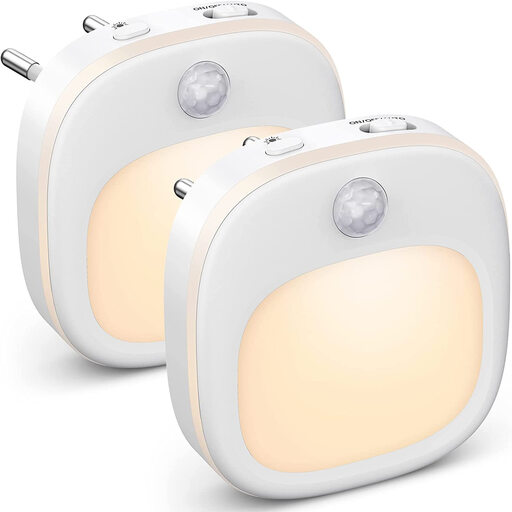
Why it suits this profile: A practical set for a hallway, bedroom, nursery or toilet. The lights run on mains power and, according to the product information, require no installation.
The product specifications list three colour temperatures and five dimming levels. This lets you adjust the brightness instead of relying on a single fixed setting that may be too bright.
2 lights per set, 1 W power and a choice of three colour temperatures with five brightness levels.
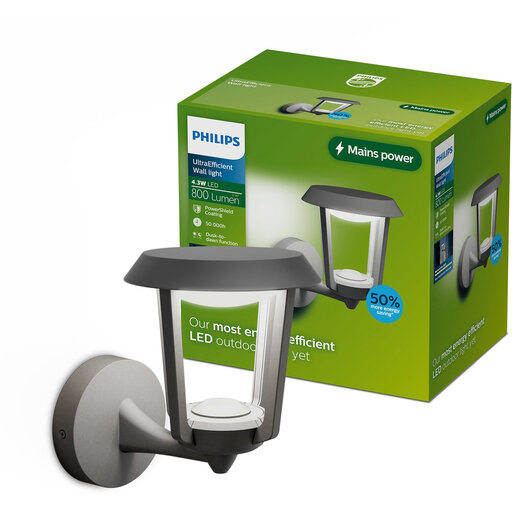
Why it suits this profile: This fixed outdoor light is designed for an exterior wall, balcony or garden. It’s a good fit if you value a neatly finished fitting with a fixed connection.
The IP44 rating is clearly stated, so you won’t mistake protection against splashes for full waterproofing.
According to the product details: 800 lm, 2700 K, 230 V connection and an integrated dusk sensor.

Why it suits this profile: These slim 40 cm lights are designed for kitchen cupboards, wardrobes, shelves and other narrow spaces where fixed wiring would be inconvenient.
The length, battery capacity and sensor range are clearly listed in the product specifications. This lets you check in advance whether the light will suit your cupboard or shelf.
2 lights, 61 LEDs per light, PIR detection at 3–5 metres and a built-in 1100 mAh battery with USB charging.
We’ve put together a complete, up-to-date list of products that meet these strict selection criteria and comply with current European safety regulations.
A sensor detects movement within its stated range. Many models only work when the ambient light falls below a certain lux level. The light then switches on automatically and turns off again after a set time.
Operating time depends on the battery capacity, brightness setting, ambient temperature and how often the light switches on. A product listing might state up to 10 hours in sensor mode, for example, but actual operating time can vary depending on how the light is used. Check whether the battery is replaceable and what type of USB charger is permitted too.
An LED night light or cupboard light with a low wattage generally uses little energy, especially if it only comes on when it detects movement. A mains-powered model does use some standby or operating power; a solar model doesn’t use mains electricity, but depends on sufficient daylight and a charged battery.
